
Ghanaians are living longer, internal migration is increasingly concentrated around major economic centres and the number of citizens living abroad has risen, according to the Ghana in Numbers, 2025 report published by the Ghana Statistical Service in October 2026.
The figures, drawn largely from the 2021 Population and Housing Census, highlight significant changes in the country’s demographic profile, particularly in longevity and the movement of people within and beyond its borders.
The report’s findings on life expectancy, internal migration and emigration point to three connected demographic developments. While improvements in longevity indicate progress in survival, the movement of people towards particular regions and the growing number of citizens abroad reveal how employment, economic opportunities, education and family circumstances continue to shape where Ghanaians live.
“Life expectancy at birth measures the number of years a newborn would be expected to live if prevailing age-specific mortality rates remained unchanged.”
Ghana in Numbers, 2025, Ghana Statistical Service
Ghana’s life expectancy has improved considerably over the past six decades, rising from 40.3 years in 1960 to 65.1 years in 2021. This represents an increase of 24.8 years, although the historical figures show that progress was not uniform throughout the period.
The most substantial improvement occurred between 1960 and 1980, when life expectancy increased by 15.7 years, from 40.3 to 56 years. The report associates these gains with the expansion of vaccination, access to clean water, improved food availability and better healthcare, factors that have contributed to improved survival conditions.
Subsequent figures show a more gradual pattern. Life expectancy stood at 54.7 years in 1993 before rising to 56.7 years in 1998 and 57.4 years in 2003, eventually reaching 62.3 years in 2008. It then recorded a slight decline to 61.8 years in 2010 before improving to 65.1 years in 2021.
The measure provides an indication of mortality conditions at a particular period, rather than a guarantee of how long an individual will live. Nevertheless, the long-term increase suggests that successive improvements in public health and living conditions have contributed to a substantial extension of expected lifespan.
The 2021 census figures also reveal a difference between male and female life expectancy. Female newborns had an estimated life expectancy of 66.8 years, compared with 63.3 years for males, giving women a 3.5-year advantage.
For people who reach age 60, however, the difference in their expected remaining years is considerably smaller. Men at that age could expect to live for approximately another 15.7 years, while women had an estimated additional 16 years.
Greater Accra Records Highest Net Migration Gain
Internal migration remains a significant feature of Ghana’s population distribution, although the proportion of people living outside their region of birth has declined.
The 2021 Population and Housing Census classified approximately 27% of the population as having been enumerated in a region different from their birthplace, compared with 35% in 2010 and 30.2% in 2000.
“Internal migration is defined as a change in the usual place of residence within national boundaries. Based on the 2021 Population and Housing Census (PHC), a migrant is classified as someone whose region of birth differed from their region of enumeration.”
Ghana in Numbers, 2025, Ghana Statistical Service
The figures suggest that regional movement remains substantial, even as the measured proportion has fallen over the two decades covered by the comparisons. The report identifies Greater Accra and Ashanti as “premier migration destinations” reflecting the concentration of economic and employment opportunities in these regions.
Greater Accra recorded the largest net migration gain, attracting approximately 1.106 million more people than it lost. The Ashanti Region followed with a net gain of 208,000, while the Western Region recorded an increase of 111,000.

Other regions with positive net migration figures included Bono East, which gained 69,000 people, Western North with 55,000 and Ahafo with 19,000. These figures represent the difference between people entering and leaving each region, rather than the total number of people who moved there.
The pattern was reversed in several other parts of the country. Volta recorded the largest net loss, with 435,000 more people leaving than entering, followed by the Upper East Region with a net loss of 292,000 and the Eastern Region with 244,000.
Upper West also recorded a net loss of 190,000, while Northern lost 179,000 and North East recorded a decline of 82,000. Central, Oti, Savannah and Bono registered net losses of 58,000, 35,000, 32,000 and 23,000 respectively.
The concentration of population gains in Greater Accra and Ashanti points to an uneven distribution of migration benefits across the country. While the figures do not establish the specific economic consequences for each region, they highlight the importance of employment opportunities and access to services in shaping population movement.
More Ghanaians Recorded as Living Abroad
Ghana’s international migration figures also show an increase in the number of citizens living outside the country. The 2010 Population and Housing Census recorded 250,624 Ghanaians abroad, but the figure had risen to 293,416 by the 2021 census.
This represents an increase of 42,792 people, or approximately 17.1%, over the period. More than half of the emigrants, representing 54%, originated from the Greater Accra and Ashanti regions, further highlighting the significant contribution of these two regions to population movement beyond Ghana’s borders.
Employment was the leading reason for emigration among people aged 15 and above, accounting for 73.4% of those recorded. Education and training followed at 14.6%, while marriage and family reunification represented 9.6%.
The report’s breakdown identifies employment as the dominant motivation for leaving Ghana, with the figures recording 73.4% of emigrants aged 15 and above as having moved for work. Permanent settlement accounted for 2.1% of the reasons recorded, while other reasons, including health-related circumstances, represented 0.4%.
The dominance of employment as a reason for emigration suggests that access to work opportunities remains a major consideration in international mobility. Although the figures do not establish whether emigrants secured better employment conditions abroad, they show that labour-related considerations outweigh education, family reunification and other recorded motivations.
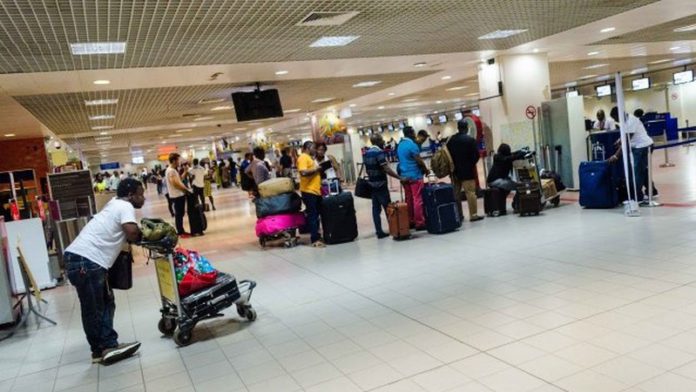
Europe was the most frequently recorded destination, accounting for 37.6% of Ghanaian emigrants. The Americas followed with 23.7%, narrowly ahead of the Economic Community of West African States (ECOWAS), which accounted for 23.3%.
Other African countries represented 10% of destinations, while Asia accounted for 4.7% and Oceania recorded 0.7%. The distribution shows that Ghanaian emigration extends across several continents, with Europe, the Americas and the ECOWAS region accounting for the largest shares.
The report also provides figures on immigration into Ghana, showing that immigrants represented 1.6% of the country’s total population in 2010. By the 2021 census, that proportion had declined to 1%, indicating a smaller immigrant share of the national population in the later census.
Taken together, the findings present a picture of a country experiencing significant changes in longevity and population movement. Although life expectancy has improved substantially since 1960, the concentration of internal migration in Greater Accra and Ashanti, alongside the predominance of employment as a reason for emigration, points to the continuing influence of economic opportunities on where Ghanaians choose to live.
READ ALSO: Ghana’s Economy Surges to GH¢1.43 Trillion