
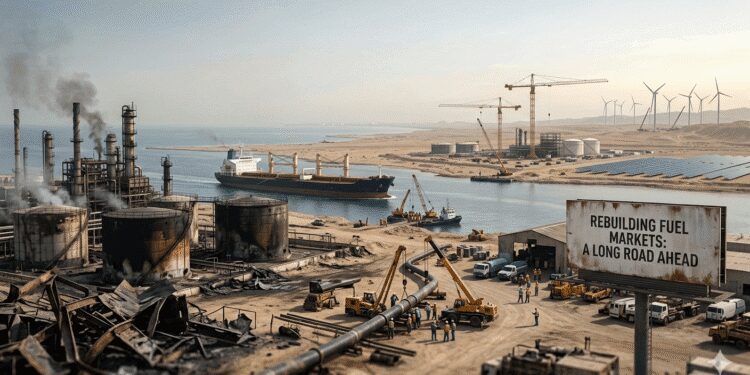
The surge in fuel prices during the ongoing Iran war is rapidly emerging as one of the most serious economic consequences of the escalating conflict in the Middle East. Even if the war were to end quickly, the ripple effects on global energy markets could last weeks or even months, leaving consumers and businesses worldwide facing higher fuel costs.
The conflict has already shaken global supply chains, disrupted shipping routes, and damaged energy infrastructure across the region. Oil markets are no longer reacting solely to geopolitical fears but to real operational disruptions affecting supply.
As analysts at JP Morgan explained in a recent note, “the market is shifting from pricing pure geopolitical risk to grappling with tangible operational disruption, as refinery shutdowns and export constraints begin to impair crude processing and regional supply flows.”
Strait of Hormuz Disruptions Shake Global Supply
At the center of the crisis lies the Strait of Hormuz, one of the most important energy chokepoints in the world. Iran’s targeting of ships moving through the narrow waterway between its coast and Oman has triggered a dramatic slowdown in oil shipments.
The conflict has already disrupted roughly one-fifth of global crude and natural gas supply, forcing major Middle Eastern producers to suspend shipments. Countries such as Saudi Arabia, the United Arab Emirates, Iraq, and Kuwait have halted the export of as much as 140 million barrels of oil.
That volume represents about 1.4 days of global demand, but the real concern lies in how long the disruption could last. Storage facilities across the Gulf are quickly filling up because oil cannot move to global markets.
Energy traders warn that if shipping lanes remain unsafe, producers may have little choice but to shut down oil fields entirely. One industry source put the situation bluntly: “At some point soon, everyone will also shut in if vessels do not come.”
Infrastructure Damage Compounds the Crisis
The risk to global supply is not limited to shipping lanes. Iranian strikes have also targeted refineries and export terminals across the region, forcing major energy facilities to suspend operations.
Saudi Aramco’s massive Ras Tanura refinery and crude export terminal has already shut down following attacks. Meanwhile, Qatar, responsible for roughly 20 percent of global liquefied natural gas supply, has declared force majeure on gas exports after drone strikes disrupted its facilities.
Sources suggest that Qatar may need at least a month to return to normal production levels. If damage proves more severe, the recovery period could stretch even longer.
Energy analysts warn that restarting oil fields after forced shutdowns is rarely immediate. Amir Zaman of Rystad Energy noted that even if the conflict ends quickly, the process of restoring production could take time. “The conflict could be ended,” he said, “but it could take days or weeks or months… before you can get production back up to what it once was.”
Oil Prices Surge, Global Economies Feel the Shock
The immediate impact of the conflict has been a sharp spike in oil prices. Global crude prices have jumped about 24 percent in a single week, climbing above $90 per barrel. The surge marks the steepest weekly increase since the pandemic era.
For consumers, the result is already visible at fuel pumps. In the United States, the average retail price of gasoline has climbed to $3.32 per gallon, while diesel prices have jumped significantly as well.
Rising fuel costs carry political consequences. For U.S. President Donald Trump, higher gasoline prices represent a major risk as midterm elections approach.
“Gasoline prices are psychologically powerful,” said Mark Malek, chief investment officer at Siebert Financial. “They are the inflation number that consumers see every single day.”
Global Energy Markets Enter Uncertain Territory
Beyond the United States, the crisis is reverberating across global supply chains. Asia, which relies on the Middle East for about 60 percent of its crude imports, is particularly exposed.
Refineries in India and China have already begun cutting operations due to limited supply. Several Asian countries have also restricted fuel exports to protect domestic markets, signaling how quickly the disruption is spreading.
Europe faces its own dilemma. After reducing reliance on Russian pipeline gas following the Ukraine war, the region now depends heavily on liquefied natural gas imports. The new crisis threatens to push prices even higher just as Europe prepares for the next winter heating season.
Even if fighting subsides soon, the broader lesson may be about energy security. The shock has exposed how fragile global supply chains can be when a single strategic waterway becomes unsafe.
For the world’s energy markets, the Iran conflict is not just a geopolitical crisis. It is a stark reminder that fuel prices are tied as much to stability in distant regions as they are to local economic conditions.
Author: Prince Agyapong
READ ALSO: Zambia Celebrates Milestone Global Mining Achievement