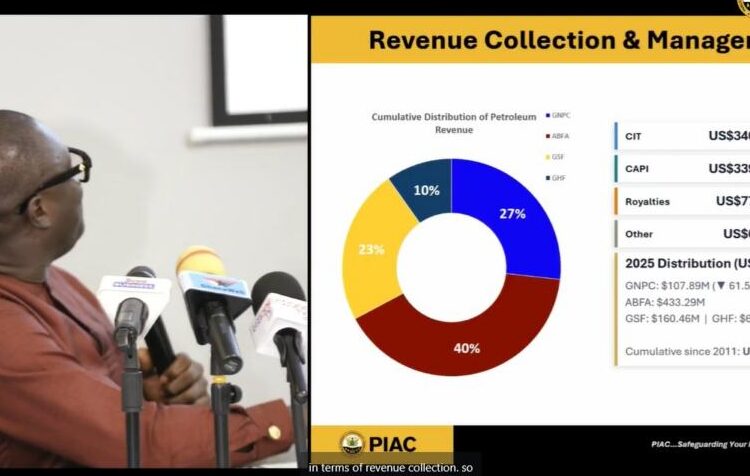
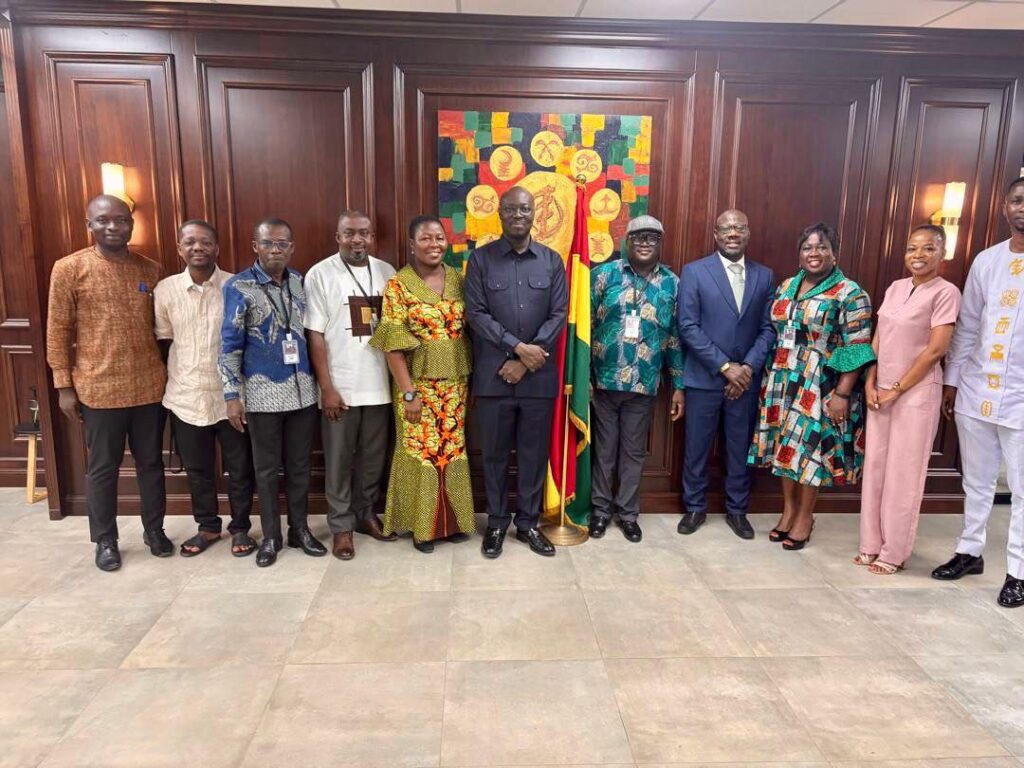
Mr. Richard Ellimah, Chairman of the Public Interest and Accountability Committee (PIAC), has identified Ghana’s rigid fiscal regime, specifically the high royalty rates, as a primary catalyst for the sustained downturn in the nation’s upstream petroleum production.
Speaking on the deteriorating output levels, the Chairman emphasized that the current 5% royalty requirement has rendered Ghana significantly uncompetitive compared to newly emerging African oil producers like Namibia and Angola, who offer more attractive fiscal terms to global investors.
He noted that while Ghana insists on these higher rates, competing nations are enticing exploration firms with royalties as low as 1% or 2%, effectively diverting much-needed capital away from Ghana’s offshore basins.
“We have newer emerging petroleum-producing countries that have decided to offer investors far better fiscals. Some are paying 1% or 2% while we are taking 5%, making Ghana uncompetitive. I’m just hoping that the process towards a review of the law will start as soon as possible to erect this decline in our production.”
Mr. Richard Ellimah, Chairman of the Public Interest and Accountability Committee (PIAC)
Dwelling on the systemic challenges facing the sector, Mr. Ellimah pointed out that the 2016 Petroleum (Exploration and Production) Act, while intended to modernize the industry, is increasingly viewed by experts as “not fit for purpose” in the current global energy landscape.
The decline is not merely a matter of policy but is exacerbated by the technical and geological complexities of the TEN, Jubilee, and Sankofa fields, which have seen a steady reduction in output over the last six years.
He argued that the technical regime and the fiscal framework are now at a crossroads, where the lack of aggressive reinvestment and the failure to review outdated laws are allowing production to slip behind regional peers.
Fiscal Uncompetitiveness and Regional Divergence
The Chairman’s assessment comes at a critical time as Ghana’s total crude output has plummeted from a peak of 71.4 million barrels in 2019 to just 37.3 million barrels in 2025.
This 48% decline over six years is largely attributed to a “technical regime” that has failed to keep pace with the incentive structures offered by neighboring countries.
Mr. Ellimah noted that while Namibia and Angola are “busy producing oil” and attracting fresh exploration through lenient royalties, Ghana’s insistence on a 5% floor creates a barrier to entry.
This fiscal rigidity acts as a deterrent for International Oil Companies (IOCs) who must weigh the geological risks of mature fields against the high “government take” required by Ghanaian law.
Furthermore, the Chairman highlighted that the current Exploration and Production Law, which he noted may have roots or iterations discussed as far back as 2009, no longer aligns with the needs of a maturing industry.
The consequence of this mismatch is a visible lack of new discoveries to replace the depleting reserves in the Jubilee and TEN fields.
By maintaining a fiscal stance that is perceived as “tough” rather than “progressive,” Ghana risks a long-term loss of interest from the very technical partners required to stabilize the energy sector.
The Technical Burden and the Case for Conversion

Technical difficulties at the Tweneboa-Enyenra-Ntomme (TEN) field have become a central point of concern for PIAC.
Mr. Ellimah suggested that the geological makeup of the fields has contributed significantly to the “declining production as we see,” creating hurdles that make pumping oil increasingly difficult and expensive.
To address this, he echoed suggestions from industry experts that parts of the TEN field should be “converted to a gas field,” a move he described as much more reasonable and easier to manage under current constraints.
This conversion would require the Department and stakeholders to “invest a lot more money and invest in more technology” to ensure that the resources are not left stranded.
According to the PIAC Chairman, shifting the focus to gas might provide a more sustainable pathway for the field’s commercial viability, provided the government is willing to commit the necessary capital and technical oversight. Without these interventions, the natural reservoir decline will continue to outpace the state’s ability to generate revenue.
Legislative Reform as a Catalyst for Recovery
The path toward reversing the production slump lies in a swift legislative overhaul. Mr. Ellimah revealed that PIAC has held high-level engagements with both the Petroleum Commission and the Ministry of Energy, both of whom have “accepted the fact that something has to be done about the law.”
The goal of these meetings has been to foster a consensus on reviewing the fiscal regime to include lower royalties and more flexible terms that can “erect this decline.”
The country is currently losing significant revenue not just from the drop in physical barrels, but from the opportunity cost of stalled exploration.
When investors opt for countries with 1% royalty rates, Ghana loses the entire lifecycle value of those potential projects, including corporate taxes, surface rentals, and local content development.
Mr. Ellimah concluded that the “process towards a review of the law” must be prioritized to ensure Ghana remains a top-tier destination for petroleum investment in Africa.
READ ALSO : World Bank predicts Ghana growth slowdown