
The Ghana Education Service has assured parents, guardians, and candidates across Ghana that every student who qualifies in the 2026 Basic Education Certificate Examination will be placed in a senior high or technical institution, dismissing recent reports suggesting that thousands of students could be left without placement.
The Public Relations Unit of the Service, in a statement, congratulated all Junior High School graduates on the successful completion of this year’s Basic Education Certificate Examination and reaffirmed its readiness to receive the next batch of students into senior high and technical schools across the country.
According to the statement, comprehensive preparations have already been completed to receive all fresh students on September 18, 2026, when the new academic year is expected to begin.
Management of the Service stated that all necessary arrangements have been put in place to guarantee that qualified candidates gain access to second cycle education, emphasizing that no eligible student would be denied placement under the Computerised School Selection and Placement System.
“We wish to indicate that all qualified candidates will be placed in schools. Every effort has been made to ensure that each student has access to senior high and technical education”.
Daniel Fenyi, Head of Public Relations, Ghana Education Service
The statement was signed by Daniel Fenyi, Head of Public Relations, for and on behalf of the management of the Ghana Education Service.
GES Rejects Reports of Potential Placement Crisis
The assurance comes in response to reports circulating in sections of the media claiming that approximately 72,000 students could risk not being placed in schools due to ongoing reforms within the education sector and the gradual phase out of the double track system.

The Ghana Education Service described such reports as speculative and inaccurate, insisting that the claims do not reflect the reality of preparations currently underway. Management urged the public to disregard what it called misleading reports and instead rely on official communication from the Service.
Officials further explained that infrastructure expansion, classroom additions, dormitory improvements, and improved planning mechanisms have created adequate capacity across the country’s senior high and technical institutions to accommodate all qualified students.
According to the Service, sufficient facilities now exist nationwide to absorb the expected student population without compromising access.
Double Track Phase Out Will Not Affect Access
The Ghana Education Service also used the opportunity to address concerns surrounding the gradual phase-out of the double-track system, a policy introduced in 2018 to manage increased enrolment under the Free Senior High School programme.
“Management assures stakeholders that the ongoing efforts to phase out the double track system will not in any way hinder students’ access to senior high and technical education. It will rather improve the quality of teaching and learning while maintaining full access for all students”.
Daniel Fenyi, Head of Public Relations, Ghana Education Service
The successful removal of the double track system has remained one of the key priorities of the education sector as government seeks to improve instructional time, reduce academic disruptions, and create a more stable learning environment.
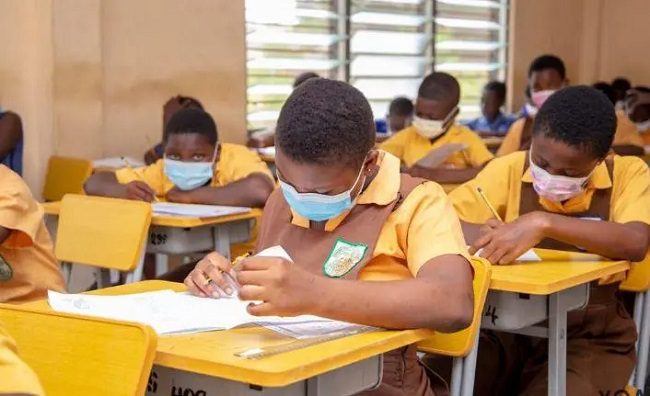
Major Changes Introduced to School Selection System
The assurance from the Ghana Education Service also comes at a time when the Ministry of Education is implementing major reforms to the school selection and placement process for the 2026 BECE.
Under the new policy announced by Education Minister Hon. Haruna Iddrisu, candidates will no longer be required to select their senior high school preferences before sitting for the examination. Instead, students will now choose or confirm their school options only after their examination results have been officially released.
Education authorities say this marks a significant departure from the previous system where candidates often selected schools before knowing their academic performance, forcing many families to make choices based on assumptions rather than actual results.
According to the Education Minister, the new arrangement is intended to make the placement process fairer, more transparent, and better aligned with student performance.
One Week Window for School Selection
As part of the new reforms, candidates will be given a mandatory one week window after the release of BECE results to submit or confirm their final school choices through the Computerised School Selection and Placement System portal.

The number of school choices has also been expanded from previous limits to eight options, giving students and parents more flexibility when selecting institutions. In addition, the new guidelines require every candidate to select at least two Category A schools as part of their options.
Officials say the revised framework is designed to provide students with broader opportunities while ensuring a balanced distribution of applicants across the country’s educational institutions.
The Ministry has also cautioned that placement will remain strictly tied to academic performance, warning that students with lower grades will not be able to manipulate the system to gain admission into highly competitive institutions beyond their academic qualification.
Curriculum Reforms Shape the Next Generation
Beyond placement reforms, broader curriculum changes are also expected to affect students entering senior high school in 2026.
Under the evolving Common Core Programme, students entering Senior High School One, now designated as Basic Stage Ten, will initially follow a unified academic curriculum before selecting specialized elective pathways such as Science, Business, General Arts, or Technical programmes in their second year.

Education experts believe the approach will provide students with broader foundational learning before they make career-oriented academic choices. The Ghana Education Service says its latest assurance reflects a broader national commitment to equitable, inclusive, and quality education for every Ghanaian child.
As preparations continue for the release of BECE results and the opening of the placement portal, the Service is calling on parents, candidates, school authorities, and other stakeholders to support the transition and rely only on verified information.
With infrastructure expansion, policy reforms, and a redesigned placement system now in motion, education authorities remain confident that the 2026 admissions process will mark another important step in strengthening access and quality within Ghana’s secondary education sector.
READ ALSO: UAE Announces Accelerated Pipeline Construction To Bypass Strait Of Hormuz