
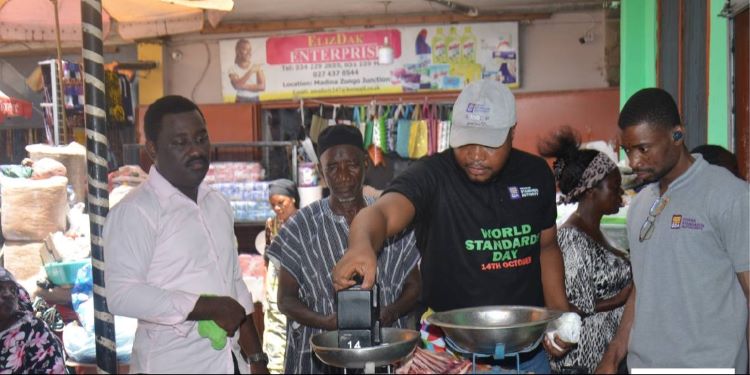
The Metrology Directorate of the Ghana Standards Authority (GSA) has sensitized butchers and cold store operators at the Madina Market on the necessity of accurate weighing practices ahead of World Metrology Day 2026.
According to the GSA, this market engagement is a proactive regulatory intervention to transition local trade activities from arbitrary measurement habits to verified, calibrated systems that align with international standards, by targeting the protein supply chain – specifically butchers and cold store owners.
The GSA is addressing critical nodes where measurement inaccuracies directly impact consumer expenditure and the perceived integrity of the marketplace. The exercise highlighted that precision in metrology is not merely a technical suggestion but a fundamental requirement for ensuring “equity and fairness” in the domestic economy.
“The Directorate embarked on the market sensitisation exercise to educate traders on the importance of accurate measurements in trade. The exercise focused primarily on butchers and cold store operators, with emphasis on the need for regular calibration and verification of weighing scales to ensure fairness and accuracy in trade”
Ghana Standards Authority
At the Madina Market, the GSA team emphasized that maintaining accurate weighing systems is the primary defense against trade imbalances. For butchers and cold store operators, the use of top-loading scales requires constant technical oversight to ensure that the weight recorded at the point of sale matches national reference standards.

This transition from informal measurement to verified metrological practices is essential for protecting the consumer from under-weighting and the business owner from inventory losses. The Authority noted that it is operationalizing a framework where every gram of meat or fish sold is backed by a system of traceable accuracy.
The infrastructure for this regulatory push is anchored by the GSA’s internationally accredited calibration laboratories. These facilities – specializing in mass, temperature, volume, balance, and humidity – provide the necessary traceability for the measuring equipment used in high-traffic commercial zones like the Madina market.
When a top-loading scale is calibrated in a GSA laboratory, it creates a “uniformity in measurement” that allows for equity in every transaction. The Authority positioned these premium calibration services as a tool for compliance, quality, and consumer confidence, bridging the gap between high-level laboratory science and everyday market commerce.
The GSA’s Metrology Directorate educated these businesses on how traceable and reliable calibration services promote a higher level of quality and compliance, as utilizing accredited laboratories can ensure their outputs are not only accurate but also defensible under the law.
This creates a standardized trading environment where the margin of error is minimized through rigorous scientific oversight.
Socio-Economic Impacts
According to the GSA, the importance of calibrating top-loading scales extends beyond simple regulatory compliance in trade, noting that calibration helps create a system where measurement accuracy is the baseline for all commercial operations.

For the butchers of Madina, an uncalibrated scale represents a breakdown in the quality chain, leading to customer disputes and financial discrepancies that can erode the reputation of the market. The GSA emphasized that any measurement taken at the point of sale, qualified by national standards, fosters a culture of precision vital to Ghana’s participation in sophisticated trade frameworks.
Furthermore, the Authority noted that it is focusing on the quality output of businesses, as accurate weighing practices allow traders to manage their inventory with greater precision, reducing waste and improving profit margins.
In a high-volume environment like the Madina Market, even a small discrepancy in a top-loading scale can lead to significant financial losses over time, so encouraging traders to invest in premium calibration services provides them with a tool to stabilize their operations and ensure that their business growth is built on a foundation of accuracy and reliability.
For the GSA, its engagement at Madina is a localized application of a global standard: sustainable trade depends on accurate metrology.
The Authority de-mystified the science of measurement and presented it as a practical business advantage through its direct engagement with traders on the market floor, with a focus on protecting “both consumers and businesses,” underscoring the social mandate of the GSA, ensuring that measurement science serves the public good by stabilizing market dynamics and protecting the purchasing power of the average citizen.
The sensitisation team utilized the Madina Market engagement to demonstrate the physical process of verification, showing butchers how to identify when a scale requires recalibration. This “boots-on-the-ground” approach is critical for ensuring that the Metrology Directorate’s standards are not just theoretical but are actively practiced in the stalls and cold stores of the city.

As the GSA continues its activities for World Metrology Day, the message remains consistent: fairness in trade is impossible without the rigorous application of metrological standards.
READ ALSO: Ghana Seals Historic IMF Exit, Transitions to a Non-Financing Technical Assistance PCI