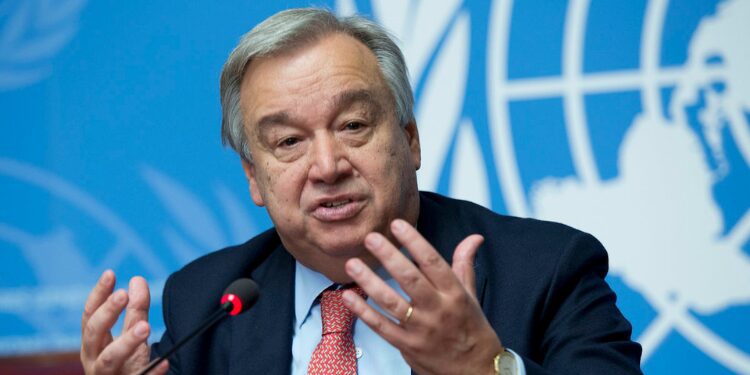
United Nations Secretary-General, António Guterres, has called on governments worldwide to place housing at the centre of sustainable development, warning that the global housing crisis is eroding dignity, widening inequality and deepening urban pressure across both developed and developing nations.
Addressing participants at the 13th session of the World Urban Forum (WUF13) in Baku, Azerbaijan, United Nations Secretary-General stressed that access to safe and affordable housing plays a decisive role in shaping health outcomes, educational opportunity and long-term economic stability.
The week-long gathering, organised by UN-Habitat in partnership with the Government of Azerbaijan, has attracted a record number of participants and comes at a time when cities are grappling with rapid urbanisation, climate-related disruptions and rising social inequality.
“As Secretary-General, I am proud that the Pact for the Future and the Doha Political Declaration recognise housing as a priority.”
António Guterres
António Guterres emphasised that, “housing is a human right, and fundamental for human dignity,” urging participants to work towards making affordable housing a “shared reality.”
He further highlighted that the housing crisis is no longer confined to poorer nations. “No society is immune, from fast-growing cities in the developing world, to advanced economies with high rents and rising homelessness,” he noted.
UN-Habitat officials described the summit as a major milestone in elevating housing and urban development to the highest political level.
Moreover, President of the UN General Assembly Annalena Baerbock emphasised that “building more houses is necessary, but it will not be enough on its own.”
Annalena Baerbock called for a broader, integrated approach linking housing with infrastructure development, financing systems, climate resilience and urban planning, while also highlighting the importance of local community participation and civil society engagement.
Rapid Urbanisation Drives Global Push for Sustainable Housing Solutions

Global discussions on urban development are intensifying as cities continue to expand at an unprecedented pace.
United Nations projections indicate that approximately 1.5 million people are moving into urban areas every week. By 2050, more than two-thirds of the world’s population is expected to reside in cities, with nearly 90 per cent of this growth concentrated in Africa and Asia.
This rapid urbanisation is placing significant pressure on infrastructure and housing systems. In developing countries, more than 30 per cent of urban residents currently live in informal settlements or slums, where access to basic services such as clean water, sanitation, and adequate housing remains limited.
Against this backdrop, delegates at the 13th World Urban Forum (WUF13) are advancing discussions on practical responses to these challenges.
Key areas of focus include expanding access to essential services, strengthening climate resilience in urban planning, and improving governance frameworks to support sustainable city development.
Azerbaijan and Somalia are co-chairing the UN-Habitat Intergovernmental Working Group on the resolution “Adequate Housing for All” for the 2025–2026 term. The group is tasked with developing global recommendations aimed at promoting safe, affordable, and sustainable housing solutions.
Azerbaijani President Ilham Aliyev described his country as a bridge between East and West, highlighting the fusion of tradition and modernity reflected in its urban landscape and architecture.
He noted that hosting the global gathering underscores Azerbaijan’s commitment to urban planning and improving living conditions.
Moreover, UN-Habitat Executive Director Anacláudia Rossbach indicated that “never before has a forum of this nature brought together such a vast and diverse global audience.”
“Despite the intense rainfall and thunderstorms that have affected parts of Azerbaijan in recent days, we have come together here in Baku with resilience, determination and a shared sense of purpose.”
Anacláudia Rossbach
The event has proceeded despite severe weather disruptions in Baku and the Absheron Peninsula, where a record 103 millimetres of rainfall was recorded on May 17, more than five times the average monthly total.
The largest Urban Expo in the history of the forum is also taking place, spanning 3.5 hectares and featuring more than 217 organisations from 66 countries. Governments, universities, private companies and start-ups are presenting projects focused on affordable housing, digital innovation, climate resilience and inclusive urban development.
At the centre of the exhibition is the UN-Habitat pavilion, themed “Housing the World.” Its spiral-inspired design represents the interconnectedness of people, cities and nature.
UN-Habitat Chief of Communications Katerina Bezgachina noted that, “we started thinking about what home means for a human being. And we realised that home is also our planet and our universe.”
“We did not want to show only problems. We wanted to show that there are many solutions people just do not always know about them.”
Katerina Bezgachina
READ ALSO: President Mahama Challenges WHO: Reform Must Be Real, Not Ritual