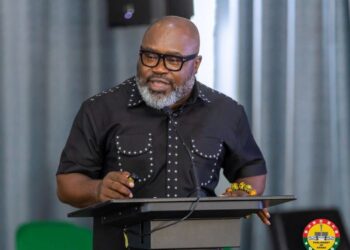
Solomon Owusu, the Director of Communications for the United Party, has criticised the National Peace Council over the framing of political tension in the country. He argued that the Council’s statement created an impression of instability without directly identifying the individuals whose comments and actions had generated controversy.
Owusu argued that opinions expressed by political figures should be examined carefully instead of being accepted as established national reality. He insisted that discussions surrounding alleged political tension must be based on specific facts and conduct rather than broad generalisations.
He further linked the National Peace Council’s statement to what he described as agenda setting, arguing that the institution was influencing public perception through its wording. According to him, the statement appeared designed to create a nationwide impression that the country was experiencing political instability.
“We must set the bar and get things straight. Again, a term was used that I want to centre this discussion on, which is agenda setting. And that is how I see what the Peace Council has done; it is agenda setting. Do you really believe, in your heart of hearts, that there is political tension in this country? Do you truly think, face to face, that this country is experiencing political tension?”
Solomon Owusu
Owusu argued that if the Peace Council genuinely intended to promote peace, it should have directly identified the politicians whose conduct it considered problematic.
He stated that references to the remarks of the Minority Leader, Alexander Afenyo-Markin, as well as comments by Salam Mustapha and the controversy surrounding Abronye, should have been addressed specifically rather than folded into a broad statement directed at all politicians.
According to Owusu, the Council weakened its own message by failing to clearly call out individuals whose actions it believed threatened public order. He maintained that peacebuilding requires direct accountability instead of collective cautioning that leaves room for ambiguity.
He also criticised the New Patriotic Party’s handling of legal and political disputes surrounding Abronye, arguing that party members should focus on challenging decisions through the courts rather than politicising every development publicly.

Owusu noted that some political actors had resorted to inflammatory rhetoric instead of relying on legal processes available under the country’s democratic system.
Drawing from his personal experience, Owusu recounted how he previously challenged a court matter while he was still a member of the NPP. He explained that although he believed the case against him was politically motivated, he deliberately chose to fight the matter legally through his lawyers rather than turning it into a political campaign.
Owusu said he instructed his legal team to pursue judicial remedies, including filing for certiorari when he believed a judge had acted improperly. He said that this approach demonstrated how politicians and public figures should respond to grievances within a constitutional democracy.
He further questioned attempts to directly link arrests or prosecutions to the presidency, referencing former President Nana Akufo-Addo’s previous public position that presidents do not personally order arrests.
Political Parties Face Equal Starting Point Ahead of 2028 Election
Solomon Owusu stated that no political party can claim a guaranteed advantage ahead of the 2028 general election. He maintained that electoral outcomes are determined by ballots cast on election day rather than assumptions about party popularity or public perception.
“What I know is that election 2028, every political party will be starting from point zero. Human beings are not bags that are put somewhere and by force they say you are going to vote in this direction.”
Solomon Owusu

Owusu made the remarks while challenging claims by the NPP that the party certain possesses fixed voting blocs capable of determining future electoral outcomes. According to him, many politicians wrongly assume that every voter who supported a party in previous elections automatically remains loyal to that organisation.
He argued that voter behaviour remains unpredictable and cannot be permanently tied to party affiliation. Owusu maintained that political parties must continue earning support through engagement and performance rather than relying on historical election results.
Owusu further dismissed suggestions that public displays of support necessarily translate into electoral victory. He stated that campaign visibility, branded clothing and crowd sizes do not determine the legitimacy of electoral outcomes.
“It is what is counted that matters, not the mere fact that you saw a lot of people wearing T-shirts. It is what is put in the ballot that matters.”
Solomon Owusu
He stressed that democratic competition remains open until votes are officially counted, adding that no political party should consider itself entitled to victory before the electorate makes its decision.
According to Owusu, the 2028 election will ultimately depend on how effectively political parties connect with voters and respond to national concerns.
READ ALSO: MPC Maintains Policy Rate at 14% to Protect Recovery