
The high-level bilateral trade mission spearheaded by the Ghana-Nebraska Agribusiness Growth and Trade Relations Chamber (GNEBCham) has advanced into its second operational phase, with the 23-member Ghanaian delegation transitioning from urban logistical hubs to the industrial heartland of Nebraska’s livestock sector.
Operating under the direct administrative leadership of Ghana’s Minister for Food and Agriculture, Hon. Eric Opoku, this multi-day deployment forms the core of a state-backed strategy to restructure Ghana’s domestic livestock value chain, accelerate cross-border investment, and establish clear technical blueprints for sub-Saharan food security.
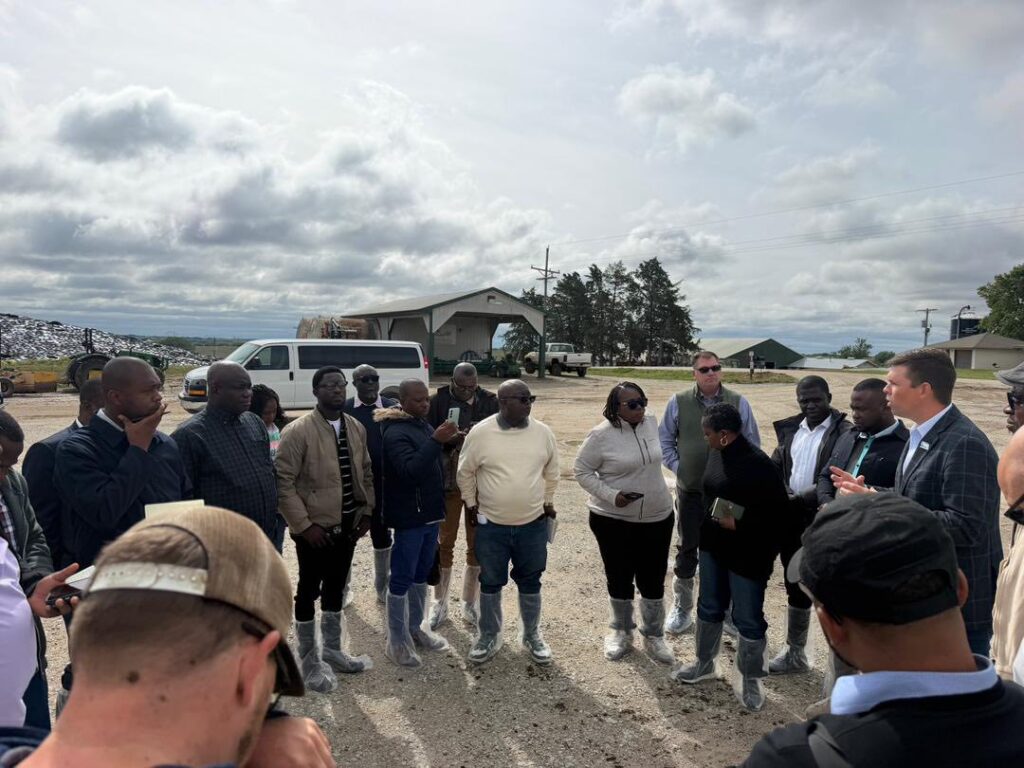
“The Ghanaian delegation visited Weber Feedyard and Bruning Farms to gain practical insights into Nebraska’s advanced cattle feeding systems, livestock technologies, feed management, and large-scale agribusiness operations”
Ghana-Nebraska Agribusiness Growth and Trade Relations Chamber
The field itineraries, built on the previous ones, were specifically designed to expose Ghanaian policymakers, agricultural investors, and animal scientists to localized, high-throughput commercial production models through direct, hands-on access to top-tier American production facilities.
For GNEBCham and its organizing partners, the aim was to move the bilateral alliance past theoretical trade frameworks and into immediate, actionable commercial transactions and technical knowledge transfers. The Weber Feedyard visit highlighted a highly automated, full-service cattle-feeding installation site renowned for its precision resource management.
The Ghanaian delegation engaged with feedyard managers to analyze the mechanical and digital infrastructure required to sustain rapid, efficient cattle weight gain under strictly monitored environmental conditions. The briefing centered on automated feeding systems, electronic cattle procurement channels, and real-time data tracking networks.
For the Ghanaian delegates, observing the integration of automated ration formulation and digital data tracking provided a direct solution to some of the chronic operational inefficiencies plaguing West African cattle ranching.

Traditional Ghanaian livestock systems often suffer from erratic weight metrics due to a heavy reliance on seasonal open-range grazing and unstructured forage collection.
The technical teams from both regions spent extensive sessions evaluating how custom feed formulations – utilizing standardized agricultural co-products like distillers’ grains – can be adapted to Ghana’s local raw materials, such as agro-industrial waste from cassava and maize processing.
The delegation studied the financial structures underpinning feedlot financing and risk management software, noting that the introduction of standardized weight-tracking data is a prerequisite for attracting commercial banking capital into Ghana’s emerging feedlot industry.
Crop-Livestock Integration Systems
Following the feedlot evaluations, the delegation traveled to Bruning Farms, a large-scale agricultural operation that demonstrates advanced crop-livestock integration and sustainable land management.
This site visit allowed the Ghanaian officials and commercial farmers to examine how large-scale grain production can be systematically linked to intensive livestock breeding to form a circular, waste-minimizing agricultural ecosystem.
The operational briefing at Bruning Farms detailed the strategic management of soil health, advanced herd genetics, and the implementation of high-efficiency grain storage systems that insulate large-scale livestock operations from global input market volatility.
The delegation analyzed the farm’s capacity to convert field residues into valuable cattle feed while recycling animal manure back into the crop fields as highly concentrated organic fertilizer. Hon. Eric Opoku highlighted that the structural lessons gathered from Bruning Farms could serve as a direct operational template for Ghana’s northern savannah ecological zones.
He noted that the Ministry for Food and Agriculture (MoFA) intends to reduce the country’s dependence on imported beef products, lower the cost of animal feed, and build a more resilient domestic supply network capable of withstanding climate-induced disruptions through formal, commercial partnerships between northern grain cultivators and local livestock associations.

The agricultural trade mission rapidly shifted from rural field operations to high-level corporate and state-level diplomacy within the capital city of Lincoln, with the delegation’s midday participation in the Green Gateau Luncheon.
This was an exclusive diplomatic event that convened key Nebraska agribusiness executives, financial investors, and state agricultural leaders to discuss immediate commercial collaboration opportunities. It provided an institutional platform for Ghanaian entrepreneurs within the delegation to pitch specific joint-venture proposals directly to American suppliers of agricultural machinery, specialized livestock vaccines, and processing equipment.
According to the GNEBCham, the delegation also visited the historic Memorial Stadium at the University of Nebraska-Lincoln (UNL), highlighting the deep cultural and educational ties being forged between the West African nation and Nebraska’s premier land-grant academic institution.
The diplomatic activities culminated in a series of formal, strategic negotiations held at the headquarters of the Nebraska Department of Agriculture, during which Hon. Opoku and senior GNEBCham directors met with American regulatory officials to establish clear, standardized protocols for agricultural trade, reciprocal investment protections, and future institutional exchange programs.
The discussions focused on creating streamlined regulatory pathways for exporting advanced Nebraska cattle genetics, embryo technologies, and veterinary equipment to Ghana, ensuring compliance with international biosecurity standards while reducing bureaucratic bottlenecks.
The institutional outcomes achieved during day two reinforce GNEBCham’s broader mandate to transition Ghana’s agricultural economy away from traditional subsistence farming and toward intensive, technology-driven industrialization.
The Ministry for Food and Agriculture plans to utilize the data gathered from Weber Feedyard and Bruning Farms to draft updated national policy guidelines for commercial feedlot development. These frameworks will prioritize state incentives for local firms that invest in automated feed management technologies, certified breeding operations, and modernized cold-chain logistics networks.
Through these continuous public-private engagements, the Ghana-Nebraska partnership is successfully positioning itself as a vital economic pipeline for eliminating Ghana’s annual livestock trade deficit, generating sustainable employment opportunities for agripreneurs, and securing a robust, self-sustaining protein supply chain for the West African sub-region.
READ ALSO: Hungarian Government Proposes Limit To Prime Minister’s Mandate