
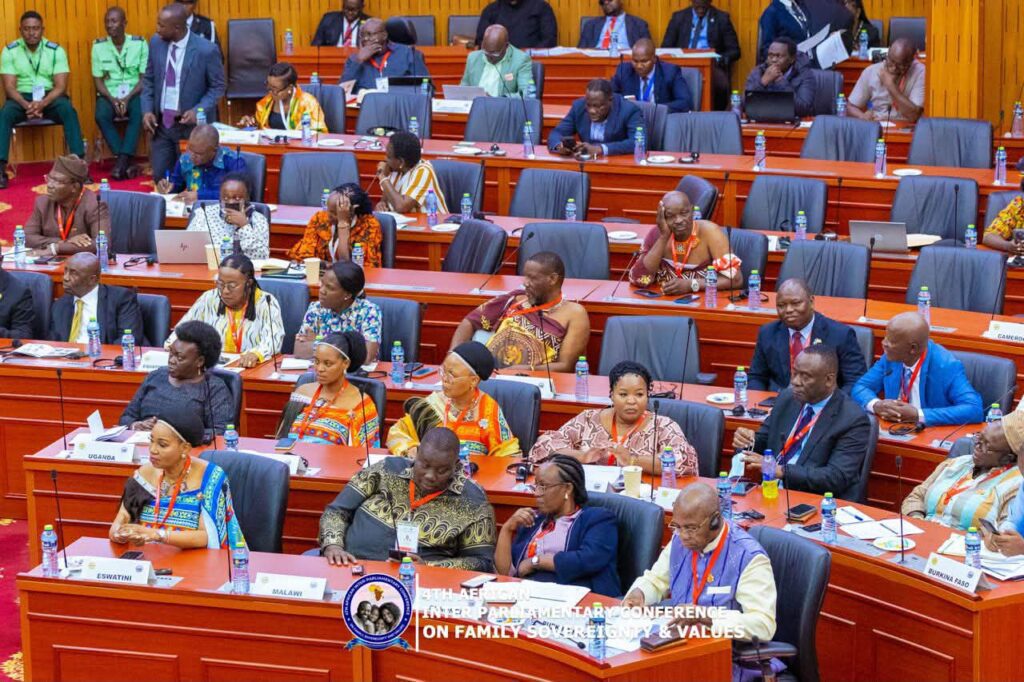
Africa’s ongoing deficit in agricultural financing has taken center stage at the 4th African Inter-Parliamentary Conference on Family, Sovereignty, and Values in Accra, with Ghana’s Minister for Food and Agriculture, Hon. Eric Opoku, issuing a sharp critique of the systemic underfunding that continues to plague the region’s primary economic sector.
The Minister called on African governments to aggressively scale up state funding by dedicating a minimum of 10 percent of their annual national budgets to agriculture, warning that the continent’s overlapping crises of youth unemployment, macroeconomic instability, and mass migration cannot be structurally resolved while its most vital industry remains starved of capital.
The high-level parliamentary summit serves as a critical policy forum, bringing together regional legislators to debate sovereign developmental protections and legislative oversight mechanisms.
Seizing the opportunity, Hon.Opoku reframed farming away from a default rural survival activity, presenting it instead as a sophisticated, US$50 billion macroeconomic gateway capable of generating tens of millions of formal downstream jobs and anchoring sub-regional peace and security.
Specifically, the Minister pointed to the historic Maputo Declaration of 2003 and its subsequent reaffirmation under the Kampala Declaration, where African states explicitly pledged to channel at least 10 percent of their national budgets toward rural development and agricultural transformation.
“Under these frameworks, our governments pledged to allocate this percentage as a means of unlocking the continent’s vast agricultural potential and accelerating economic transformation. Evidence across the continent suggests that many countries are yet to fulfill this commitment. In some countries, agriculture receives less than one percent of their national budget”
Hon. Eric Opoku, Minister for Food and Agriculture
Hon. Opoku dwelled on this severe disconnect between diplomatic rhetoric and budgetary execution, as a majority of sovereign treasuries continue to relegate the industry to the periphery of national development plans, with actual funding often falling to fractions of the agreed targets.
For decades, regional leaders have gathered at diplomatic summits to ratify ambitious, multi-state frameworks designed to stimulate agrarian productivity and achieve food sovereignty, yet a persistent implementation gap continues to characterize African agricultural policy.
This chronic under-capitalization is especially damaging given that agriculture serves as the primary source of livelihood and employment for the vast majority of the African workforce.
According to Hon. Opoku, some nations allocate as little as 0.6 percent of their national expenditures to the sector, starving the sector of essential capital expenditure and actively capping their own industrialization potential, keeping rural communities trapped in cycles of low productivity, and remaining highly vulnerable to global supply shocks.
Reversing Capital Flight
The structural consequence of this localized funding deficit is an unsustainable reliance on foreign food pipelines.
Hon. Opoku stressed that it is economically indefensible for African nations to continue spending billions of dollars annually to import processed food and basic staples that could easily be cultivated, harvested, and packaged within local agricultural zones.
This massive drain on foreign exchange reserves directly undermines national currencies, destabilizes balance-of-payments positions, and transfers vital manufacturing jobs to foreign economies.
To shift agriculture from basic subsistence to a high-yield, commercially viable agribusiness model, governments must deliberately align public expenditure with core value-chain interventions.
The Minister noted that a strategic, coordinated investment of approximately US$50 billion across the continent could fundamentally revolutionize regional supply networks and keep wealth within local economies.

He noted that by channeling targeted capital into industrial processing enclaves, modernizing logistics corridors, securing cold-storage facilities, farm mechanization hubs, and private agribusiness development, African nations can successfully execute a comprehensive import-substitution agenda.
This transformation requires moving away from the simple export of raw agricultural commodities toward extensive local processing, allowing domestic producers to capture higher profit margins and protect national food systems from international price fluctuations.
Managing Unemployment
Beyond the immediate imperatives of food security, the modernization of the agricultural sector is directly tied to managing the continent’s rapidly expanding youth demographic, as Hon. presented sobering demographic data highlighting the widening gap between young job seekers entering the market and the formal economy’s actual capacity to absorb them.
Currently, between 10 million and 12 million young Africans enter the labor market every single year, yet continental economies manage to generate only about three million formal jobs annually, leaving millions of capable citizens without meaningful economic opportunities.
This structural employment crisis creates severe socio-economic pressures that ripple far beyond the agrarian sector. When rural livelihoods collapse due to a lack of public investment, young people are forced to migrate into oversaturated urban centers or attempt dangerous transnational journeys, creating deep social tensions, regional instability, and localized conflict.
A modernized, heavily capitalized agricultural value chain has the unique capacity to absorb this youthful labor force at scale by aggressively executing a US$ 50 billion infrastructure rollout to generate between 10 million and 20 million sustainable, direct and indirect jobs, especially under the African Continental Free Trade Area (AfCFTA) framework.
These opportunities span the entire modern agribusiness spectrum, moving far beyond manual field labor to include digital agronomy, specialized machine operations, cold-chain logistics management, processing facility engineering, and international trade compliance.

The Ministerial address concluded with a direct challenge to the assembled regional lawmakers, urging them to utilize their constitutional powers to enforce fiscal discipline and executive accountability.
With well-intentioned agricultural policies consistently failing during the implementation phase because budget approvals frequently exist only on paper, while actual cash releases are heavily delayed or diverted to other administrative urgencies, parliaments must step up and actively exercise their oversight responsibilities over public expenditure.
Lawmakers were urged to rigorously scrutinize national budget allocations, audit district-level disbursements, and demand clear answers whenever agricultural funding falls short of the agreed 10 percent continental targets.
READ ALSO: Ghana Moving from Resource-Rich Economy to Value-Driven Economy – Armah-Kofi Buah