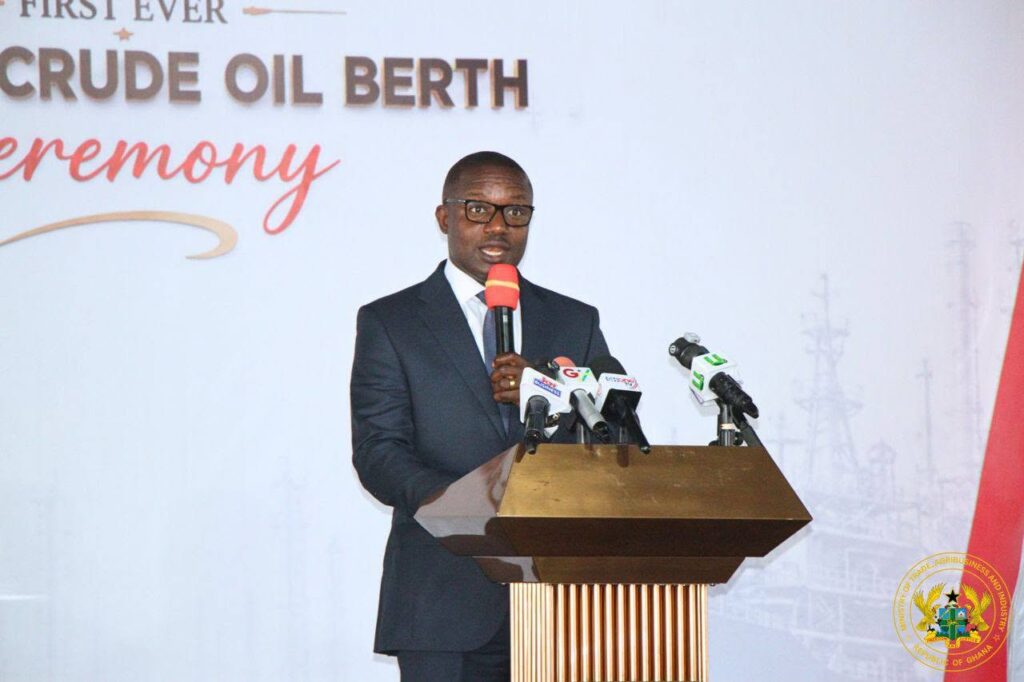
Minister for Trade, Agribusiness and Industry, Hon. Elizabeth Ofosu-Adjare, has celebrated the historic arrival of locally produced Jubilee crude oil at the Sentuo Oil Refinery in Tema for domestic processing, describing the event as a monumental turning point in Ghana’s economic development.
This structural realignment marks a definitive departure from the colonial-era economic model of exporting raw natural resources and subsequently importing high-priced, refined downstream products back into the country.
The landmark milestone stands as a concrete execution of President John Dramani Mahama’s industrial transformation agenda, which seeks to convert Ghana’s native natural resource wealth into high-value, locally manufactured commodities to insulate the domestic marketplace from external price volatility.
“For the first time in Ghana’s history as an oil-producing nation, a cargo of Jubilee crude, lifted from beneath our own waters, has arrived not in Rotterdam, Guangdong or the Gulf of Mexico, but here on Ghanaian soil, at a world-class refinery in Tema, to be transformed into fuel that will power Ghanaian homes, businesses and roads. Today, that cycle begins to change as we build the Ghana envisioned under President Mahama’s reset agenda – a Ghana that not only extracts its wealth but transforms it.”
Minister for Trade, Agribusiness and Industry, Hon. Elizabeth Ofosu-Adjare

Expanding on this national milestone, the approximately US$2 billion investment injected into the Tema facility by the Sentuo Oil Refinery Limited and its parent entity, the Sentuo Group, serves as a direct, private sector-led counteroffensive against the systemic “resource curse” that has structurally undermined African economies for generations.
For more than fifteen years, ordinary Ghanaian consumers including transport operators, market traders, smallholder farmers, and artisanal fishermen have born the heavy financial burden of erratic, foreign-determined deregulated pump prices.
By processing domestic crude oil lifted directly from Ghanaian territorial waters at a world-class facility in Tema, the state establishes a reliable domestic supply chain.
This strategic alignment ensures that the primary margins of the petroleum value chain remain completely internal, driving domestic industrialization, expanding technical engineering skillsets, and providing sustainable livelihoods for Ghanaian families.
“The benefits of this refinery extend far beyond petroleum products; behind every barrel refined are jobs, opportunities, technical skills and improved livelihoods for Ghanaian workers, engineers and families,” trade minister emphasized

Eliminating the Multi-Billion Dollar Import Drain and Protecting the Cedi
Historically, Bulk Oil Distribution Companies (BDCs) have had to aggressively source hundreds of millions of United States Dollars in every pricing window to fund the importation of finished petroleum products, creating persistent, structural depreciation pressure on the Ghanaian Cedi.
By shifting the refining burden to the domestic Sentuo facility, Ghana drastically curtails its foreign exchange capital flight, retaining valuable hard currency within the local banking ecosystem.
The reduction in international shipping, maritime insurance, and offshore handling overhead markups means the government can effectively stabilize the local pricing architecture of commercial energy.

This structural insulation shields the domestic macroeconomy from international supply chain shocks, linear freight disruptions, and geopolitical tensions occurring in external oil-producing blocks.
Catalyzing a Local Petrochemical Ecosystem and Industrial Inputs
The downstream operations at the Tema refinery create deep cross-sectoral linkages that go far beyond standard automotive fuels, forming the foundational bedrock for a diversified manufacturing base.
The facility is structurally configured to process crude inputs into high-demand industrial byproducts, including commercial-grade asphalt, liquefied petroleum gas (LPG), and essential chemical feedstocks.
The domestic production of asphalt provides an immediate, low-cost supply line for national road construction and transport infrastructure development, while local LPG outputs directly advance national clean cooking goals, mitigating the environmental degradation associated with biomass fuels.
Furthermore, the Ministry of Trade, Agribusiness and Industry is leveraging this refinery footprint to anchor a broader industrial cluster, actively pursuing international partnerships to establish localized plastics manufacturing, synthetic industrial inputs, and advanced petrochemical processing networks that reduce total national import reliance.
READ MORE : Unsafe Buildings Must Go Down To Protect Lives — NADMO