
Months after returning to crude oil refining following years of operational setbacks, Tema Oil Refinery (TOR) is beginning to assemble what industry observers have long argued is essential for a sustainable recovery: reliable access to crude oil.
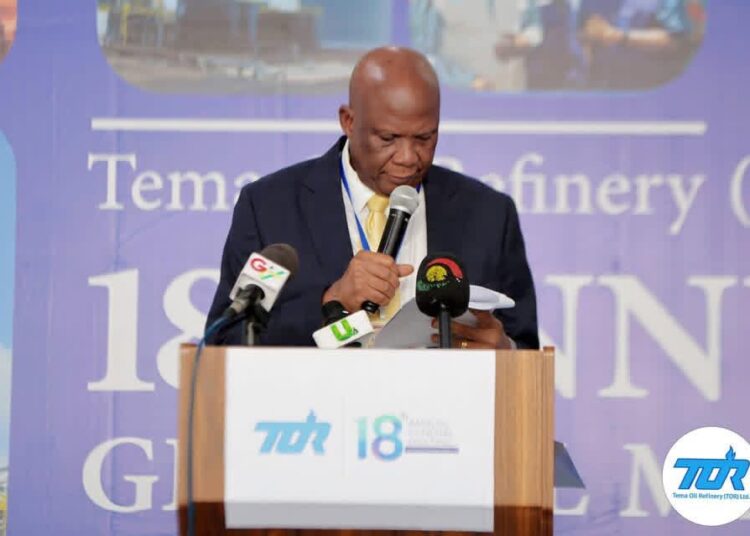
At the refinery’s 18th Annual General Meeting (AGM), management disclosed that TOR has secured an agreement with Dubai-based Fujairah/Triangle Commodities Trading (TCT) for the supply of approximately one million barrels of crude oil every month over the next two years.
The agreement is expected to provide the refinery with a predictable stream of feedstock, reducing one of the biggest operational uncertainties that has historically affected refining activities.
Rather than relying on occasional crude purchases, the arrangement provides a framework for continuous supply as the refinery works to rebuild commercial operations.
TOR has an agreement for the supply of about one million barrels of crude oil every month for the next two years, with no interruptions envisaged.
Board Chairman Nayon Bilijo
He added that the refinery is also expected to receive locally produced crude oil through government allocations beginning in July, creating another potential source of supply for domestic refining.
A refinery moving beyond restart mode
The announcement suggests TOR is entering a different phase of its recovery.
When refining operations resumed in late 2025 after maintenance works on the Crude Distillation Unit, attention naturally focused on whether the refinery could process crude again after years of interruptions.
That milestone has since been followed by the successful processing of approximately one million barrels of Bonga crude oil imported earlier this year under a tolling arrangement with the same trading partner.

The latest agreement shifts the conversation from restarting operations to sustaining them.
For refineries, maintaining a steady flow of crude is just as important as having functioning processing units. Without regular feedstock, plants face intermittent shutdowns, making it difficult to generate consistent revenues, optimise maintenance schedules or supply petroleum products reliably.
Industry analysts have often pointed to inconsistent crude supply as one of several structural challenges that contributed to TOR’s operational instability over the years.
Recovery extending across the refinery
Management indicated that the crude supply arrangement forms part of a broader operational programme already underway.
According to Mr Bilijo, work continues on restoring 17 storage tanks that had fallen out of service, while maintenance on the refinery’s Residual Fluid Catalytic Cracking Unit (RFCC), a key value-adding processing facility, is expected to be completed during the third quarter of the year.

The Board also outlined ongoing efforts to strengthen revenue generation, reduce operating costs and improve the refinery’s financial position as part of its longer-term restructuring programme.
These initiatives come alongside measures aimed at strengthening technical capacity within the refinery as operations gradually expand.
Why it matters for Ghana
Although Ghana now has additional refining capacity through private investment, TOR remains the country’s premier refinery and continues to play an important strategic role within the national petroleum industry.
A refinery operating consistently has implications that extend beyond the company itself.
Domestic refining can improve supply flexibility, support energy security and strengthen Ghana’s ability to respond to disruptions in international petroleum markets.

Recent volatility in global crude oil prices, triggered by geopolitical tensions in the Middle East, highlighted the importance of resilient domestic energy infrastructure even in countries that continue to participate in international fuel markets.
A more stable TOR could also support wider government efforts to retain greater value within Ghana’s petroleum sector by linking domestic crude production more closely with local refining.
A broader government strategy
The developments at TOR also reflect a wider policy direction emerging across Ghana’s energy sector.
Before the AGM, the Ministry of Energy and Green Transition led the heads of its agencies in a strategic engagement with the Ministry of Finance to align priorities across the petroleum, electricity and renewable energy sectors.
That meeting focused on coordinating reforms, financing priorities and institutional support needed to strengthen energy security while improving the performance of state energy institutions.

The refinery’s progress therefore fits within a broader effort to reposition strategic energy assets through stronger governance, improved financing and operational reforms.
The presentation of financial statements covering the period from 2017 to 2025 at the AGM further formed part of that wider governance agenda, as management seeks to improve transparency and restore confidence in the refinery’s long-term direction.
The next phase
The crude supply agreement does not remove every challenge facing TOR.
Long-term commercial success will still depend on efficient refinery operations, continued infrastructure rehabilitation, sound financial management and the ability to compete within Ghana’s liberalised downstream petroleum market.
Nevertheless, securing dependable access to crude oil addresses one of the operational constraints that has repeatedly undermined refining activities in the past.
Taken together with the refinery’s return to operations, ongoing rehabilitation works and broader government efforts to strengthen energy institutions, the agreement suggests that TOR’s recovery is increasingly being built on longer-term operational planning rather than short-term interventions.
Whether that momentum can be sustained will ultimately determine the refinery’s contribution to Ghana’s energy security, industrial development and efforts to reduce dependence on imported refined petroleum products.
READ ALSO: Uganda Confirms Isolated Marburg Case