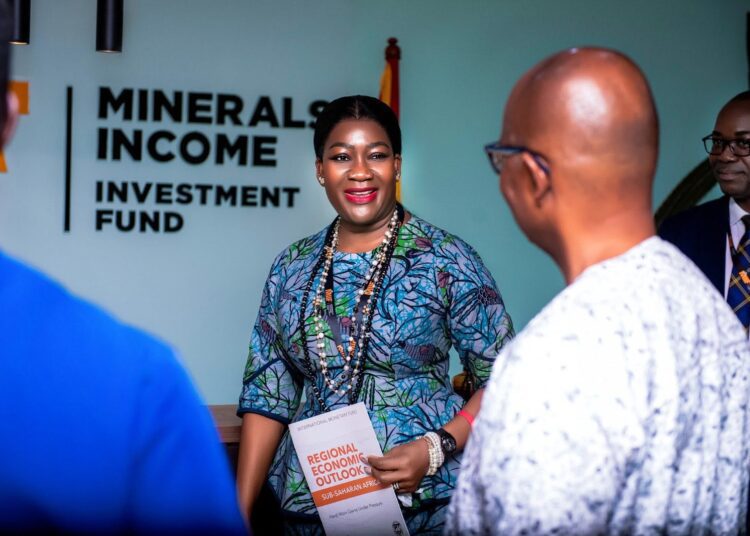
Minerals Income Investment Fund (MIIF) has ordered steps to explore solutions to proactively tackle a severe funding squeeze threatening the future of mining as global exploration budgets experience consecutive years of steep decline.
With grassroots exploration hitting historic lows worldwide, the sovereign fund is actively designing strategic interventions to keep high-risk, early-stage capital flowing into the local extraction sector.
This move reflects MIIF’s transition from a passive collector of mineral royalties into an active architect of competitive fiscal and regulatory solutions aimed at preventing a long-term drop in national mineral output.
“Recent industry reporting shows that global exploration budgets have fallen for two consecutive years, with spending dropping again in 2025 as junior companies struggled to access finance and grassroots exploration reached a record low share of total budgets. This matters because early-stage exploration is where the next generation of mineral discoveries begin.”
Minerals Income Investment Fund (MIIF)
To expand on this urgent shift, the fund recognizes that exploration is the absolute lifeblood of the entire mining industry.
Without immediate capital injected into early-stage discoveries, greenfield project pipelines dry up, domestic production inevitably declines over time, and the state’s long-term mineral royalty inflows face severe degradation.

While Ghana recently made progressive policy strides under its RESET Agenda such as eliminating the Value Added Tax (VAT) on exploration services the high-risk, capital-intensive, and long-dated nature of grassroots mineral hunting demands much more robust frameworks to remain competitive globally.
Junior mining firms are currently bearing the brunt of the global financing crunch, forcing resource-rich nations into a fierce international race to attract patient, risk-tolerant investment capital.
The Imperative for a Strategic Policy Turnaround
Historically, state agencies relied heavily on passive market forces and the natural allure of geological endowments to bring in foreign direct investment.
However, the current global climate has made it abundantly clear that passive reliance on market forces alone is unlikely to be sufficient to sustain growth.
Because early-stage mining exploration is inherently uncertain and depends completely on long-term regulatory predictability, investors are migrating rapidly toward jurisdictions that actively derisk their capital.
If MIIF fails to engineer a competitive counter-strategy to this global downturn, Ghana risks watching vital risk capital flow elsewhere to competing destinations.

Long-term production drops do not happen overnight; they are the direct consequence of neglecting grassroots prospecting years prior.
For the sovereign fund, stepping into the “solution market” means actively advocating for an institutional system that reduces friction, protects the state’s future mineral revenue streams, and establishes an airtight pathway from initial license acquisition straight through to commercial project development.
Global Benchmarking and the Derisking Framework
To build an effective local response, Ghana is studying the deliberate policy mechanisms deployed by the world’s most successful mining jurisdictions.
Canada has established a gold-standard blueprint through its highly successful flow-through share regime, which is further bolstered by the Mineral Exploration Tax Credit.
This innovative fiscal mechanism allows junior exploration entities to pass their qualifying exploration deductions and tax credits directly down to individual investors, significantly minimizing personal financial exposure and making high-risk grassroots projects highly financeable.

Simultaneously, Australia has engineered a related competitive framework via its Junior Minerals Exploration Incentive.
The targeted incentive permits eligible greenfield exploration operations to convert their accumulated tax losses into valuable credits, which are then distributed directly to investors who purchase newly issued corporate shares.
The explicit objective of both systems is identical: aggressively stimulate funding for early-stage exploration precisely where the commercial hazards are highest.
Customizing Incentives for Ghana’s Mining Future
The ultimate takeaway for MIIF is not to replicate these foreign frameworks wholesale, but rather to recognize that leading mining jurisdictions actively compete for exploration capital on the global stage.
Ghana must adapt these underlying principles to fit its unique socio-economic landscape by resolving localized hurdles such as protracted permitting delays, complex land access constraints, and broader investor concerns regarding mid-stream policy shifts.

By taking the lead in the “solution market,” MIIF can spearhead the creation of predictable, targeted fiscal incentives that shield junior miners from the worst of the global financing crunch.
By moving beyond basic VAT exemptions and establishing a comprehensive, derisked regulatory environment, the country will effectively secure the fresh mineral discoveries required to anchor national wealth and ensure robust mineral royalty collections for generations to come.
READ ALSO: Queiroz Ends Short Stint as Ghana Coach After World Cup Exit