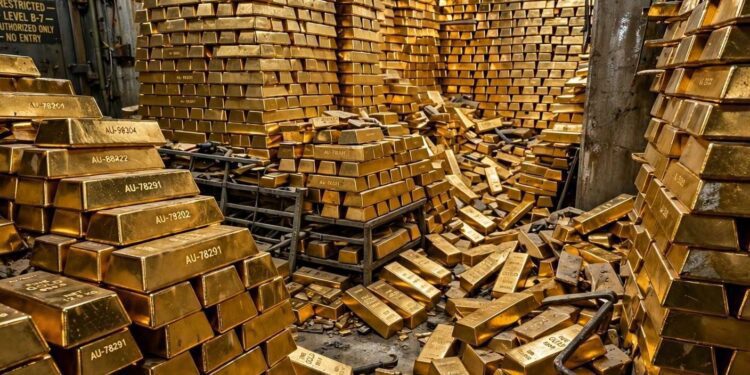
The Ghana Statistical Service’s released 22 years of comprehensive trade data spanning 2004 to 2025, has revealed a radical geographical realignment in the international routing of the country’s gold exports as the United Arab Emirates captured a dominant 40.8% share of total shipments in 2025.
This historic pivot highlights how global refining dynamics and domestic production structures have redirected the flow of Ghana’s primary mineral wealth away from traditional European and African refining hubs toward Asian and Middle Eastern commercial corridors.
“The destination story is interesting. South Africa took more than 80% of Ghana’s gold exports for most of the 2000s. It fell out of the top three by 2015. Switzerland took over, and since 2020 the United Arab Emirates has led, at 40.8% in 2025, with India now third at 20.7%.”
Data and Policy Analyst Mr. Alfred Appiah

To fully grasp this transformation, the two-decade trade trajectory reflects a structural migration of bullion channels. South Africa served as the destination for more than 80% of Ghana’s gold exports throughout most of the 2000s, but completely lost its dominance and fell out of the top three receiving nations by 2015.
Switzerland subsequently stepped in as the primary refining destination during the mid-2010s; however, since 2020, the United Arab Emirates has firmly assumed leadership of the trade, while India has surged into third place with a 20.7% market share.
Industry analysis suggests that the rapid expansion of artisanal and small-scale gold mining (ASGM) remains the primary catalyst behind this commercial pivot toward trading ecosystems centered in Dubai and Ahmedabad.
Gold Dominance and the Decline of Traditional Export Pillars
Beyond destination shifts, the newly published statistics paint a striking picture of an economy increasingly reliant on a single extractive commodity.
The year 2025 proved to be a remarkable period for national balance-of-payments figures, delivering a trade surplus of approximately $12 billion the highest recorded across the entire 22-year series.
However, this historic windfall was overwhelmingly driven by unprecedented international price increases rather than volume growth, as precious metal export values surged by roughly 80% alongside a modest 16% rise in physical volume.
Consequently, gold generated nearly two out of every three cedis earned from total exports in 2025, jumping dramatically from 55% in 2024.
As gold expanded its footprint across national accounts, former powerhouse export commodities suffered steep contractions in their relative contributions.

Crude oil exports experienced a sharp slide, dropping from 17.8% of total export receipts in 2024 down to 8.3% in 2025. Simultaneously, cocoa beans have undergone a dramatic structural decline over the two-decade window, falling “from grace to grass.”
Having comprised more than a quarter of all export revenues in 2004, raw cocoa beans managed just 8.6% in 2025, even after staging a mild recovery from a historical low of 5.1% in 2024.
While processed cocoa derivatives have displayed greater resilience, their impact remains constrained within the relatively small non-traditional export category, prompting strategic state commitments to accelerate domestic value addition.
Macroeconomic Vulnerabilities and the Urgent Call for Diversification
The structural concentration of export earnings within the gold sector introduces profound systemic risks for Ghana’s macroeconomic stability.
While elevated global prices have temporarily cushioned foreign exchange reserves and inflated trade balances, this heavy dependence leaves the fiscal framework dangerously exposed to external market shocks.
A sharp downward correction in world gold prices would deliver a devastating blow to revenue generation, currency stabilization efforts, and debt servicing capabilities, particularly at a time when secondary revenue streams from petroleum and agriculture are severely diminished.
Reflecting on these systemic exposure risks, Data and Policy Analyst emphasized that the empirical evidence reinforces “why we need to diversify exports and reduce dependence on one commodity,” cautioning that “a price correction in gold would be very devastating” while noting that the trajectories of “cocoa and oil should offer us some lessons.”
Ultimately, navigating this transition requires policymakers to treat the current gold revenue surge not as a permanent baseline, but as a temporary windfall to fund structural reforms.
Rebalancing the national export basket necessitates aggressive industrial policies that expand local cocoa processing capacity, incentivize non-traditional exports, and build secondary manufacturing capabilities.
Without immediate and deliberate steps to build export complexity beyond raw minerals, Ghana remains vulnerable to the volatile cycles of global commodity markets.
READ ALSO: UK Defends Russian-Linked Tanker Seizure as Putin Warns of Retaliation