Nepal’s Ministers have agreed to contribute one month’s salary to the Prime Minister’s Disaster Relief Fund as the government steps up its response to catastrophic flooding that has killed hundreds and left many missing across the country’s Himalayan border region.
The decision was taken during a Cabinet meeting, according to a statement from the Office of the Prime Minister and Council of Ministers. The Cabinet also directed the Ministry of Finance to prepare a rehabilitation package for individuals and businesses affected by the floods, which struck communities around Rasuwagadhi near the Nepal-China border, the Bhotekoshi River area and several downstream districts.
The measures come as Nepali authorities continue to assess the scale of one of the country’s worst recent natural disasters. Nepali police said that the death toll had risen to 489 after bodies were recovered from several flood-hit districts. Rasuwa and Nuwakot were among the areas worst affected, while many victims were found further downstream in Chitwan district, where the Trishuli River continues through the region before joining the Seti Gandaki River system.
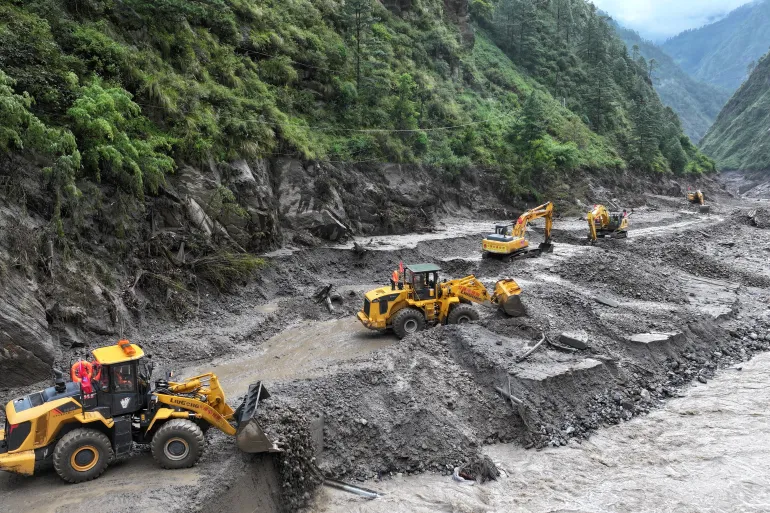
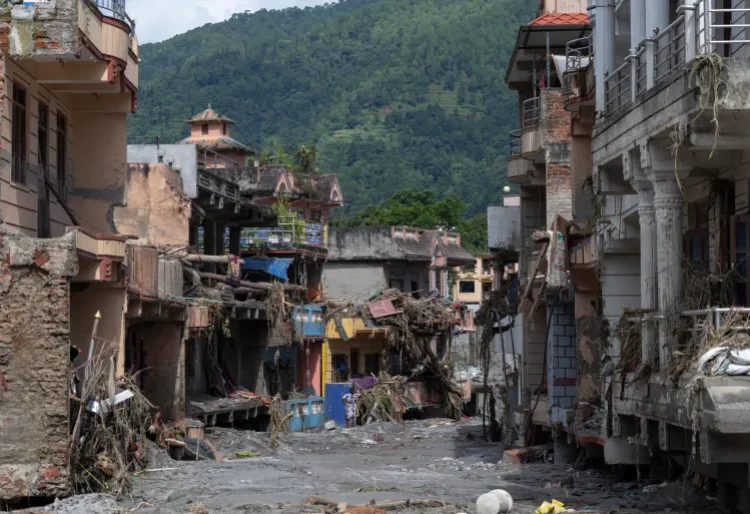
The disaster began on Wednesday when devastating floods swept through mountainous communities, destroying homes, roads, bridges and other critical infrastructure.The full extent of the damage remains unclear, particularly in remote areas that have been cut off from the rest of the country.
Nepal’s Information Minister Bikram Timilsina said that Rasuwa district had become almost completely inaccessible. “We have not been able to get there, it will take time for us to assess the scale of the damage,” Timilsina stated. He said that helicopters had become the main means of reaching survivors in some of the most severely affected communities.
The difficulty in accessing the region has complicated search and rescue operations and slowed the delivery of humanitarian assistance. The Red Cross estimated today that more than 90,000 people had been affected by the disaster. Relief operations have also been complicated by the formation of a barrier lake near the Nepal-Tibet border, raising fears that a secondary flood could strike downstream communities.
David Fisher, Head of delegation for the International Federation of Red Cross and Red Crescent Societies in Nepal, said that humanitarian agencies were closely monitoring the threat. “We’re of course very concerned about the secondary flood,” Fisher said. A barrier lake forms when landslides, flooding or other debris block the natural flow of a river, causing water to build up behind a temporary natural dam.
Chinese authorities have warned that the barrier lake near the Nepal-Tibet border faces a high risk of breaching. Chinese state broadcaster reported that approximately 2.5 million cubic metres of water had accumulated in the lake as of Friday. The lake formed at the confluence of the Chhochen Khola and Purepu Tsangpo rivers and has already begun to overflow, according to China’s Ministry of Water Resources.
Officials warned that around three million cubic metres of additional water could flow into the lake between Thursday and the weekend, increasing pressure on the natural barrier and raising concerns about another sudden flood. The threat has added urgency to rescue operations and prompted authorities to closely monitor communities downstream.
The disaster has also affected hundreds of foreign nationals who were travelling through the Himalayan region. Earlier today, the Nepali government released the names of 537 foreign nationals who remain out of contact following Wednesday’s flooding. The missing include 178 Indian nationals, 65 Americans, 53 Ukrainians, 51 Malaysians, 33 Australians and 33 British nationals.
The large number of missing foreigners reflects the importance of the region for tourism, trekking and religious pilgrimage.
Chinese Leader Holds Emergency Meeting On Flood
As Nepal continues its rescue operations, China has also intensified its emergency response. Chinese President Xi Jinping chaired an emergency meeting with officials to coordinate search and rescue efforts.
The meeting concluded that search operations should be “scientifically formulated to spare no effort in locating missing persons from both China and abroad.” Chinese officials also agreed that aid “must be provided” to affected communities in Nepal and that “international rescue co-operation must be carried out.”
China is expected to provide emergency assistance to Nepal’s disaster-hit areas as rescue and relief efforts continue. For Nepal’s government, the Cabinet decision to contribute one month’s salary to the Prime Minister’s Disaster Relief Fund represents an immediate gesture of support as authorities prepare for what could be a prolonged recovery effort.
READ ALSO: Countries Express Solidarity After Flash Floods In Nepal and China