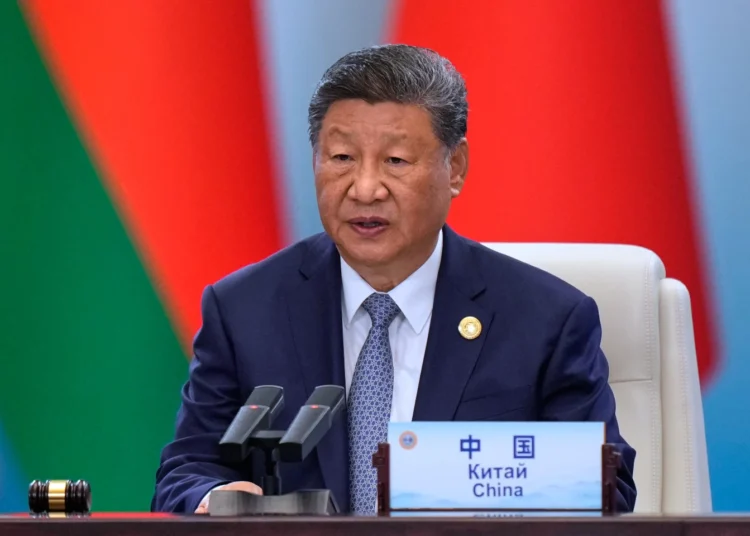
Chinese President Xi Jinping has called on Middle Eastern countries to oppose outside interference and take greater control of the region’s security affairs, as Beijing seeks to deepen its influence amid the ongoing war between the United States, Israel and Iran.
Xi made the remarks on Wednesday during talks with Egyptian President Abdel Fattah el-Sisi in Cairo, his first visit to the Egyptian capital in a decade. The meeting came as China seeks to strengthen diplomatic and economic relationships across the Middle East while the conflict continues to disrupt regional security and international shipping.
“We must uphold the principle that the people of the Middle East are the masters of their own affairs, oppose external interference [and] support regional countries in strengthening dialogue on peace and security.”
Xi Jinping
Xi was received by el-Sisi at the Ittihadiya presidential palace, where the Chinese President was welcomed with a 21-gun salute before the two leaders began their discussions.The talks focused heavily on the six-month conflict involving the United States, Israel and Iran.
According to a statement from the Egyptian presidency, both leaders called for diplomatic efforts aimed at securing a “comprehensive agreement to end the war.” The appeal for diplomacy reflects China’s broader position that regional disputes should be addressed through negotiations rather than external military intervention.
Beijing has repeatedly called for political solutions to conflicts in the Middle East while seeking to position itself as a diplomatic partner capable of engaging with countries across the region. Xi’s comments also come as the war has increased pressure on major international shipping routes.
Fighting and heightened security concerns have disrupted traffic through the Strait of Hormuz, which separates Iran and Oman, while instability around Yemen has affected shipping through the Bab al-Mandeb Strait between Yemen and the Horn of Africa. The disruption has raised concerns over energy supplies, trade and global supply chains because the waterways are important routes for oil, gas and other commodities.
China Prepared To Cooperate With Middle Eastern Countries
Xi said China was prepared to cooperate with Middle Eastern countries to protect international shipping and promote economic development. “China stands ready to work with countries in the region to safeguard the security of international shipping lanes, advance development cooperation … and eliminate the breeding grounds for conflict,” he said.
The visit also produced an important economic development for Egypt. El-Sisi’s office said the two countries signed an agreement to launch the third phase of the Egyptian-Chinese industrial zone at the Suez Canal. The industrial zone already hosts about 200 companies and represents approximately $4 billion in investment, according to Egyptian officials.
The expansion is strategically significant because the Suez Canal is one of the world’s most important trade routes, linking the Mediterranean Sea with the Red Sea and providing a major connection between Europe and Asia. Greater Chinese investment in the canal zone could therefore strengthen Beijing’s economic presence in a strategically important part of the global trading system, particularly at a time when conflict elsewhere in the region is placing pressure on alternative shipping routes.
A series of additional agreements were also signed during Xi’s visit, further broadening economic and diplomatic cooperation between Beijing and Cairo. Egypt occupies an important position in China’s Middle East strategy. The country controls the Suez Canal and has traditionally played a prominent role in regional diplomacy, while also maintaining close relations with Washington.
Cairo is one of the largest recipients of U.S. military assistance, receiving about $1.3 billion annually. Its longstanding relationships with both the United States and countries across the Arab world give Egypt a significant role in regional diplomatic efforts.
Xi’s outreach comes as several Middle Eastern countries appear increasingly interested in diversifying their strategic partnerships. Saudi Arabia, Türkiye and Pakistan signed the Mecca Defence Alliance last month, a development that analysts have interpreted as evidence of a growing desire among regional powers to develop security relationships beyond their traditional dependence on Washington.
China has sought to take advantage of this changing regional environment by expanding its economic partnerships while presenting itself as an advocate of dialogue and non-interference. The timing of Xi’s visit is also significant because it comes ahead of an expected meeting with U.S. President Donald Trump later this month.
Relations between Washington and Beijing remain marked by competition over trade, technology and global influence, making China’s growing role in the Middle East another area of strategic importance. For Beijing, deeper engagement with Egypt offers both economic and diplomatic benefits.
Expanded investment around the Suez Canal can strengthen China’s commercial position, while closer political ties with Cairo provide another channel for engagement on regional conflicts.
READ ALSO: COCOBOD Pays GH¢2.68bn to Complete 2026 DDEP Obligations, Clears GH¢162m Cocoa Bills