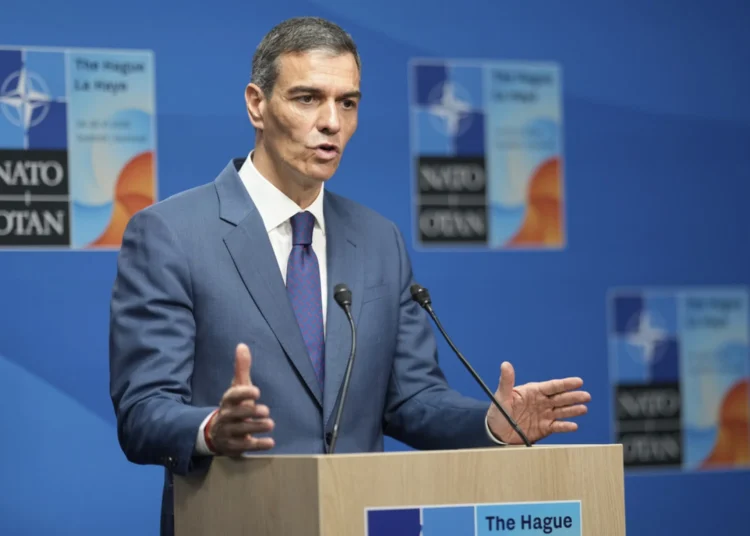
Spanish Prime Minister Pedro Sánchez has called for greater European solidarity in responding to the migration crisis in the Spanish enclave of Ceuta.
Addressing parliament today, Sánchez said that the crisis had demonstrated the need for a coordinated European response as Spain continues to deal with thousands of migrants who remain in Ceuta following a mass border crossing from Morocco.
He did not name individual countries, but in an apparent reference to Italy and Denmark, which have publicly criticised Spain’s handling of the crisis, Sánchez argued that the principle of solidarity should apply to Ceuta as much as it applies to Greenland and Lampedusa.
The influx into Ceuta has triggered a political crisis in Spain, placed significant pressure on local authorities and reignited disagreements within the EU over immigration, border management and responsibility for migrants arriving at the bloc’s external borders. The Spanish government has said around 90% of those who crossed into Ceuta returned to Morocco within 24 hours.
However, several thousand migrants are believed to remain in the enclave, including at least 500 minors, with some living on the streets or in temporary shelters. The continuing presence of migrants, especially minors, has placed pressure on Ceuta’s limited accommodation and social services, prompting calls from opposition parties for the remaining migrants to be returned to Morocco.
Sánchez, however, defended the government’s decision to treat migrants in accordance with Spanish, European and international law. “You can’t just grab someone by the arm and drag them across the frontier as though they were a sack of dirt,” he told MPs.

His comments signal the government’s preference for expanding facilities in Ceuta to accommodate those who remain rather than transferring large numbers of migrants to mainland Spain or carrying out mass returns that could trigger further political controversy. Sánchez noted that the income per person in Ceuta is significantly higher than in neighbouring Morocco, arguing that economic disparities will continue to create incentives for people to attempt dangerous crossings. “Even if we build a wall 100 metres high there will still be people prepared to throw themselves into the sea to get across,” he said.
The Spanish Prime Minister said that the government would continue working to strengthen Ceuta and improve its integration within Spain and the wider European Union. “We will not stop working until Ceuta emerges from this difficult situation: stronger, more prosperous, and more integrated with the rest of Spain and the EU,” Sánchez said.
Sánchez Rules Out Moroccan Government Involvement
Sánchez also rejected claims that Morocco’s government had organised or deliberately facilitated the mass crossing, despite the emergence of a police report commissioned by a judge that was widely reported by Spanish media. The report reportedly claimed that Moroccan border forces had actively assisted around 70,000 people in crossing into Ceuta in late July.
Sánchez told parliament that Spain had received no credible evidence from its own institutions or international partners showing that Morocco had planned or carried out the incident. “I can assure you that no institution – not the diplomatic service, nor the European Commission, nor any international body – has provided the Spanish government with any solid evidence that Morocco planned or carried out the incident. None whatsoever,” he said.
Sánchez said that he had, for now, ruled out direct involvement by the Moroccan government. He nevertheless acknowledged that Moroccan security forces had allowed crossings to take place during a crucial 10-hour period on July 30. The Prime Minister has repeatedly highlighted Morocco’s cooperation in the days following the mass influx, particularly its role in facilitating the return of most of the migrants to Moroccan territory.
Sánchez said that Spain had summoned Morocco’s Ambassador on August 21 following what he described as “unacceptable statements” by two Moroccan Ministers concerning Ceuta and Melilla, another Spanish enclave in North Africa. Spanish opposition parties have used the crisis to intensify criticism of Sánchez’s government.
People’s Party leader Alberto Núñez Feijóo called for Sánchez’s resignation, accusing him of “incompetence and complicity.” Vox leader Santiago Abascal also attacked the government’s approach, telling Sánchez, “Morocco doesn’t need an Ambassador in Spain – you are its Ambassador.”
Despite the political confrontation, Sánchez has sought to keep the focus on European cooperation. His appeal for solidarity reflects a broader debate within the EU over how responsibility for migration should be shared between frontline states and other member countries.
Ceuta and neighbouring Melilla are particularly sensitive because they constitute Spain’s land borders with Morocco and, by extension, the European Union’s only land borders with Africa. Their geographical position has made them recurring points of attempted irregular migration into Europe.
READ ALSO: COCOBOD Pays GH¢2.68bn to Complete 2026 DDEP Obligations, Clears GH¢162m Cocoa Bills