Ghana and India are deepening agricultural research cooperation through a five year partnership between the CSIR-Crops Research Institute (CSIR-CRI) and the Indian Council of Agricultural Research (ICAR), with a focus on developing technologies that can improve crop productivity, strengthen value chains and enhance the livelihoods of farmers.
The partnership is facilitated by Arima Farms Ltd., highlighting the growing role of private-sector participation in connecting agricultural research with investment, commercialisation and market opportunities.
The Memorandum of Understanding (MoU) was signed by Prof. Paul Pinnock Bosu, Director-General of the Council for Scientific and Industrial Research (CSIR), and Shri Sevala Naik Mude, MEA Central and West Africa, on behalf of the Indian side.
According to the Prof. Paul Pinnock, the agricultural research, technology development and capacity building at the centre of a renewed partnership between the two countries. The collaboration initially targets tomato research and development, cassava and other tuber crops, value addition and post harvest technologies.
“Turning international partnerships into technologies, increased productivity, value addition and improved livelihoods for Ghanaian farmers.”
Director-General of CSIR, Prof. Paul Pinnock Bossu
It also creates opportunities for scientist and germplasm exchanges and wider collaborative research, providing a platform for Ghanaian and Indian scientists to share knowledge, expertise and technologies in response to common agricultural challenges.
For Ghana, the collaboration comes at a time when agricultural transformation increasingly depends on the ability to move scientific research beyond laboratories and research stations into farms, processing facilities and commercial value chains.
The initial focus on tomatoes is significant given the crop’s importance to Ghana’s food system and the challenges associated with productivity, production costs, post-harvest losses and dependence on imported tomato products.
Using Research to Explore Opportunities
For Arima Farms Ltd, the partnership is expected to explore opportunities to improve production and strengthen the broader tomato value chain. This could include the development and adoption of improved technologies, better production practices and post harvest solutions that help farmers and agribusinesses retain more value from their produce.
‘’Cassava and other tuber crops are also central to the agreement. These crops have significant potential for food security, industrial processing and income generation, particularly when linked to stronger value addition systems.’’
Arima Farms Ltd.
The emphasis on value addition is particularly important as Ghana seeks to increase the economic returns from agriculture by processing more agricultural commodities locally rather than depending predominantly on the export or sale of raw produce.
Post harvest technology forms another major component of the partnership. Improved post-harvest systems can help reduce losses, improve the quality and shelf life of agricultural products and create better opportunities for farmers to supply processors and other commercial buyers.
The agreement also provides for scientist exchanges between Ghana and India. Such exchanges can expose researchers to new approaches, technologies and methodologies while creating opportunities for joint research and innovation.
Germplasm exchange is another area covered by the partnership, potentially strengthening access to plant genetic resources needed for crop improvement and research.
Promoting Bilateral Relationship Between Ghana-India
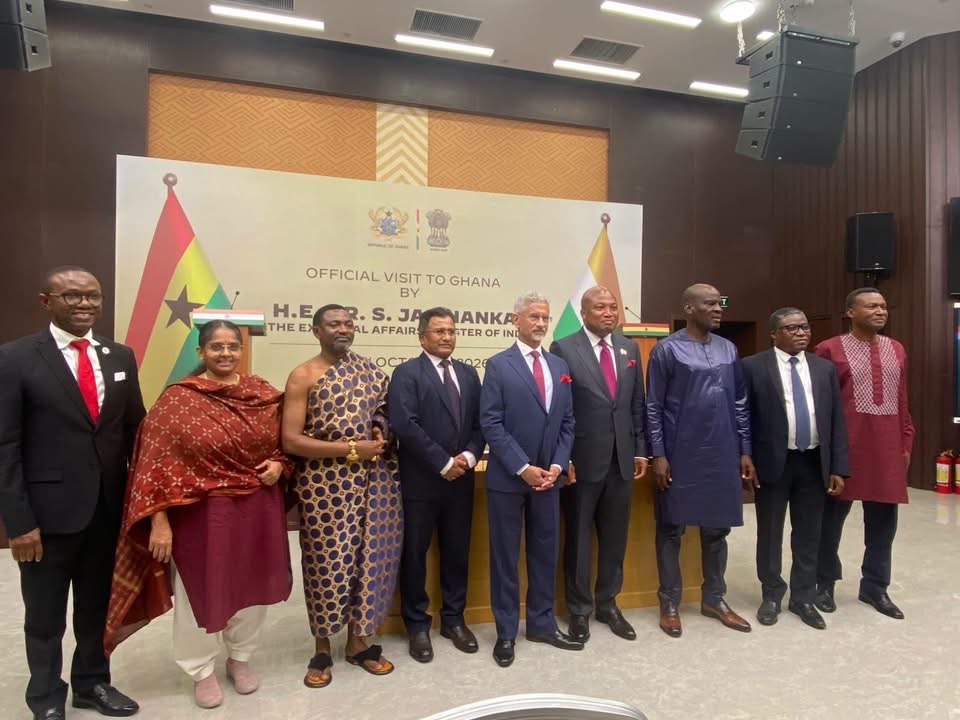
The signing ceremony brings together senior officials from both Ghana and India, promoting bilateral relationship between the two countries demonstrating the strategic importance attached to agricultural science and technology within the two countries’ growing bilateral relationship.
The ceremony is witnessed by India’s External Affairs Minister, H.E. Dr. S. Jaishankar; Ghana’s Minister for Foreign Affairs, H.E. Samuel Okudzeto Ablakwa; and Ghana’s Minister for Education, H.E. Haruna Iddrisu.
Also present are Prof. Maxwell Darko Asante, Director of CSIR-CRI; Saalai Manikam, Managing Director of Arima Farms Ltd.; Barima Acheampong Sarpong II, Director of Business Development at Arima Farms Ltd.; and Col. Ing. J.M. Opai-Tetteh (Rtd.), Director of Strategic Development at Arima Farms Ltd.
The involvement of Arima Farms provides an important commercial dimension to the agreement, particularly as Ghana seeks stronger partnerships between research institutions and private businesses.

‘’For agricultural researchers, the ability to connect research findings with commercial investment can improve the prospects of turning innovations into products and technologies that farmers can actually access.’’
Arima Farms Ltd.
The collaboration also reflects the broader expansion of Ghana-India relations into science, technology and agricultural development.
A second MoU signed during the ceremony further strengthens that scientific relationship. The agreement between the Zoological Survey of India and the Department of Animal Biology and Conservation Science of the University of Ghana expands cooperation into biodiversity, zoological research and conservation science.
The two agreements demonstrate the growing scope of institutional and scientific collaboration between Ghana and India.
The agricultural agreement, however, carries particular relevance for Ghana’s food-security agenda as the country seeks to raise domestic production, improve farmer incomes and build more resilient agricultural value chains.
Research partnerships such as the one between CSIR-CRI and ICAR can contribute to these objectives by providing opportunities to develop technologies suited to local production conditions and strengthen the technical capacity of agricultural researchers.
Ghana’s Intention to Join BRICS
The partnership also comes against the backdrop of Ghana’s intention to formally apply to join BRICS, signalling the country’s efforts to strengthen its engagement with emerging global economic and development partners.
For agriculture, the immediate opportunity lies in translating stronger diplomatic relations into practical cooperation that benefits farmers, agribusinesses and consumers.
The five-year CSIR-CRI–ICAR agreement provides a framework for that process, combining research collaboration, technology development, capacity building and scientific exchange.
Its success will ultimately be measured by the extent to which the partnership produces practical innovations, improves agricultural productivity and creates opportunities for farmers and businesses.
For Ghanaian agriculture, the focus on tomato, cassava and other tuber crops, alongside value addition and post harvest technologies, provides a clear starting point for that transformation.
By bringing together Ghanaian research expertise, Indian agricultural knowledge and private-sector investment, the partnership has the potential to strengthen the link between science and farming while supporting Ghana’s broader ambitions for food security, agricultural industrialisation and improved rural livelihoods.
READ ALSO:Prof. Mike Oquaye Urges Constitutional Reforms on Minerals