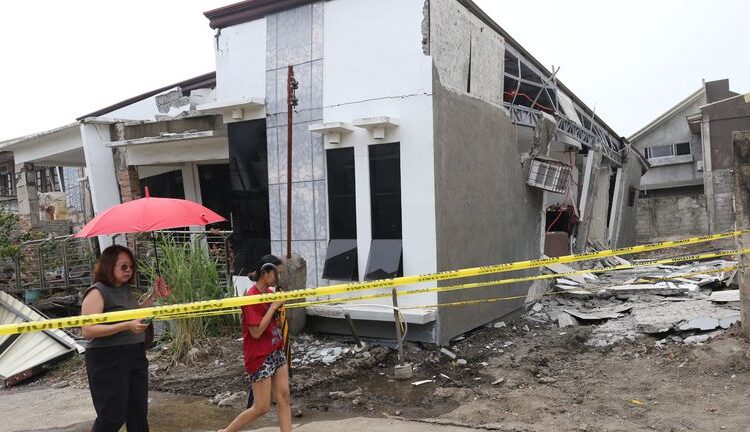
A 7.4 magnitude earthquake has struck the southeastern coast of the Philippines.
According to the US Geological Survey, the quake struck off the eastern side of Mindanao island, 123 kilometers (79 miles) from the island’s biggest city Davao, at a depth of 58.1 kilometers (36 miles), around 9:45 a.m. local time, sending panicked residents running into the streets as the ground shook.

The earthquake killed at least two people, damaged a hospital and schools, knocked out power and prompted evacuations of coastal areas nearby due to an initially-feared tsunami.
Governor Nelson Dayanghirang Sr. told a news agency that atleast two people died after being pinned in damaged houses in Davao Oriental, in the Philippines provincial.
The Governor added that about 250 patients were evacuated from a damaged hospital and would be temporarily housed in tents.
Office of Civil Defense Deputy Administrator, Bernardo Rafaelito Alejandro IV said that several buildings sustained cracks in their walls, including an international airport in Davao city, but it remained operational without any flights being canceled, Alejandro said.
The US Tsunami Warning center initially warned of possible tsunami waves in the Philippines, Indonesia and the island nation of Palau, but the threat had passed by midday.
The centre had initially warned the earthquake could trigger waves of up to 1-3 metres above tide level along the coast of the Philippines, and waves of 0.3 to 1 metres above tide level in parts of Indonesia and Palau.
The Pacific Tsunami Warning Center also said that the tsunami threat from an earthquake off the southern Philippines has now passed.
Small waves were detected on the Indonesian and Philippine coasts today, Friday, October 10, 2025, after the earthquake.
The Philippines and some regions of Indonesia had issued a tsunami warning, urging coastal communities to evacuate after a magnitude 7.4 earthquake struck offshore in the southern Philippines.
The tsunami centre in Honolulu, Hawaii, said that while the threat had passed about two hours after the quake, small sea fluctuations may continue. Damage from the earthquake was still being assessed.
The Philippine Institute of Volcanology and Seismology “strongly advised” people living in coastal communities in the southern and central Philippines to evacuate to higher ground, as waves of more than 1 metre were expected to hit the area.
A news agency also said that Indonesia’s northern Sulawesi and Papua regions had also issued tsunami warnings that waves as high as 50cm (1.6ft) could hit coastal areas.
President Points To Assessment After Earthquake

President of the Philippines, Ferdinand Marcos Jr. said that authorities were assessing the situation on the ground and search and rescue efforts were being prepared.
“I have directed the National Disaster Risk Reduction and Management Council, the Office of Civil Defense, the Armed Forces, the Philippine Coast Guard, and all concerned agencies to immediately carry out evacuations in coastal areas, activate emergency communication lines, and coordinate closely with local governments.”
Ferdinand Marcos Jr.
He emphasized that work is being done round the clock to “ensure that help reaches everyone who needs it.”
The country is still recovering from a powerful quake that struck off the central island of Cebu less than two weeks ago.
The 6.9 magnitude earthquake was the Philippines’ deadliest in over a decade, killing at least 72 people, wounding hundreds and displacing tens of thousands, and causing extensive damage, according to a news agency.
The Philippines is prone to natural disasters because of its location along the Ring of Fire, a 25,000-mile (40,000-kilometer) arc of seismic fault lines around the Pacific Ocean home to more than half of the world’s volcanoes, and regularly experiences powerful quakes.
The archipelago nation has also been battered by two destructive typhoons this month. Meanwhile, protests have broken out over the government’s alleged misuse of funds designated for flood relief projects.