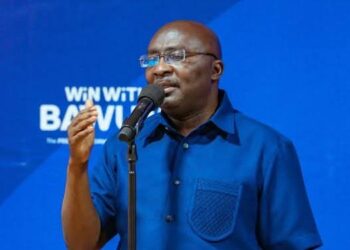

Member of Parliament for Gushegu and a key figure on the Bawumia campaign team, Hon Alhassan Tampuli Sulemana, has described Dr Mahamudu Bawumia’s victory in the New Patriotic Party presidential primaries as a clear demonstration of broad-based national popularity and organisational resilience within a highly competitive internal contest.
Speaking after the formal declaration of results, Hon. Tampuli reflected on the unique dynamics of the race, noting that unlike previous contests where the party faced a single dominant internal challenger, the 2026 primaries featured multiple strong contenders whose strategies often overlapped and competed for the same political space.
According to him, this made the campaign unusually demanding and fluid, requiring constant recalibration and rapid response across constituencies. He explained that the presence of several formidable aspirants meant campaign resources and attention had to be split in ways that were not always predictable.
As one contender was being managed in a particular area, another would emerge with a different strategy, forcing campaign teams to adjust quickly. Hon. Tampuli said this reality partly explains why some areas saw intense fluctuations in support during the campaign period, adding that it was easy to momentarily lose sight of emerging threats in fast-changing constituencies.

In assessing the performance of the various candidates, Hon. Tampuli singled out Dr Bryan Acheampong for particular recognition. He described Acheampong as the real standout among the challengers, especially given that it was his first attempt at a national party primary.
The number of votes he secured, Hon. Tampuli said, was an indication that the race was tighter than many within the party had initially anticipated. In his view, Acheampong’s showing confirmed that the contest was genuinely competitive and tested the depth of support for all aspirants.
Hon. Tampuli noted that the geographical spread of the candidates also influenced voting patterns. With aspirants drawing strength from different regions, including Ashanti, Central, Eastern, and Northern areas, the contest naturally reflected regional loyalties in some constituencies.
Bawumia’s National Reach
He cited examples such as Bosomtwe, where the former Education Minister won convincingly, and Yagaba Kubori, a Mamprusi dominant area, where Dr Bawumia secured one hundred percent of the votes. Despite these localised patterns, Hon. Tampuli stressed that the overall outcome underscored Dr Bawumia’s national reach.
“This election truly demonstrates that Dr. Mahamudu Bawumia is indeed very, very popular. Out of 276 constituencies, he won in 232 constituencies, and he won across the country, not in some areas, and didn’t perform well in some other areas. So, there was no region that he didn’t win in some constituencies.”
Member of Parliament for Gushegu and a key figure on the Bawumia campaign team, Hon Alhassan Tampuli Sulemana
He highlighted performances in regions often perceived as challenging terrain for the Bawumia campaign. In the Central Region, where the party’s overall showing was considered below expectations, Dr Bawumia still managed to win in about five constituencies.
In the Eastern Region, out of thirty three constituencies, he won in twenty-five, with the remaining seats split among other contenders. n the Ashanti Region, long regarded as the party’s stronghold, Hon. Tampuli said Dr Bawumia won in forty five out of forty seven constituencies.

Addressing questions about the strength of the Ashanti Region performance, which stood at about fifty eight percent, Hon. Tampuli rejected suggestions that it was weak. He argued that the figure was above the national average and must be viewed in the context of heightened internal competition.
Fluid Dynamics
He observed that some individuals who had previously aligned with the Bawumia camp shifted their support to other aspirants, while new voices emerged with strong media presence on radio and television, intensifying the contest.
“This election, I was telling some of our team members that I found this election even more challenging and tougher than the 2024 elections. This internal party election. Yeah, these internal party elections. The dynamics were so fluid.”
Member of Parliament for Gushegu and a key figure on the Bawumia campaign team, Hon Alhassan Tampuli Sulemana
He said the campaign environment was so fluid that events in one constituency could quickly alter dynamics elsewhere, forcing campaign leaders to revisit areas they had already covered in order to stabilise support.
He recalled that in the final days before voting, he had to leave his own constituency to reinforce support in several others, as last minute interventions by rival camps threatened earlier gains. According to him, it was easy for narratives to change and for minds to be influenced if campaign teams relaxed their efforts even briefly.

Despite the intensity of the race, Hon. Tampuli praised the conduct of the party and the attitude of the candidates after the results were declared. He said the losing aspirants accepted the outcome with maturity, while Dr Bawumia received the mandate with humility. In his assessment, this posture positions the party well for the task ahead.
Dr Bawumia was officially declared the flagbearer elect of the New Patriotic Party following the presidential primaries held on Saturday, January 31, 2026. He secured 110,645 votes, representing 56.48 percent of the total valid votes cast, comfortably crossing the required majority threshold.
Kennedy Ohene Agyapong placed second with 46,554 votes, representing 23.76 percent, while Dr Bryan Acheampong followed with 36,303 votes, accounting for 18.53 percent.
Hon. Tampuli concluded that the real winner of the contest was the party itself, adding that unity would now be critical as the NPP prepares to face its external opponents. He said the party must stand ready to consolidate its strengths and move forward together toward the 2028 general elections.
READ ALSO: Ghana’s Petroleum Fund Inflows Hit $399.65m in H2 2025