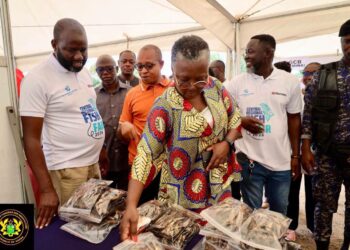

The Environmental Justice Foundation (EJF) has called on the Government of Ghana to accelerate the implementation of the Global Charter for Fisheries Transparency to safeguard the nation’s marine resources.
In its latest analysis, titled the “Ghana transparency gap analysis report: Evaluating transparency in Ghana’s fisheries sector,” the organization highlighted critical deficiencies in the public disclosure of vessel information.
While acknowledging recent legislative progress, the EJF maintained that total transparency is the only viable defense against illegal fishing and the potential collapse of fish populations.
“It is imperative for authorities, including the Ministry of Fisheries and Aquaculture (MoFAD), to publish the register of fishing vessels on the ministry’s website and submit this information for inclusion in the FAO Global Record of Fishing Vessels.
“It is equally important for an updated data on fisheries-related infringements and sanctions to be published and made publicly available at least once per year”
Environmental Justice Foundation
The organization argued that the data must be shared with the FAO Global Record of Fishing Vessels to ensure international oversight. Currently, the lack of accessible data regarding who owns and operates industrial vessels in Ghanaian waters remains a significant barrier to effective governance and accountability.

The report placed heavy emphasis on the disclosure of beneficial ownership. The EJF contended that at the point of registration, the true owners of vessels – those who ultimately profit from the catch – must be identified and made public.
This measure is intended to expose and prevent foreign entities from illegally using the Ghanaian flag to exploit local waters. According to the EJF, vessels controlled by foreign interests should not be eligible for local registration but should instead operate under strictly transparent access arrangements.
Furthermore, the EJF highlighted that while the Fisheries and Aquaculture Act establishes a legal basis for listing licenses and out-of-court settlements, public access to beneficial ownership data remains a major gap. The organization urged MoFAD to update existing regulations to ensure that transparency principles are not “watered down,” as the new legal framework is fully operationalized.
Economic Risks and Livelihood Security
The stakes for the fisheries sector are exceptionally high, as it serves as a lifeline for approximately 10 percent of Ghana’s population. With over three million people employed across the value chain – including thousands of women working as fishmongers and processors – the depletion of marine stocks would trigger a socio-economic crisis.
The EJF report warns that illegal, unreported, and unregulated (IUU) fishing continues to cost the state millions of dollars annually while undermining the basic human rights of coastal dwellers.
Although MoFAD demonstrated political will by endorsing the Global Charter at the 2025 Our Oceans Conference, the EJF notes that “further action is needed.” Recent successes, such as the publication of sanctions that led to the suspension of four industrial trawler licenses, are seen as positive steps that must now be institutionalized into a routine, transparent reporting cycle.
“Illegal fishing and overfishing risk collapsing Ghana’s fish populations, directly undermining the most basic human rights of coastal communities” EFJ noted.
To bridge the remaining transparency gaps, the EJF suggested that the government prioritizes the mandatory use of the Automatic Identification System (AIS) and clarify the details of the fish product traceability system.
By ensuring that every catch can be traced from the vessel to the market, the state can effectively enforce the existing ban on at-sea transshipment and prevent illegal products from entering the supply chain.

As the Mahama administration continues its 2026 economic reset, the fisheries sector represents a critical frontier for governance reform. The EJF maintains that a transparent vessel registry and the consistent publication of sanctions will not only deter illegal operators but also attract ethical investment into Ghana’s blue economy.
READ ALSO: Fall in Gold Prices Not Justification for Sale of Reserves – Mining Consultant