
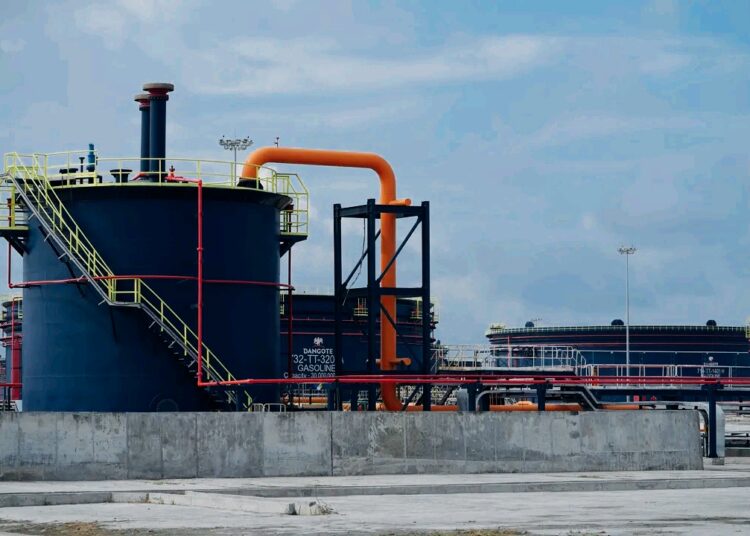
The Dangote Petroleum Refinery has reached its full designed processing capacity of 650,000 barrels of crude oil per day (bpd), marking a significant milestone for Nigeria’s energy sector and the global refining industry.
The company described the achievement as historic, noting that it is the first refinery worldwide to attain full nameplate capacity in a single train of that scale. The development signals a major step toward reducing Nigeria’s reliance on imported petroleum products and repositioning the country as a potential net exporter of refined fuels.
Chief Executive Officer of Dangote Refinery, David Bird, confirmed that key processing units are now operating steadily at full output following successful stabilization and performance tests.
Bird attributed the refinery’s rapid progress to the seamless integration of its core processing units, particularly the Crude Distillation Unit (CDU) and the MS Block.
“This performance testing phase enables us to validate the entire plant under real operating conditions.
“We are confident that the refinery remains firmly on track to deliver consistent, world-class output.”
David Bird, Chief Executive Officer of Dangote Refinery
According to Bird, the CDU and MS Block, comprising the naphtha hydrotreater, isomerisation unit and reformer unit are now operating steadily at the full nameplate capacity of 650,000 bpd.
The strong performance of these units underscores what he described as the plant’s “strength, reliability, and engineering quality.”
Phase Two Testing Set to Begin
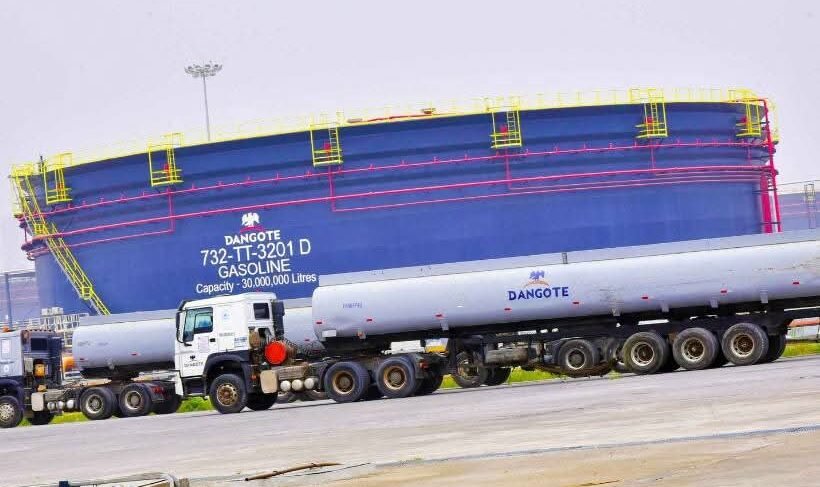
While the refinery has achieved full crude processing capacity, additional units are scheduled to undergo performance validation. Bird disclosed that the remaining processing units will commence their respective test runs in Phase Two, which is expected to begin next week.
As part of the ongoing commissioning process, the refinery has initiated an intensive 72-hour performance test run in collaboration with its technology licensor, UOP. The exercise is aimed at confirming operational efficiency and ensuring all critical parameters meet international standards.
Industry observers note that such rigorous testing is standard for large-scale refining complexes and provides assurance that output quality, safety, and environmental benchmarks are fully satisfied before sustained commercial operations.
Boosting Domestic Fuel Supply

The refinery’s capacity milestone is already translating into tangible supply gains for Nigeria’s domestic market. During the recent festive season, the plant supplied between 45 and 50 million litres of Premium Motor Spirit (PMS) daily.
With the CDU and MS Block fully operational, the refinery says it can now comfortably deliver up to 75 million litres of PMS per day to meet domestic demand as required.
This represents a substantial boost to local fuel availability and could help stabilise supply across the country.
Nigeria has historically depended on imports for more than 80 percent of its refined petroleum products, despite being one of Africa’s largest crude oil producers.
The Dangote Refinery’s full-scale operation is widely expected to reverse this trend and reduce exposure to international supply disruptions.
Transforming Nigeria’s Energy Landscape
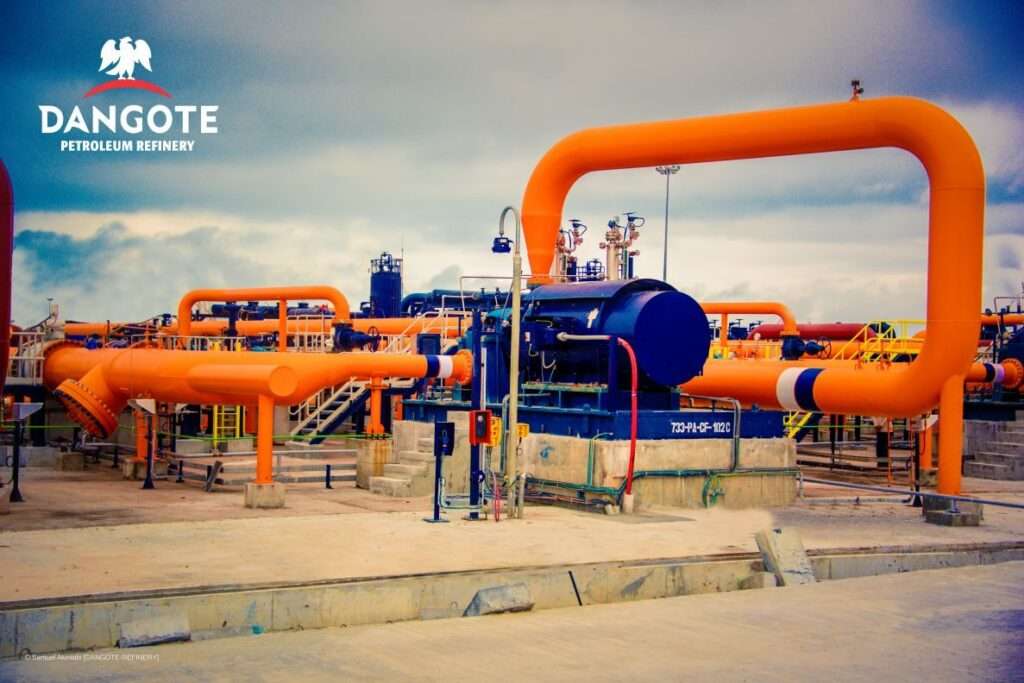
Bird emphasised that the refinery’s mission goes beyond operational metrics.
“We remain committed to producing high-quality refined products that will transform Nigeria’s energy landscape, eliminate import dependence, and position the nation as a net exporter of petroleum products.”
David Bird, Chief Executive Officer of Dangote Refinery
The 650,000 bpd refinery is not only designed to produce fuels such as petrol, diesel, and aviation fuel but also to support downstream industrial growth.
The complex includes petrochemical components that could stimulate local manufacturing and fertiliser production, contributing positively to Nigeria’s Gross Domestic Product.
Energy experts view the project as a transformative infrastructure investment capable of reshaping West Africa’s energy trade flows. With sufficient output, Nigeria could supply refined products to neighbouring countries, strengthening regional energy security and boosting export earnings.
The attainment of full 650,000 bpd capacity represents more than a technical milestone; it signals a potential turning point for Nigeria’s downstream petroleum sector.
If sustained, the refinery’s operations could usher in a new era of self-sufficiency, reduced import bills, and enhanced industrial capacity.
As Phase Two performance testing begins and additional units come fully online, stakeholders across government and industry will be closely watching how the refinery’s output reshapes Nigeria’s energy and economic landscape in the months ahead.
READ ALSO: MoFA Secures $90 Million Danish Investment for Shea Factory