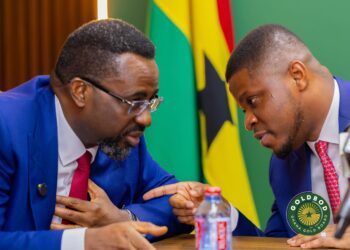
Chief Executive Officer of the Minerals Income Investment Fund (MIIF), Mrs. Justina Nelson, has identified the adoption of digital cadastral systems and the accessibility of transparent geological data as the primary catalysts for attracting global exploration capital to the continent.
She argued that these digital tools are no longer optional but are fundamental to reducing investment risk and shortening the lead time between discovery and production.
By modernizing land tenure management, African nations can effectively signal to the international market that they are open for business with a “predictable and efficient” administrative framework.

The transition to a digital cadastre allows for the seamless, real-time management of mineral rights, effectively eliminating the bureaucratic delays and title overlaps that have historically deterred junior explorers.
Mrs. Nelson expanded on this by noting that when digital land management is paired with strategic fiscal reforms such as Ghana’s removal of VAT on exploration inputs it creates a potent environment for “regulatory clarity” that stimulates investor appetite.
This digital transformation provides a single, verifiable “point of truth” for investors, ensuring that geological potential is matched by administrative certainty.
“Digital cadastral systems and transparent geological data are essential tools for attracting exploration capital and reducing investment risk. We are focused on supporting sustainable mining investments and advancing Africa’s broader industrialisation agenda.”
MIIF
Unlocking Economic Dividends Through Geospatial Transparency

For Ghana and the wider African continent, the economic benefits of a digital cadastral system extend far beyond mere administrative ease; they function as a cornerstone for “fiscal optimization and resource sovereignty.”
By digitizing the mining lifecycle, governments can improve the accuracy of royalty collections and fee administration, ensuring that the state captures its fair share of mineral wealth.
This transparency also facilitates “platform investments in shared infrastructure,” where digital data allows multiple operators to coordinate on logistics and power, thereby reducing the “operational and technological execution” burden on individual private investors.
Regional Integration and the AfCFTA Framework

Mrs. Nelson further emphasized that the African Continental Free Trade Area (AfCFTA) serves as a vital vehicle for “harmonising standards and pooling infrastructure” across the region.
A unified digital approach to mineral data could allow for the development of “regional processing hubs” that are more economically viable than isolated national projects.
By sharing geological insights across borders, African nations can create a competitive “investment-ready pipeline” that attracts large-scale capital while supporting the continent’s broader industrialisation goals.
Strengthening Public-Private Risk Sharing

The Minerals Income Investment Fund (MIIF) CEO advocated for a “pragmatic risk-sharing framework” where the public sector assumes the weight of infrastructure and regulatory risks, leaving the private sector to focus on technological innovation.
Successful examples from Ghana, particularly in “power infrastructure partnerships,” have already demonstrated how this model improves the bankability of mining and processing ventures.
Through this collaborative lens, digital systems act as the bridge that connects state-led governance discipline with the agility of private sector capital, ensuring a “sustainable mining development” that does not distort local markets.
READ ALSO : Petroleum Hub Lot One to Employ Over 30,000 Ghanaians