
The Ghana Revenue Authority has interdicted five officers of its Customs Division following the uncovering of a large scale border revenue evasion scheme estimated at more than GH¢85 million.
The interdiction, which takes immediate effect, is intended to pave the way for an independent and comprehensive internal investigation into suspected breaches of customs procedures linked to the diversion of transit goods. According to a statement issued by the Authority, the action follows preliminary findings from an enforcement operation conducted on February 18, 2026.
The operation focused on a consignment of transit cargo that had been declared for onward movement to Niger but was later found to have serious discrepancies in documentation and compliance with established transit protocols.
Management of the Authority explained that the interdiction does not constitute a finding of guilt. Rather, it is an administrative step to ensure that investigations are conducted without interference and in line with principles of fairness and accountability.
Details of the Revenue Evasion Scheme
Further details emerging from the operation point to a sophisticated attempt to abuse Ghana’s transit regime. Intelligence gathered by Customs and National Security revealed that a convoy of eighteen articulated trucks carrying more than forty four thousand packages of edible oil, tomato paste, and spaghetti entered the country through Akanu and was declared as transit cargo destined for Niger.
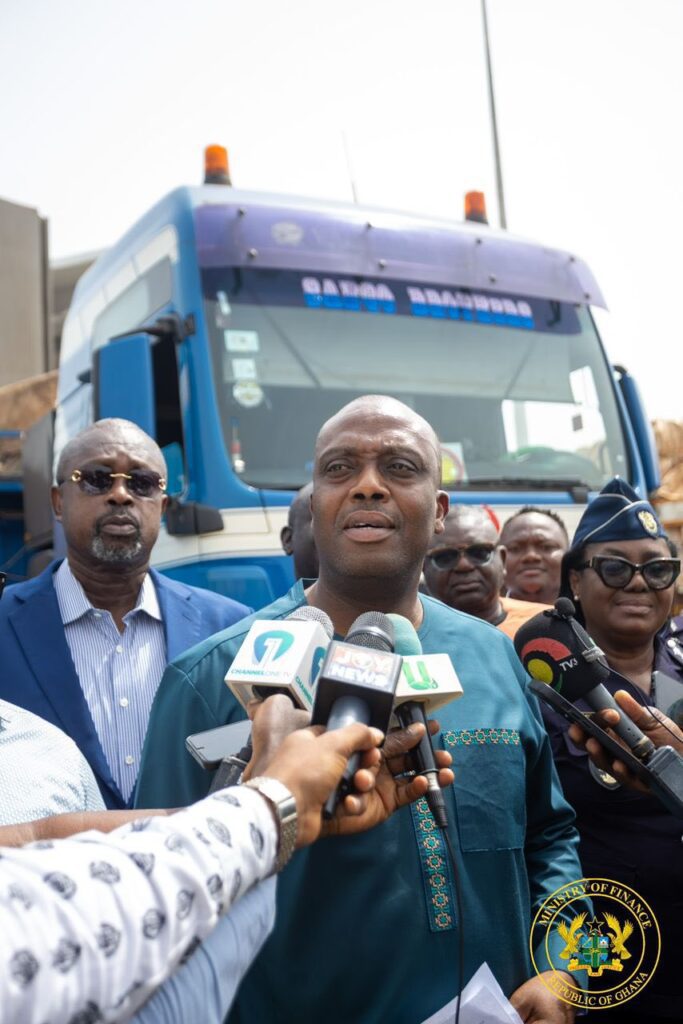
By declaring the goods as transit items, the importer avoided the payment of domestic import duties and taxes. However, on February 18, 2026, authorities intercepted twelve of the eighteen trucks along the Dawhenya Tema Road.
Investigators discovered that the trucks were moving without the mandatory Customs human escort and that their electronic tracking devices had been disabled, both in violation of transit regulations. Initial assessments by officers at the point of interception placed the suspended duties and taxes at about GH¢2.6 million.
A subsequent post interception audit by the Ministry of Finance, however, revealed extensive under declaration of cargo values and weight. This reassessment pushed the revised revenue exposure to approximately GH¢85.3 million, highlighting the scale of the attempted evasion.
Internal Accountability and Wider Investigations
The Ghana Revenue Authority said the ongoing internal investigation will establish the full facts surrounding the operation, including the extent of individual involvement and any departures from approved Customs protocols.
Additional officers may be invited to assist with the process where necessary, and appropriate administrative action will be taken upon its conclusion in accordance with applicable laws and regulations.

The Authority stressed that its decision reflects a commitment to protecting national revenue, safeguarding local industries, and promoting overall economic development. Effective enforcement of transit rules, it noted, is critical to preventing unfair competition that undermines domestic producers and erodes the tax base.
In a related development, the Office of the Special Prosecutor has launched a separate investigation into the suspected involvement of some security operatives and clearing agents in the scheme. The OSP probe is expected to complement internal Customs processes by examining possible criminal dimensions of the case.
Government Response and Policy Measures
The scale of the revenue discrepancy has prompted swift action at the highest levels of government. Finance Minister Cassiel Ato Forson has directed the Ghana Revenue Authority to undertake comprehensive investigations without delay and pledged that any officer found culpable will face firm sanctions, receiving presidential backing
As part of immediate corrective measures, the Minister announced a policy shift banning the land transit of cooking oil. Under the new directive, all such imports must pass exclusively through Ghana’s seaports, where monitoring and valuation controls are considered more robust.
The move is intended to close loopholes that have been exploited under the transit regime. Meanwhile, security agencies have launched a manhunt for the remaining six trucks that are yet to be accounted for. Authorities say efforts are ongoing to locate and secure the missing vehicles and their cargo as part of the broader investigation.
In its statement, the Ghana Revenue Authority reassured stakeholders and the general public that it remains committed to ensuring that all revenue collection and enforcement procedures are executed with the highest standards of professionalism and accountability.

Management emphasized that integrity, fairness, and service remain the guiding principles of the institution. The case has renewed public attention on the vulnerabilities of transit trade and the importance of strong internal controls within revenue collecting agencies.
Analysts note that while transit arrangements are essential for regional trade, they require strict enforcement to prevent abuse that deprives the state of critical revenue. As investigations continue across multiple institutions, the outcome is expected to shape future reforms in border management and Customs enforcement.
For now, the interdiction of the five officers signals a clear message that lapses in duty, whether procedural or deliberate, will be subjected to scrutiny in the interest of protecting the public purse and maintaining confidence in Ghana’s revenue administration.
READ ALSO: Banking Stocks Spark Trading Frenzy