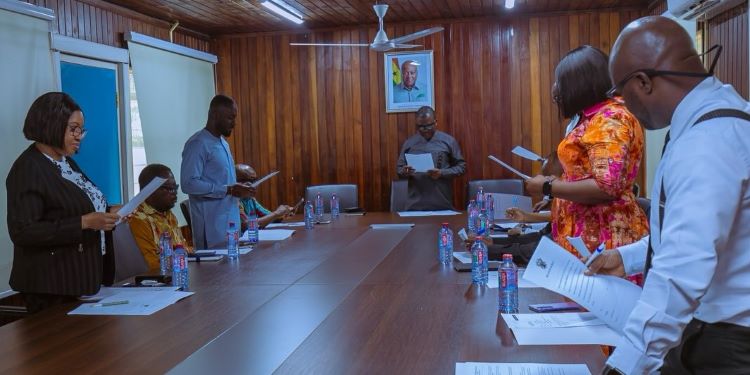
In a definitive move to dismantle weak enforcement and transparency lapses that have historically plagued Ghana’s maritime borders, the Fisheries Commission has formally inaugurated two high-powered regulatory bodies – the Compounding Offences Committee (COC) and the Fisheries License Evaluation Committee (FLEC).
The concurrent swearing-in at the Commission’s headquarters in Accra represented the final institutionalization of the Fisheries and Aquaculture Act, 2025 (Act 1146), as these committees will serve as the “judicial and administrative backbone” of the blue economy, to ensure that the exploitation of Ghana’s marine resources is governed by merit and law rather than influence and opacity.
“Speaking at the ceremony, the Deputy Executive Director (Technical), Professor Berchie Asiedu, emphasized that the country is counting on the Committees to discharge their duties with diligence and integrity.
“He noted that challenges such as weak enforcement and transparency issues have contributed to lapses in the sector, including those that led to the issuance of the yellow card by international regulators in previous years”
Fisheries Commission
Professor Asiedu, reminded all that the “yellow card” was a direct result of the very lapses these committees are now tasked to fix, and streamlining the licensing process and creating a fast-track administrative route for settling offences, provides the regulatory stability necessary for large-scale industrial investment in aquaculture and deep-sea fishing.
For the Fisheries Commission, the installation of the Compounding Offences Committee (COC), chaired by Mrs. Marina Appiah of the Office of the Attorney General, is a non-negotiable requirement for the Blue Economy nationwide, especially since the COC is engineered to bypass the “bottleneck” of the traditional court system.

Under the new framework, fisheries-related offences can now be addressed through rigorous administrative procedures that allow for “amicable settlements” without compromising the severity of the penalty.
This mechanism is critical for the Industrialization pillar, as it allows the state to recover the value of illegally caught fish and impose fines in real-time, rather than waiting years for a judicial verdict while the evidence – and the economic impact – dissipates. The COC’s mandate also includes evaluating the financial worth of illegal catches and determining the suitability of specific offences for settlement.
Shifting to this administrative model allows the Fisheries Commission to “properly tax,” non-compliance and reinvest those proceeds back into maritime safety.
Mrs. Appiah emphasized that the committee will act with “diligence and fairness,” ensuring that while the burden on the courts is reduced, the deterrent against illegal, unreported, and unregulated (IUU) fishing remains absolute. This sends a message to industrial trawlers, that the cost of non-compliance has just become immediate and unavoidable.
Gatekeeper of Maritime Accountability
The Commission clarified that while the COC handles the “aftermath” of offences, the Fisheries License Evaluation Committee (FLEC) is designed to prevent bad actors from entering Ghanaian waters in the first place.
Led by Captain Derrick Attachie of the Ghana Maritime Authority (GMA), FLEC will conduct high-level due diligence on every fisheries license application. This “credible and transparent,” system replaces the previous ad-hoc allocation methods with a professionalized evaluation process that prioritizes local content, technical capacity, and environmental sustainability.
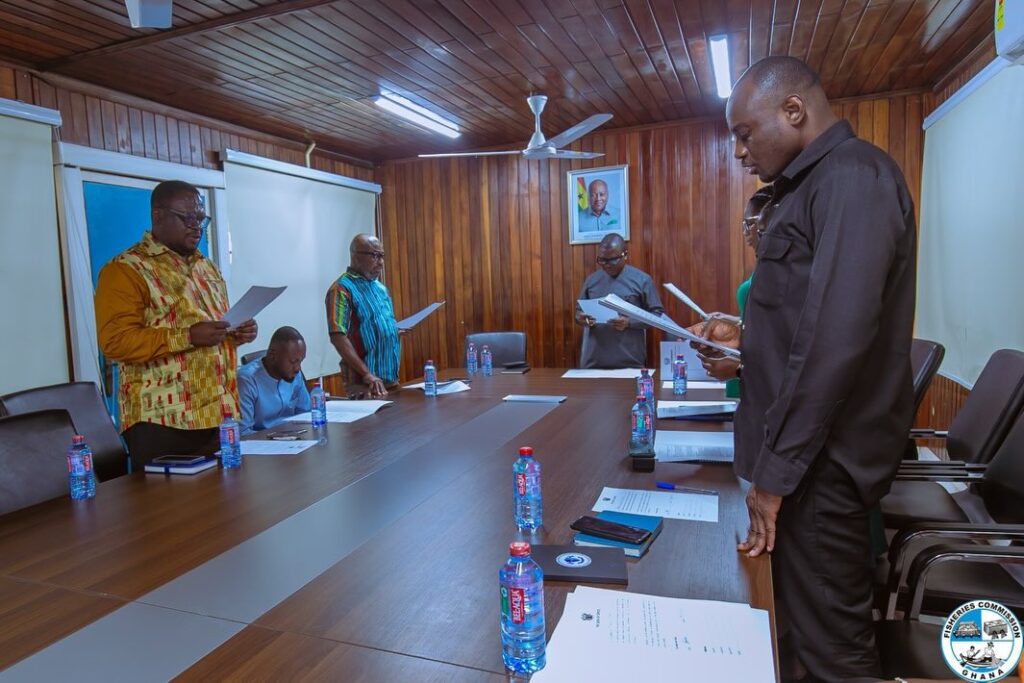
“The establishment of FLEC will enhance due diligence in evaluating fisheries license applications and promote accountability in the licensing process. This milestone demonstrates the Commission’s commitment to ensuring a transparent, fair, and efficient process”
Fisheries Commission
According to the Commission, the Committee will protect the national fish stock from over-exploitation by ensuring that licenses are only granted to professional, compliant entities. Professor Asiedu noted that FLEC’s work is the first line of defense in maintaining the “institutional framework,” of the sector.
Every license issued under this new regime will be a verified “contract of responsibility,” between the operator and the state, ensuring that the industrialization of the sea does not come at the expense of the artisanal fisher.
New Maritime Standard
The dual inauguration marks a departure from the external pressures that have historically compromised maritime governance. Professor Asiedu was explicit in his directive to the committees to report any attempts at interference or corruption.
Through the direct involvement of representatives from the Attorney General’s Office and the Ghana Maritime Authority, the Commission has cross-linked the nation’s legal and maritime experts to ensure that no single entity can exert undue influence over the licensing or settlement process.
Captain Derrick Attachie underscored that the work of these committees will have a “direct impact” on the governance and sustainability of the sector. For investors, this means that the rules of engagement in Ghana’s waters are now predictable, documented, and objectively enforced.
This regulatory clarity is the green light for the private sector to scale up tuna processing, aquaculture farms, and cold-chain logistics hubs along the coast. The 24-Hour Economy thrives on the certainty of the law, and with the COC and FLEC in place, the maritime sector has finally secured that certainty.

As the ceremonies at the Fisheries Commission concluded, the shift in the nation’s maritime posture was palpable. The Commission has moved beyond the “yellow card” era of international warnings into a new epoch of Regulatory Sovereignty.
With the IEZET Project providing the technical monitoring on the water and the COC and FLEC providing the administrative and judicial enforcement on land, the “blue fence” around Ghana’s territorial waters is now fully electrified.
The Ministry of Fisheries and Aquaculture Development (MoFAD) is delivering on its promise to build a resilient, transparent, and accountable institutional framework.
Under the oversight of the Fisheries Commission, the ocean is no longer a “frontiersman’s” territory but a regulated industrial corridor, and as these committees begin their work, the thousands whose lives depend on the sea can be assured that their resources are being guarded by a system built for integrity.
READ ALSO: EU Lawmakers Back Ban on AI-Generated Sexual Deepfakes