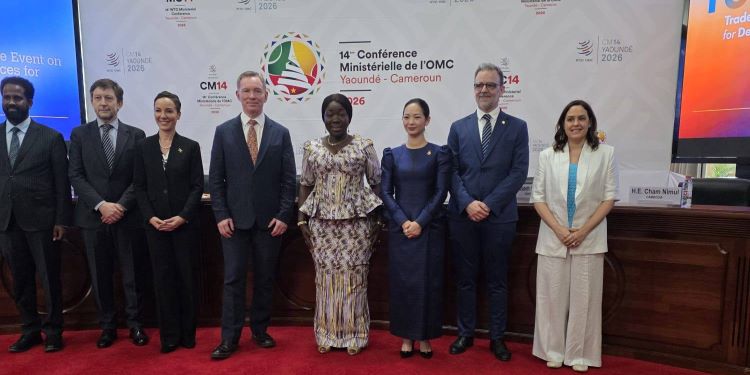
As the global community converges for the preparatory meetings of the 14th World Trade Organization (WTO) Ministerial Conference (MC14), Ghana has positioned itself at the forefront of the conversation on modern trade, with Hon. Elizabeth Ofosu-Adjare (MP), Minister for Trade, Agribusiness and Industry, advocating for a fundamental pivot in how developing economies structure their growth.
Participating in a panel discussion on the margins of the MC14 preparations, the Minister utilized this multilateral stage to identify services trade as the most potent driver for long-term economic transformation. This strategic shift moves the narrative beyond the traditional export of raw commodities and places the emphasis on high-value, digitally-enabled sectors.
“The Minister underscored the expanding role of sectors such as fintech, professional services, and other digitally enabled industries in promoting economic diversification, resilience, and job creation, particularly for youth”
Ministry of Trade, Agribusiness and Industry
Hon. Ofosu-Adjare signaled a new era of economic diversification designed to insulate the national economy from the volatility of global goods markets. Her intervention at the WTO comes at a critical juncture where the definition of “trade” is being rapidly rewritten by technological advancement.
No longer confined to the movement of physical containers across borders, the modern trade landscape is increasingly defined by the cross-border flow of data, expertise, and financial solutions. Hon. Ofosu-Adjare underscored that for a country like Ghana, the services sector represents an untapped frontier for job creation, particularly for a tech-savvy and expanding youth population.

According to her, focusing on digitally enabled industries has the potential of creating a resilient economic base that can withstand the secondary shocks of global supply chain disruptions. Central to her presentation was the meteoric rise of the Fintech Sector as a catalyst for financial inclusion and trade efficiency.
In the context of the WTO’s mission to strengthen the multilateral trading system, Ghana is presenting its digital financial infrastructure as a model for meaningful development outcomes. Hon. Ofosu-Adjare noted that services trade is no longer a peripheral component of the economy but a central driver of inclusive and sustainable growth.
For the Ministry of Trade, Agribusiness and Industry (MoTAI), fostering an environment where professional services – ranging from legal and accounting to architectural and engineering consultancy – are exported digitally, effectively removes the geographical barriers that previously limited Ghana’s economic footprint.
This focus on professional services is particularly relevant as the nation prepares to fully leverage the African Continental Free Trade Area (AfCFTA), and the Minister reaffirmed Ghana’s commitment to using the AfCFTA framework as a springboard for service exports across the continent.
Catalyst For Resilience
The discussion at the WTO preparatory meeting highlighted that digital innovation presents significant opportunities for developing economies to leapfrog traditional industrial hurdles.

Hon. Ofosu-Adjare emphasized that the infrastructure required for services trade – namely high-speed internet and digital literacy – is often more adaptable and scalable than the heavy infrastructure required for large-scale manufacturing.
This “digital resilience,” allows the economy to remain productive even when physical trade routes are compromised, and integrating digital innovation into the core of the trade agenda, ensures that Ghana remains future-proof in an increasingly automated global market.
Moreover, the Minister’s advocacy for a strengthened multilateral trading system suggests a desire for global rules that protect the interests of service exporters in the Global South. As the MC14 approaches, Ghana is seeking to influence the WTO’s development dimension to ensure that the rules governing digital trade are equitable.
This involves addressing issues such as data sovereignty, cross-border payment regulations, and the recognition of professional certifications across different jurisdictions, aimed at creating a seamless trade environment where a software developer in Accra can compete on the same terms as one in London or Singapore.
A recurring theme in the Minister’s panel discussion was the synergy between regional frameworks and global trade rules, noting that Ghana’s role as the host of the AfCFTA Secretariat places an added responsibility on MoTAI to lead by example.
Through highlighting services trade at the WTO, Hon. Ofosu-Adjare aligned the continent’s regional ambitions with the global trade architecture, which is essential for ensuring that African service providers have access to global value chains.

She added that though the AfCFTA’s Protocol on Trade in Services provides a robust foundation, it must be supported by a WTO system that prioritizes meaningful development. This collaborative approach was a hallmark of the discussion, as ministers from across the globe exchanged views on how to deliver developmental wins for their respective populations.
For Ghana, a win is defined by the ability to convert digital innovation into tangible economic opportunities for the informal sector and small-scale entrepreneurs, and Hon. Ofosu-Adjare’s focus on inclusive growth sought to ensure the benefits of the digital economy are not restricted to urban centers but distributed across the country.
The Minister’s participation in the MC14 preparatory meetings underscored the government’s belief that the service economy is the next frontier of the African independence struggle – this time, an economic one.
READ ALSO: Bawumia: Africa Must Embrace AI Revolution to Drive Prosperity