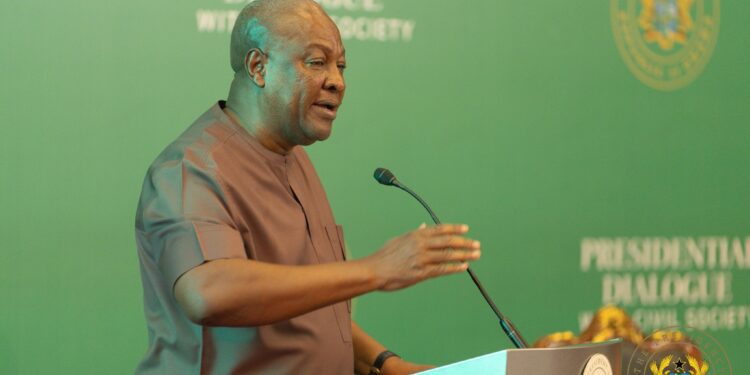
President John Dramani Mahama has directed a full review of procurement processes under the government’s Big Push programme, following concerns raised in an investigative exposé.
Speaking at the Presidential Dialogue with Civil Society Organisations at the Jubilee House, the President emphasized the need for transparency and accountability in public spending.
His intervention signals a renewed focus on procurement reforms, particularly regarding the use of sole sourcing in awarding government contracts. The President indicated that while the practice is legally permitted under existing laws, it must be applied cautiously and with clear justification.
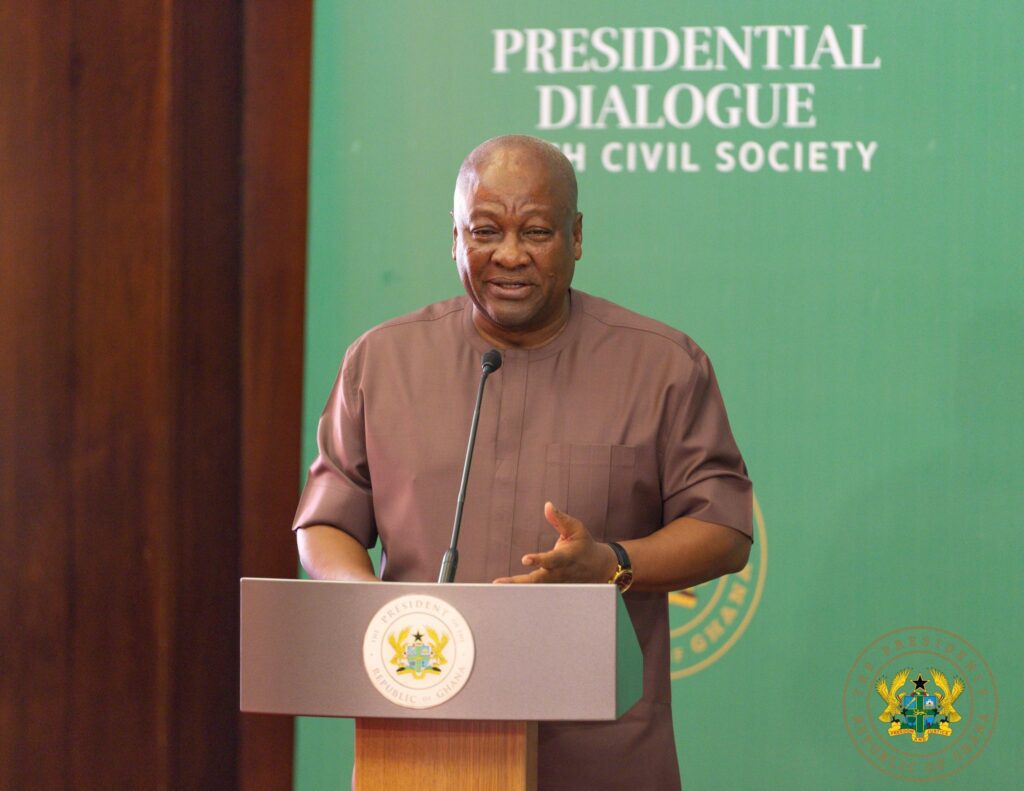
Addressing participants at the forum, President Mahama revealed that his office has formally requested the complete report from The Fourth Estate, whose investigation has sparked public debate. According to him, only a detailed examination of the findings will enable government to take informed and appropriate action.
“Although we have seen snippets of the investigation from the media, I have instructed my office to obtain the full detailed report from the Fourth Estate and to conduct a study of the various allegations presented in the report”
President John Dramani Mahama
In addition to seeking the report, the President has instructed the Ministry of Roads and Highways to submit a comprehensive response addressing the issues raised. This dual approach, combining independent analysis with institutional accountability, is expected to shape the government’s next steps.
Renewed Push for Procurement Reforms
The controversy surrounding the Big Push programme has reignited discussions about procurement practices in Ghana. President Mahama used the platform to outline his administration’s intention to amend the Public Procurement Act, with a specific focus on limiting the use of single sourcing.
He acknowledged that while sole sourcing is permissible under certain conditions, it often raises concerns about value for money and competitive pricing. “Open, transparent tenders are always preferable,” he stated, underscoring the importance of competition in achieving efficiency in public spending.

The proposed amendments aim to tighten the conditions under which sole sourcing can be applied, thereby reducing opportunities for misuse. The President noted that these reforms would be developed in consultation with civil society groups, ensuring that diverse perspectives are incorporated into the legislative process.
A key component of the reform agenda is the establishment of an Independent Value for Money Office. President Mahama disclosed that he has tasked the Ministry of Finance to accelerate the process of setting up the institution.
The proposed office is expected to play a central role in evaluating procurement decisions, particularly those involving single source contracts. Under the new framework, all such procurements will be subjected to rigorous value for money assessments before approval.
This move reflects a broader effort to strengthen oversight mechanisms and ensure that public funds are used efficiently. By introducing an additional layer of scrutiny, the government aims to restore public confidence in procurement processes and reduce the risk of inflated contract costs.
Balancing Legality and Accountability
President Mahama’s remarks highlight the delicate balance between legal compliance and public accountability. While existing laws provide for sole sourcing under specific circumstances, the President made it clear that legality alone is not sufficient justification.

He reiterated his belief that single sourcing should be used sparingly, emphasizing that its overuse can undermine transparency and public trust. The current situation, he suggested, presents an opportunity to reassess existing practices and implement reforms that align with best governance standards.
The engagement with civil society groups also reflects a commitment to participatory governance. By inviting input from non-state actors, the government aims to build consensus around the proposed changes and ensure that they address the concerns of citizens.
The Big Push programme, which focuses on infrastructure development, represents a significant component of the government’s economic strategy. As such, any concerns regarding procurement processes have far reaching implications for public confidence and fiscal management.
President Mahama’s decision to seek a full report and demand accountability from the Roads Ministry underscores the importance of safeguarding public resources. It also signals a proactive approach to addressing allegations before they escalate into broader governance challenges.

As the review process unfolds, attention will be on the government’s ability to translate its commitments into concrete actions. The proposed amendments to procurement laws and the establishment of the Value for Money Office are expected to define the next phase of reforms.
For now, the President’s message is clear: transparency, accountability, and value for money must remain at the core of public procurement. The outcome of this process will likely shape not only the future of the Big Push programme but also the broader framework for managing public resources in Ghana.
READ ALSO: Otto Addo Sacked as Black Stars Coach