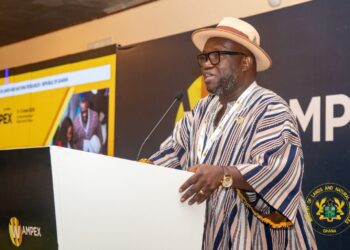
Minerals Development Fund (MDF) has signed a Geological Investigation Services Agreement with the Ghana Geological Survey Authority (GGSA), signalling a major shift in how the government intends to tackle illegal small-scale mining, not just through enforcement, but through inclusion.
The agreement seeks to transition the fight against the “galamsey” menace from a purely interdiction-based strategy to a more structured, science-led framework.
Rather than simply shutting illegal miners out, the government is creating a structured pathway for communities to mine legally, responsibly and profitably.
This evolution in strategy, directed by the Minister of Lands and Natural Resources, Hon. Emmanuel Armah Kofi Buah, aligns with the broader vision of H.E. President John Dramani Mahama to formalize the artisanal sector.
By utilizing geological intelligence, the state aims to replace the chaotic “search-and-dig” method with precise extraction that protects forest reserves and water bodies.
“We are giving communities the tools, data and legal backing to mine responsibly, protect their environment and benefit sustainably from their natural resources.”
Dr. Hanna Louisa Bisiw-Kotei, Administrator of the MDF
A Scientific Pivot in Mineral Governance

The core of this partnership lies in the “blocking-out” of viable mineral zones assigned to the MDF by the Minerals Commission.
Unlike previous attempts at reform, this initiative relies on the GGSA to conduct comprehensive technical investigations before any shovel hits the ground.
These assessments are designed to evaluate both mineral viability and environmental risk, ensuring that licenses are only granted for areas where extraction is sustainable.
According to Dr. Prosper Akaba, the Director-General of the GGSA, this scientific foundation is what separates the current approach from past failures.
He noted that “with proper investigation, we can ensure that mining activities are conducted in areas that minimize environmental risks and maximize economic benefits.”
This data-driven decision-making process is expected to reduce the incidence of abandoned pits and the degradation of fertile farmlands.
Moving Beyond Enforcement to Inclusion

For years, Ghana’s response to illegal mining leaned heavily on the prosecution of miners and the deployment of security interventions like the Blue Water Guards and the National Anti-Illegal Mining Operations Secretariat (NAIMOS).
While these units were vital in preserving water bodies, the MDF-GGSA agreement introduces a social contract that offers a legal alternative to those previously operating outside the law.
The agreement, signed in Accra, falls under a national policy focused on cooperative mining licenses.
By organizing artisanal miners into cooperatives and providing them with geological data, the government is effectively “sanitizing” the sector.
This collaborative model ensures that the economic benefits of Ghana’s mineral wealth are felt at the grassroots level without compromising the ecological integrity of the nation.
Strategic Implementation for Long-Term Sustainability

To ensure the success of this agreement, the GGSA will deploy modern technology to map out the “blocked-out” areas with high precision.
This ensures that miners do not waste resources prospecting in low-yield areas, which often leads to the destruction of vast tracts of land. Instead, targeted mining allows for a smaller environmental footprint and more efficient resource recovery.
Hon. Emmanuel Armah Kofi Buah has emphasized that these innovative solutions are part of a continuous effort to modernize the extractive industry.
By integrating the technical expertise of the GGSA with the community-focused mandate of the MDF, the government is building a resilient framework for artisanal mining.
This strategy not only addresses the immediate threat of galamsey but also secures the livelihoods of thousands of Ghanaians who depend on small-scale mining for their survival.
READ ALSO: UK Discloses Details of Russian Submarine Operation in North Atlantic