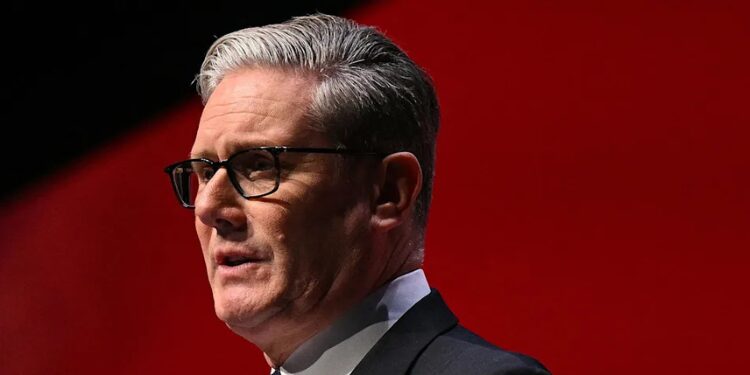
United Kingdom has announced a sweeping ban on social media access for all children under the age of 16, in what Prime Minister, Keir Starmer described as a “big moment for our country” and a decisive step to protect young people from harmful online environments.
The policy, unveiled by the Prime Minister, will prohibit under-16s from accessing major social media platforms including Snapchat, TikTok, Instagram, Facebook, X (formerly Twitter) and YouTube.
The move represents one of the most far-reaching interventions in the digital lives of children anywhere in the world, and is expected to come into force in early 2027 following the passage of new regulations.
According to Keir Starmer, “Today is a big moment for our country. This is a big step, real change for our children and our future.”



“Because today I can announce that the government will ban access to social media for all children under the age of 16.”
Keir Starmer
The Prime Minister indicated that, the decision was driven by growing concern over the impact of social media on children’s mental health, wellbeing and safety.
Speaking as a parent, Starmer noted that the policy reflected widespread anxieties felt across families in the UK about the effects of constant online exposure.
“I come to it as a parent myself. All I’ve ever wanted for my own children, hand on heart, is for them to be happy and for them to be safe but I ask the question now, do we truly believe that social media creates a happy environment for our children?”
Keir Starmer
Keir Starmer also argued that social media platforms were contributing to rising levels of unhappiness among children, enabling bullying and exposing young users to harmful and distressing content.
He added that, algorithms were increasingly designed to maximise engagement rather than safeguard wellbeing, creating an environment where vulnerable children could be disproportionately affected.
“Social media is making children unhappy, it’s making it easier for bullies to harass and abuse them, and it could even be harming their mental health, exposing them to content that is dangerous, because that’s what grabs the attention.”
Keir Starmer
The Prime Minister also framed the policy as a confrontation with major technology companies, which he accused of failing to adequately protect young users.
He noted, “I am not prepared to compromise on the safety and happiness of our children, and that is why this ban must happen, and that is why this ban will happen,” adding that the government would “fight for their happiness and safety against the most powerful companies in the world.”
While acknowledging that enforcement would not be perfect, Starmer defended the principle of the ban, comparing it to existing age restrictions on alcohol and other regulated goods.
“Now, will it mean that no child ever logs on to social media again? No,” he said. “But we don’t say, ‘Oh, look, a teenager managed to get a drink somehow, so let’s not bother banning alcohol sales to children that would be utterly ridiculous.”
Keir Starmer
The government confirmed that the legislation is expected to be introduced before the end of the year, with implementation targeted for spring 2027.
According to the government, they intend to move “at speed” to establish regulatory frameworks and enforcement mechanisms.
Alongside the ban, the government outlined broader restrictions aimed at reshaping how young people interact with digital platforms. These include limits on live-streaming features, tighter controls on stranger contact functions, and stricter safeguards across gaming platforms and other online services where children may be exposed to unsolicited interactions.
Artificial intelligence “romantic companion” chatbots, designed to simulate emotional or sexual relationships, will be restricted to users aged 18 and above. Similar AI-based features will also face age-based limitations under the new framework.
The government highlighted that, it does not intend to include messaging services such as WhatsApp and Signal within the ban, although exemptions will be narrowly defined to allow access to educational tools and music streaming platforms.
Moreover, Technology Secretary Liz Kendall stated the reforms marked a shift in power away from tech companies and back towards families and regulators.
“Tech companies have had countless opportunities to keep children safe, yet they have failed to act. That is why we are taking power away from the tech giants and putting it back in parents’ hands.”
Liz Kendall
She added that the government would strengthen enforcement capacity at Ofcom, which will be tasked with overseeing compliance and conducting rapid assessments of age verification systems.
Social Media Under Fire as Countries Enforce Sweeping Age Bans and Restrictions

The global debate over child access to social media has intensified as governments move toward stricter age-based restrictions, with a growing number of countries introducing bans, regulatory frameworks and parental consent requirements to address online safety concerns.
Australia became the first country to implement an outright ban on social media for users under 16, which took effect in December 2025. The policy covers major platforms including Facebook, Instagram, Snapchat, Threads, TikTok, X, YouTube and Reddit. Under the rules, children under 16 are prohibited from creating new accounts, and existing profiles were deactivated as part of enforcement.
China also maintains one of the most restrictive systems, combining tiered age limits with strict digital controls. Under-18s face heavy screen-time restrictions and anti-addiction measures alongside content filtering designed for minors.
In Vietnam, children under 16 can only access social media accounts registered and supervised by parents, with platforms linked to mandatory government identification. Brazil has introduced Latin America’s first comprehensive children’s online safety law, requiring parental consent, stronger privacy protections, and safeguards against addictive design features.
The United Arab Emirates has also implemented a child digital safety law requiring age verification, parental controls and restrictions on data collection for under-13s, with full compliance expected by January 2027.
In Europe, France has advanced a proposed under-15 ban, while Spain, Greece, Denmark and Portugal are pursuing varying degrees of restriction, from full bans to parental consent frameworks.
READ ALSO: IEA’s Call for Gold Fields’ Lease Denial Would Destroy Local Businesses – Expert