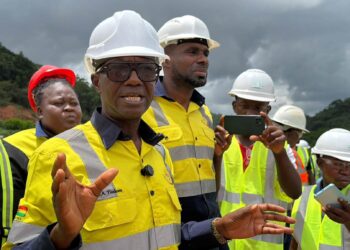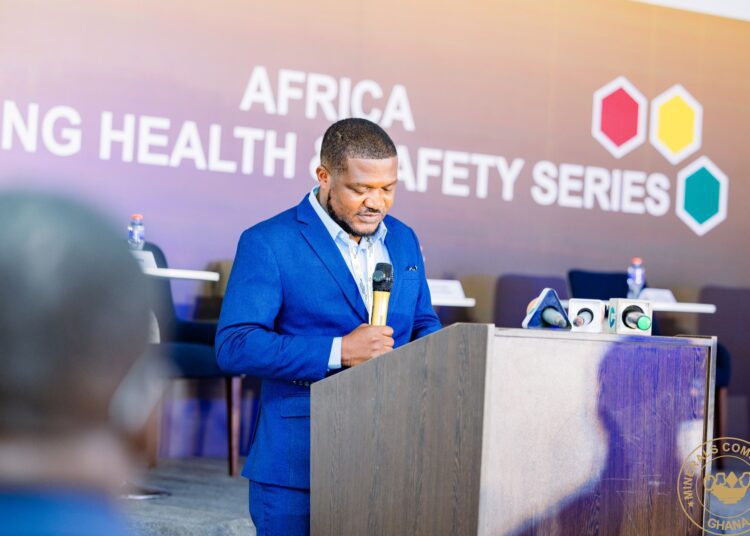
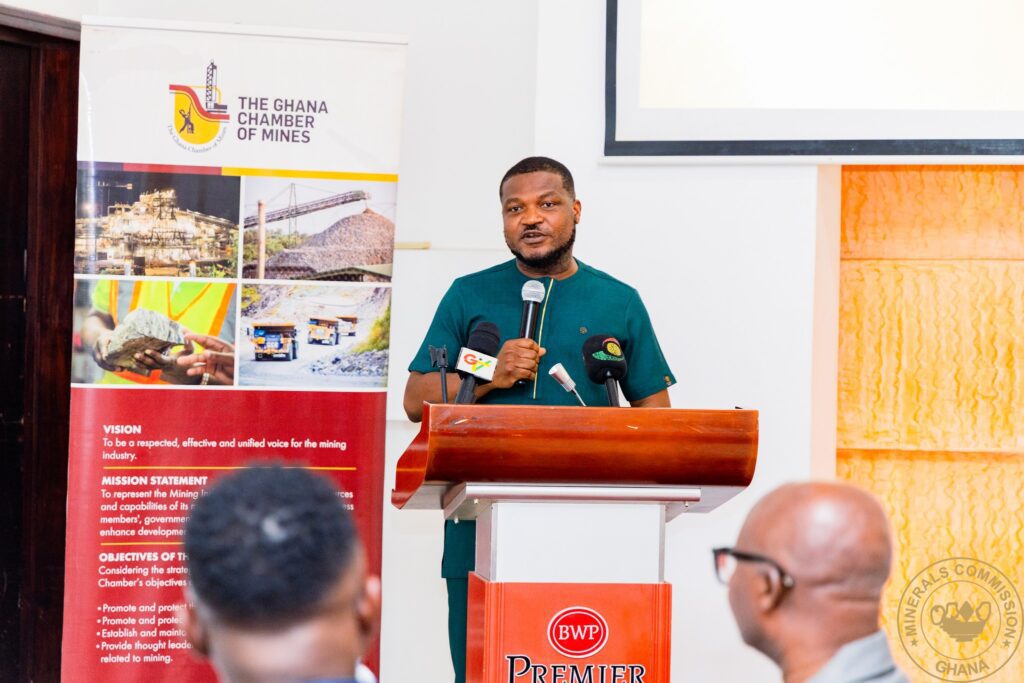
The Chief Executive Officer of the Minerals Commission, Mr. Isaac Andrews Tandoh, has challenged the Inter-Mines Research and Innovation Group (IMRIG) to operate as an independent center of excellence that provides empirical, practical, and objective data-driven insights to help the Ghanaian government navigate emerging industry bottlenecks.
Speaking at a strategic stakeholder gathering, Mr. Tandoh emphasized that the long-term survival and commercial viability of the country’s extractive sector depend heavily on creating sophisticated regulatory frameworks and policy blueprints grounded in world-class, scientific analysis rather than reactionary approaches.
“He challenged the Institute to serve as an independent centre of excellence capable of producing rigorous research, practical policy solutions, and objective analysis to guide Government in addressing emerging issues such as environmental, social and governance (ESG) standards, climate change, licensing transparency, critical minerals development, and responsible resource management.”
Minerals Commission
The Minerals Commission chief executive underscored the state’s unwavering readiness to open its repositories to IMRIG, offering the research body direct access to vital institutional data, joint research collaborations, and active involvement in high-level, multi-stakeholder policy dialogues designed to redefine resource extraction dynamics.
Mr. Tandoh observed that modern mineral governance can no longer ignore the complex interplay between community survival, ecological preservation, and international capital influx.
By positioning itself at the vanguard of policy innovation, IMRIG is expected to pioneer actionable solutions to pressing transactional vulnerabilities within the continent’s supply chain, ensuring that local host communities and state entities secure equitable economic returns.
Navigating the ESG Paradigm and Climate Disruptions
The contemporary global mining landscape has experienced a monumental paradigm shift, where traditional financial metrics are no longer the sole determinants of a project’s viability.
Environmental, Social, and Governance (ESG) standards have evolved from corporate public relations buzzwords into stringent gatekeeping metrics utilized by global institutional financiers, sovereign wealth funds, and multilateral development banks.
For a premium mining destination like Ghana, tracking, analyzing, and standardizing these ESG indicators requires deep, localized academic inquiry that aligns domestic regulatory oversight with international benchmarking expectations.
Furthermore, the cascading crises precipitated by global climate change demand immediate attention, as mining operations are simultaneously vulnerable to extreme weather disruptions and scrutinized for their localized carbon footprints.
Investigating decarbonization pathways for energy-intensive processing plants, evaluating mine-site water conservation protocols, and establishing green restoration baselines for post-extractive landscapes require specialized scientific inquiry.
Without rigorous, home-grown research tailored to the unique geological and ecological realities of West Africa, state agencies risk imposing generic, poorly aligned policies that could inadvertently stifle investment or accelerate environmental degradation.
Enhancing Transparency, Licensing, and Strategic Mineral Mapping
A primary area where specialized research serves as an existential necessity is in the optimization of licensing protocols and institutional transparency.
Historically, the asymmetric distribution of geological data between international conglomerates and host governments has compromised the state’s bargaining position during concession negotiations.
Independent research institutions play a pivotal role in reviewing global best practices for mineral concessions, suggesting digitized, tamper-proof cadastral frameworks, and designing open-governance metrics that shield the licensing regime from bureaucratic inefficiencies and rent-seeking vulnerabilities.
Simultaneously, the global energy transition has sparked an aggressive international race to secure “critical minerals” including lithium, cobalt, manganese, and graphite which are vital for electric vehicle manufacturing and renewable energy storage systems.
To capitalize on this geopolitical shift, Ghana must pivot away from its traditional reliance on gold, bauxite, and manganese in their raw, unrefined forms.
Comprehensive domestic research is urgently required to map out localized critical mineral reserves, assess the commercial feasibility of downstream value-addition facilities, and formulate protectionist yet market-friendly policies that prevent the exploitative, unrefined exportation of these 21st-century strategic assets.
Bridging Investment and Governance for Sustainable Development
The fundamental metric of success for any mineral-rich nation does not reside in the sheer volume of underground geological anomalies, but rather in the structural integrity of the administrative frameworks governing those deposits.
Mr. Isaac Andrews Tandoh strongly reinforced this position by expressing absolute confidence that IMRIG would successfully transform into a “continental centre for research and policy innovation.”
In doing so, the institution will serve as a structural bridge, seamlessly connecting international capital investment with progressive regulatory governance to foster a balanced ecosystem where investors achieve fair yields while the state retains its ecological and financial sovereignty.

Ultimately, the shift toward highly detailed, evidence-based oversight is what will distinguish sustainable mineral-producing jurisdictions from those plagued by resource mismanagement.
By actively embracing constructive institutional scrutiny and fostering an environment of continuous administrative learning, the Minerals Commission aims to institutionalize accountability across all operational spheres.
The collaborative ecosystem envisioned between state regulators and independent research bodies will safeguard the sovereign wealth of the nation, effectively transforming Ghana’s mineral reserves into a resilient, highly competitive, and globally respected benchmark for African resource governance.
READ ALSO: Sarkodie Gifts Fans Major League Collab with Kweku Smoke