Mr. Isaac Andrews Tandoh, the Chief Executive Officer (CEO) of the Minerals Commission, has reaffirmed the government’s unwavering commitment to strengthening mineral resource governance through evidence-based policy, transparency, and strategic partnerships.
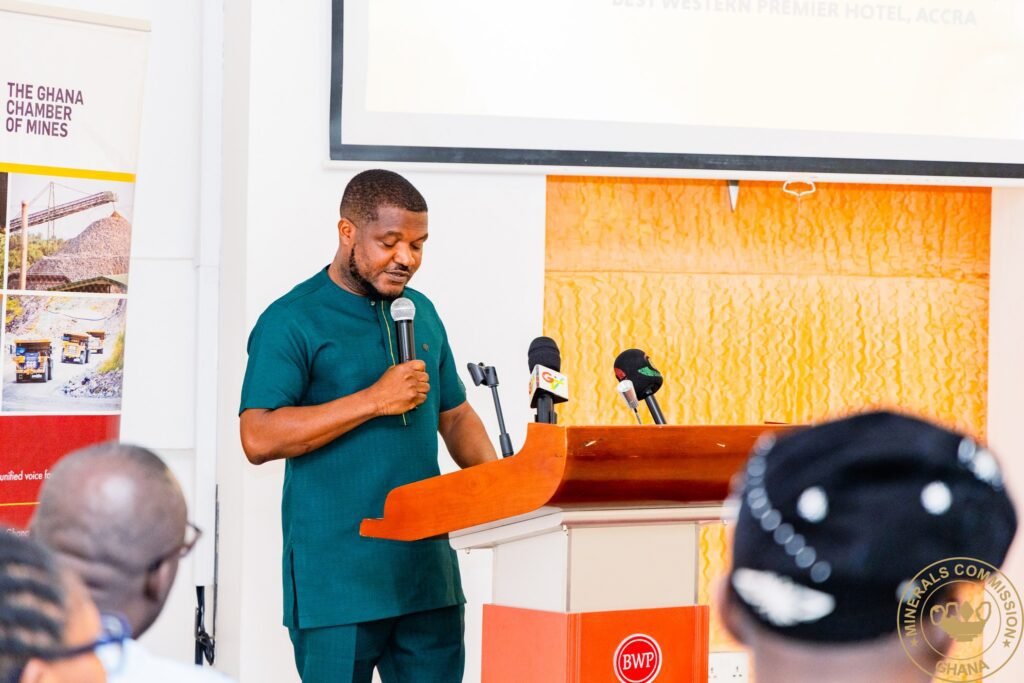
Speaking at the official launch of the Institute for Mineral Resources Investment and Governance (IMRIG) at the University of Mines and Technology (UMaT), Mr. Tandoh described the establishment of the Institute as a defining milestone for Ghana’s extractive sector.
“The CEO highlighted Government’s ongoing reforms, including the review of the Minerals and Mining Act, 2006 (Act 703), the revision of the 2014 Minerals and Mining Policy, the introduction of a progressive Minerals (Royalties) Pricing Schedule Regulation, and efforts to strengthen fiscal and regulatory systems to ensure that Ghana derives maximum value from its mineral wealth. He stressed that these reforms are aimed at enhancing transparency, promoting value addition, strengthening local content, and positioning Ghana to effectively govern emerging strategic and critical minerals for the benefit of present and future generations.”
Minerals Commission

The Minerals Commission boss congratulated the visionary leadership of UMaT for establishing the Institute, noting that IMRIG arrives at a critical juncture when Ghana’s mining sector is dynamically evolving amidst the global energy transition and an escalating demand for critical minerals.
He pointed out that while Ghana remains one of Africa’s premier mining investment destinations, the future sustainability of the extractive sector depends on robust governance frameworks, sound policy formulation, and meaningful multi-stakeholder collaboration among government, academia, industry, civil society, and development partners.
As part of his address, Mr. Tandoh provided a clear outlook on the state’s ongoing policy enhancements to maximize national benefits, stating:
Navigating the Global Energy Transition and Critical Mineral Demands
The establishment of IMRIG comes at a time when the global extractive industry is shifting toward green energy technologies, requiring a steady supply of lithium, manganese, and other critical resources.
In his keynote address, Mr. Tandoh observed that Ghana’s position as an economic hub for mining requires an aggressive and updated regulatory framework to capture value from these emerging strategic minerals. Without proactive frameworks, resource-rich nations risk being left behind in the international value chain.

Therefore, leveraging academic institutions like UMaT helps ensure that upcoming policy choices are backed by thorough scientific data and rigorous analysis.
Structural Reforms and Legal Overhauls for National Wealth Retainment
To protect the country’s sovereign interests, the regulatory authority is implementing extensive structural changes.
The ongoing revision of the foundational Minerals and Mining Act, 2006 (Act 703), alongside the review of the 2014 Minerals and Mining Policy, represents a deliberate push toward maximizing local retention rather than relying solely on raw material export volumes.
Furthermore, the introduction of a progressive Minerals (Royalties) Pricing Schedule Regulation creates an adaptive fiscal regime capable of protecting the state’s economic margins during global commodity price booms while continuing to encourage inflows of foreign direct investment.
Enhancing Transparency, Value Addition, and Local Content Capabilities
Strong resource governance serves as the primary mechanism for preventing economic leakage and securing equitable returns for host communities.
The industry leader argue that transparency and aggressive local content protocols are non-negotiable if Ghana is to avoid the historical pitfalls of resource dependency.

By enforcing value addition such as local refining and processing and ensuring the integration of domestic companies into the mining supply chain, the state can generate sustainable employment and foster industrialization.
Cultivating strong governance through institutional partnerships ensures that the exploitation of natural endowments yields tangible economic transformation for present and future generations.
READ ALSO: Gov’t Targets Cheaper Industrial Power with 1.5GW Renewable Energy Project for 24-Hour Economy