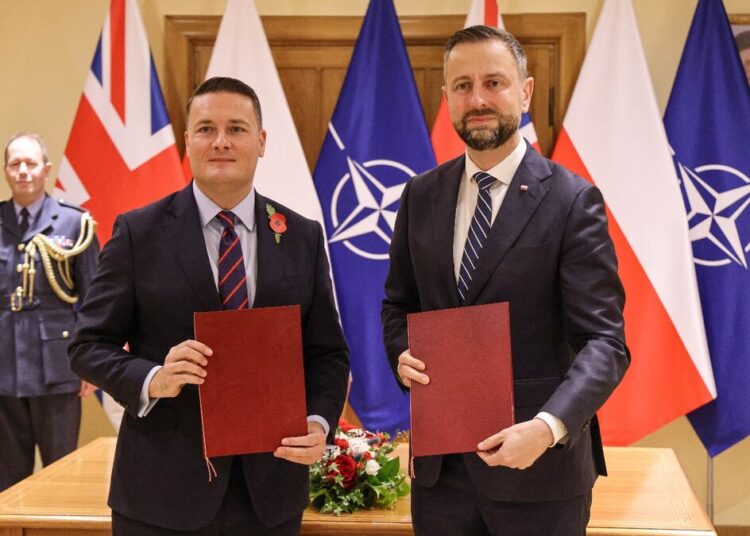
Britian and Poland have agreed to deepen military cooperation under a new defence agreement aimed at deterring Russian threats, strengthening NATO’s eastern flank and improving Europe’s ability to respond to emerging security challenges.
The Warsaw Defence Plan, signed by UK Defence Secretary Wes Streeting and his Polish counterpart, Władysław Kosiniak-Kamysz, in Warsaw, establishes an expanded framework for cooperation across land, sea, air, cyber security and defence industry development.
Wes Streeting described Poland as “one of the UK’s closest allies from flying together in the Battle of Britain, to breaking the Enigma code, they have been a vital partner for our defence for nearly a century.”
“The new Warsaw Defence Plan honours this cooperation and sets out how we will continue to work together today, building a stronger Europe in a stronger NATO.
From collaborating on NATO exercises that deter our adversaries to working together to support Ukraine in its fight for freedom, we are committed to standing together for European security whilst boosting our economies with stronger defence industries.”
Wes Streeting
The agreement comes as European governments face mounting pressure to strengthen military capabilities, protect critical infrastructure and sustain support for Ukraine amid continuing tensions with Russia.
It also marks the first phase of defence cooperation under the UK-Poland Security and Defence Partnership Treaty.
Britain, Poland Expand Defence Industrial and Military Cooperation

Under the plan, Britain and Poland will work together to develop the next generation of air defence missiles, advance drone and counter-drone technologies and improve cyber resilience.
The partnership will also expand cooperation between their defence industries, including ammunition production, military procurement, training and workforce development.
The two countries intend to combine their technological expertise and operational experience to address threats extending beyond conventional warfare. These include drone incursions, electronic warfare, missile threats and hostile activity targeting civilian and military infrastructure.
The agreement also places renewed emphasis on protecting strategic maritime routes in the Baltic Sea, where increased defensive activity and regional coordination will support efforts to safeguard vital lines of communication.
Defence industrial cooperation forms another central element of the agreement, with both governments seeking to strengthen production capacity and improve coordination in the procurement of military equipment. Existing partnerships, including Poland’s procurement of the Narew air defence system from MBDA UK, provide a foundation for further collaboration.
British defence company BAE Systems and Poland’s PGZ will also expand large-calibre ammunition production capacity and capability, while wider cooperation between defence industries will promote education, training and workforce mobility.
The plan further commits both countries to maintaining military readiness through large-scale exercises, including Steadfast Defender, Polish Dragon and Joint Warrior. These exercises are intended to improve coordination between British and Polish forces and prepare them for future operational challenges, including counter-drone warfare, electronic warfare and missile defence.
The agreement also comes as Britain and Poland prepare for a major Coalition of the Willing exercise in Poland next month, involving thousands of personnel. The exercise is intended to ensure the Multinational Force Ukraine is prepared to support military training and the post-war rebuilding Ukraine will require.
Baltic Security and Ukraine Remain Strategic Priorities

Britain and Poland will increase defensive maritime activity in the Baltic Sea through joint exercises and regional coordination, strengthening their capacity to protect important communication routes and respond to security threats.
Their cooperation will also extend to cyber security, with both countries working to improve the resilience of military and civilian sites against hostile activity. Sharing experience from their Type 31 and Miecznik naval programmes will further support the development of their maritime capabilities.
Military exercises, including the planned Coalition of the Willing activity in Poland next month, will complement these efforts by improving operational readiness and coordination among participating forces preparing to support Ukraine.
Ultimately, the agreement places the emphasis on turning political commitments into practical capabilities. Its effectiveness will depend on the successful delivery of advanced weapons, stronger industrial production, improved military coordination, and sustained cooperation in protecting Europe’s eastern flank.
READ ALSO: Kofi Bentil Jabs Gov’t Over Armed Seizures of Northern Ashanti Mine