
Prime Minister, Mark Carney, has reaffirmed Canada’s commitment to space exploration, science, and international collaboration during a live space-to-Earth call with Canadian Space Agency astronaut Jeremy Hansen.
The conversation took place as part of the Artemis II mission, the first crewed test flight in NASA’s ( National Aeronautics and Space Administration) broader Artemis programme, which aims to establish a sustained human presence on the Moon and lay the groundwork for future missions to Mars.
During the call, the Prime Minister emphasized Canada’s contributions to space exploration and acknowledged the role of Canadian expertise, particularly in areas such as robotics and advanced technology systems, in enabling participation in such missions.
He also highlighted the significance of international cooperation, noting the partnership between Canada and the United States in pushing the boundaries of exploration.
“Colonel Hansen has made history as the first Canadian to venture to the Moon – a testament to his exceptional skill, and to the decades of discipline, dedication, and perseverance that brought him to this moment. It is also a testament to Canada and our world-class science, our cutting-edge technology, and our remarkable astronauts. Together with our American partners, we have pushed the boundaries of what was thought possible, opened a bold new frontier in space exploration. Following the Artemis II crew has united us all in wonder, and we wish them a safe return to Earth.”
Mark Carney
The Artemis II mission has already achieved notable milestones during its trajectory. The crew reached a maximum distance of 406,773 kilometres from Earth, surpassing the previous record set during the Apollo 13 mission. At its closest approach, the Orion capsule passed within approximately 6,545 kilometres of the Moon’s surface during a lunar flyby. Over the course of the mission, the crew is expected to travel more than 2 million kilometres during an approximate 10-day journey.
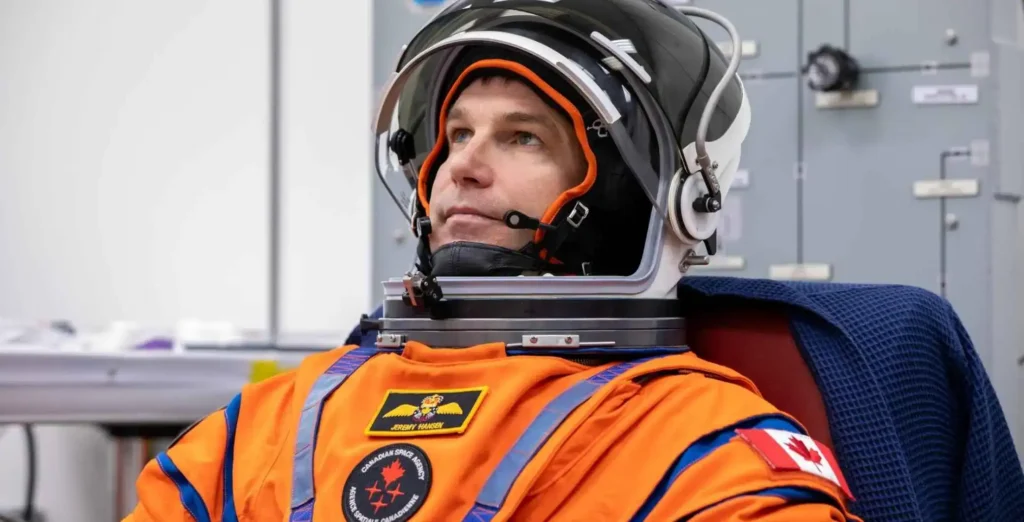
Jeremy Hansen, Canadian Space Agency astronaut also indicated that, “for Canada, this mission started with a bold vision and a deep-rooted faith in Canadian know-how,” adding, “today, we can proudly say that our country is helping write a page of space exploration history.”
Earlier, US President, Donald Trump, praised NASA’s Artemis II astronauts following their historic lunar flyby, describing the mission as a major achievement in space exploration and a moment of national pride.
According to Donald Trump, “this is really is a big stuff.” He added, “there’s nothing like what you’re doing, circling around the moon for the first time in more than a half century and breaking the all-time record for the farthest distance from planet Earth.”
China’s Lunar Ambitions Gain Urgency Amid NASA’s Artemis Success
Meanwhile, China’s effort to achieve a crewed lunar landing by 2030 is drawing increased attention as NASA’s Artemis programme advances.
The success of the Artemis missions, particularly recent milestones involving deep-space human travel, has added momentum to China’s parallel push to establish itself as a leading space power, while also placing greater pressure on Beijing to meet its stated timeline.
The return to the Moon after more than half a century is being closely monitored in China, where authorities are developing a comprehensive lunar exploration system. This system includes the Long March-10 heavy-lift rocket, the Mengzhou crewed spacecraft, and the Lanyue lunar lander, all of which are intended to function together to enable a successful human landing.
China has made notable progress in its space programme in recent years, particularly through its robotic lunar missions. It became the first country to return samples collected from both the near and far sides of the Moon, demonstrating growing technical capability in sample retrieval, communication, and mission control.
Simultaneously, the crewed spaceflight program has developed via long-term missions in Earth orbit, including space station administration and in-orbit emergency response.
However, Clayton Swope, Deputy Director of the Aerospace Security Project at the U.S.-based Center for Strategic and International Studies (CSIS), noted that landing humans on the Moon represents a significant leap in complexity compared to robotic missions.
“There is no bigger prize for China on the table today than landing people on the moon, this is the essential next step for China on the road to pre-eminence in space.”
Clayton Swope
According to China’s Manned Space Agency, the proposed mission would involve two Long March-10 launches: one carrying the crewed spacecraft and the other delivering the lunar lander. The spacecraft would rendezvous and dock in lunar orbit, allowing astronauts to transfer to the lander, descend to the surface, conduct sample collection, and then return to orbit for re-docking before heading back to Earth.
Despite these developments, key components of the mission remain under testing.
READ ALSO : GIP Targets 10 More SMEs Following $20m Investment