

A new March 2026 tracking poll by Global InfoAnalytics has revealed a surprising shift in the National Democratic Congress internal race, with Vice President Jane Naana Opoku-Agyemang emerging as the preferred candidate in the Volta and Oti regions.
The analysis, presented by Mussa Dankwah, indicates that the Vice President has edged ahead of other leading contenders in what is traditionally considered a stronghold of the party.
According to the poll, Vice President Jane Naana Opoku-Agyemang leads with 22 percent support, narrowly ahead of Johnson Asiedu Nketia, who records 21 percent. Dr Cassiel Ato Forson follows with 18 percent, while Haruna Iddrisu polls 14 percent.
Other candidates, including Hon. Samuel Okudzeto Ablakwa, account for 7 percent, with a notable 19 percent of respondents indicating no clear preference. Mussa Dankwah described the outcome as a “twist” in the race, highlighting a shift in voter sentiment within the regional bloc.
Fragmented Support and Voter Uncertainty
The poll points to a fragmented field in the Volta and Oti regions, with no candidate commanding a decisive lead. The narrow margins between the top contenders suggest a competitive contest, with voter preferences still fluid.

The presence of a significant undecided segment further underscores the uncertainty. Nearly one in five respondents have yet to make a choice, indicating that the race remains open and subject to change as candidates intensify their campaigns.
Analysts suggest that the lack of a dominant frontrunner in the region could influence broader party dynamics, particularly as the NDC prepares to select a candidate for the 2028 elections.
Head to Head Contest Shows Tight Race
While Vice President Jane Naana Opoku-Agyemang leads in the broader field, a head-to-head contest between Ato Forson and Asiedu Nketia presents a different picture. In this scenario, the race is virtually tied, with Asiedu Nketia recording 36 percent support compared to 34 percent for Ato Forson.
Mussa Dankwah noted that the difference falls within the poll’s margin of error, indicating no clear advantage for either candidate. This close contest reflects a balance of support between the two leading figures, particularly among key voter groups.
Among New Patriotic Party voters, Asiedu Nketia leads with 30 percent support, while Ato Forson records 15 percent. Within the NDC base, however, the race remains tight, with Asiedu Nketia at 43 percent and Ato Forson at 40 percent.
The pattern is similar among floating voters, where the ruling party’s National Chairman, Johnson Asiedu Nketia, holds a slight edge with 37 percent compared to Ato Forson’s 36 percent.
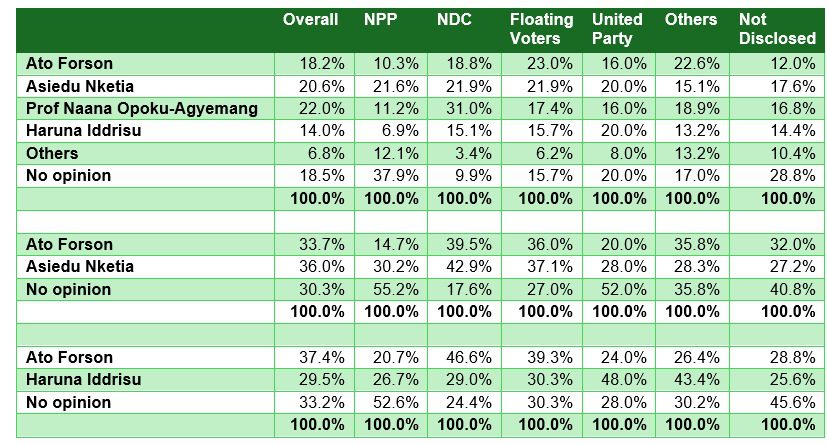
Among supporters of other political parties, Ato Forson leads with 39 percent against Asiedu Nketia’s 28 percent, while among respondents who did not disclose their affiliations, Ato Forson also leads with 32 percent compared to 27 percent.
Signs of Emerging Voting Patterns
The poll highlights what analysts describe as unusual voting behavior in the Volta and Oti regions. Unlike other regions where clear patterns have emerged, the data suggests a more fluid and potentially strategic approach by voters.
Mussa Dankwah indicated that this could point to a form of transactional voting, where preferences may shift based on evolving political considerations rather than fixed loyalties. He noted that the absence of a dominant candidate in the region may be contributing to this dynamic.
“The poll shows signs of unusual behavior,” he explained, suggesting that voters may be weighing their options carefully as the race develops. The emergence of Vice President Jane Naana Opoku-Agyemang as the leading candidate in the region adds a new dimension to the NDC contest.
Her performance in the Volta and Oti regions, combined with competitive showings by other candidates, indicates a highly contested race with no clear frontrunner.
For Ato Forson and Asiedu Nketia, the results highlight both opportunities and challenges. While they remain strong contenders nationally, the close margins in this regional bloc suggest the need for targeted engagement to consolidate support.
The findings also underscore the importance of regional dynamics in shaping the overall outcome of the race. As one of the party’s key support bases, the Volta and Oti regions are expected to play a critical role in determining the eventual nominee.
Outlook Ahead of 2028
As the NDC race continues to unfold, the latest poll provides a snapshot of an evolving political landscape marked by competition and uncertainty. With multiple candidates vying for support and a significant portion of voters still undecided, the contest remains wide open.

Mussa Dankwah emphasized that the dynamics observed in the Volta and Oti regions could influence broader trends within the party. As campaigns intensify and voter engagement increases, shifts in support are likely to continue.
For now, the poll highlights a key development in the race, with Vice President Jane Naana Opoku-Agyemang emerging as a leading figure in a region that remains central to the NDC’s electoral strategy.
READ ALSO: Ghana Advances Bold Financial Inclusion Drive After High-Level Talks