
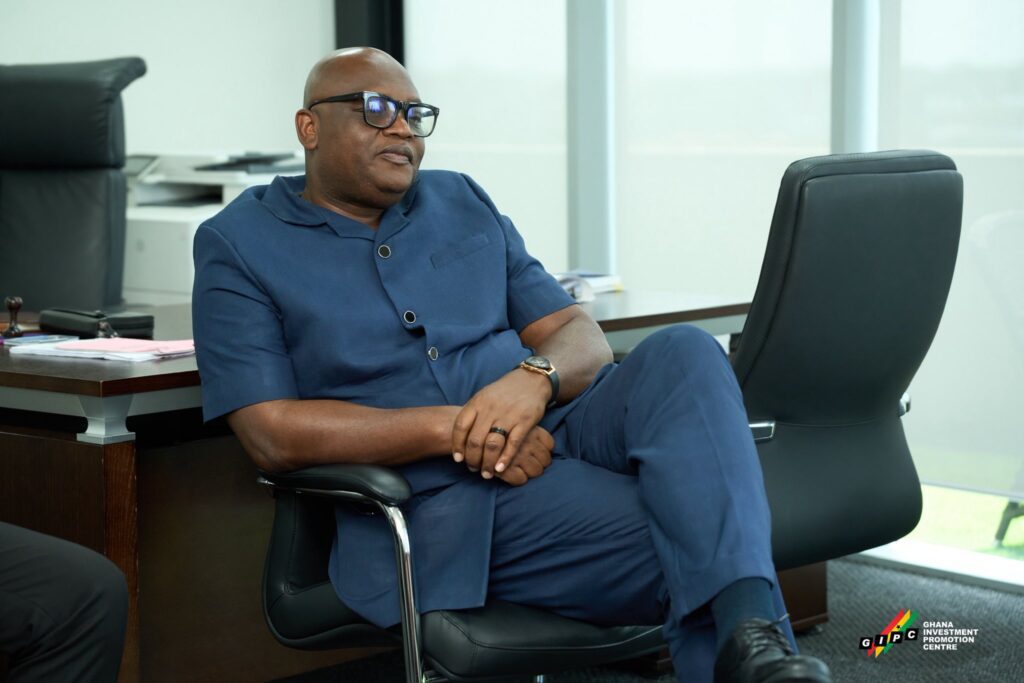
Mr. Simon Madjie, the Chief Executive Officer (CEO) of the Ghana Investment Promotion Centre (GIPC), has presented a sweeping structural and legal overhaul of the country’s investment architecture to global capital allocators at the Ghana-UK Investment Summit in London.
Backed by an executive transition that will see the center formalize into an independent “Authority,” Mr. Madjie’s market pitch moved entirely past traditional bureaucratic updates, focusing instead on dismantling operational bottlenecks and presenting hard financial data.
He noted that Ghana’s aggressive strategy seeks to strengthen long-term strategic partnerships with the United Kingdom, building directly upon a bilateral trade baseline that stood at £1.6 billion in 2025 and a cumulative foreign direct investment tracking well over £6.85 billion since 1994.
“There are about 2.6 million businesses registered in our country. Now, these are formal businesses. But because we are an entrepreneurial country, the average Ghanaian you meet is a businessperson waiting for partnerships with you. And we are looking for partnerships that will propel our economy and deliver value for you”
Mr. Simon Madjie, GIPC CEO
The core thesis driving this international capital drive rests on a long-term demographic divergence between the West African nation and its historical trading partners. Spanning 238,000 square kilometers – positioning it as geographically comparable to the UK’s 244,000 square kilometers – Ghana is preparing for a massive expansion of its domestic market.
While the UK population is projected to scale marginally from 60 million to 70 million by 2050, Ghana’s demographic footprint is on track to surge from 34 million to 50 million consumers.
This imminent 15 million-person market expansion frames the country as the central growth frontier for British firms looking to build an export base capable of tapping into the wider ECOWAS trade zone of 125 million people and the continent-wide African Continental Free Trade Area (AfCFTA).
To accommodate this anticipated influx of international corporate entities, Ghana is fundamentally rewriting its basic investment law. Chief among these statutory shifts is the complete removal of the minimum capital requirement for foreign enterprises, a regulatory floor that previously created significant friction for external capital entry.
This targeted opening is explicitly counterbalanced by the introduction of strict statutory obligations for foreign firms, tying expanded commercial access directly to local enforcement frameworks. Madjie detailed the structural mechanics of the new investment law, outlining how the state has recalibrated the operational framework for incoming corporate entities.
“The President and Minister for Trade have spoken about the removal of the minimum capital requirement. That’s not all. We also have citizenship by investment provisions in our new investment law, so you can invest and, subject to certain rules and regulations, acquire citizenship through that.
“We’ve improved on our investor grievance… But this new investment law also places obligations on investors, an obligation to obey human rights, to protect the environment, and to live by our labor standards as well”
Mr. Simon Madjie, GIPC CEO
Beyond removing capital floors, the revised legal framework aggressively scales operational flexibility by moving automatic investment quotas for foreign employees from four to as many as twelve designated slots.
To protect these inbound capital flows against political risks, the country relies on its active Bilateral Investment Treaty (BIT) with the UK, which guarantees national treatment, most-favored-nation status, and structured subrogation frameworks.
In the rare event of expropriation, the treaty provides a constitutional guarantee of prompt, adequate compensation, paired with a comprehensive Double Taxation Agreement (DTA) to ensure corporate earnings are not taxed twice between jurisdictions.
Digital and Green Frontier Asset Classes
According to Mr. Madjie, this statutory modernization underpins an intentional pivot toward highly regulated, frontier economic sectors, notably fintech, artificial intelligence, and environmental finance.
Ghana has enacted its first digital assets and Virtual Asset Service Providers (VASP) law, establishing an explicit legal framework for blockchain operations, digital payments, and cryptocurrency platforms.
The legislative architecture aims to capture additional corporate investment within an established domestic fintech ecosystem currently valued at nearly $50 billion, driven by 26 million active electronic money customers and close to one million registered mobile money agents.
Simultaneously, Ghana is leveraging its status as a pioneer in continental carbon markets, operating an active carbon registry and executing verified protocols under Article 6 of the Paris Climate Agreement. This specialized environmental framework possesses the direct potential to secure up to $1.1 billion in international climate financing by 2030.
It aligns closely with a comprehensive national energy transition plan targeted for 2070, which seeks to trigger $562 billion in cumulative investments and create 1.4 million green jobs across solar, wind, hydro, and lithium processing value chains.
Part of this clean energy rollout includes setting up 1,000 electric vehicle charging stations by 2028, preparing the market for deep EV penetration by 2045 following recent trade missions to China to encourage direct manufacturing and assembly.
In a parallel push to capture high-value, niche global supply chains, the GIPC boss highlighted the newly structured legislative landscape governing regulated medical cannabis and industrial hemp processing. Mr. Madjie addressed the commercial realities of this newly unlocked export-driven framework, assuring institutional investors of the country’s fertile capacity.
“It’s an $82 billion economy, and Ghana has fertile lands for it. We are not saying it’s for domestic consumption. It’s for medical uses. As well as industrial and value addition opportunities, in agro-processing, pharmaceuticals, the automotive, textiles, garments, machinery, engineering, and food processing”
Mr. Simon Madjie, GIPC CEO
This legal and economic remodeling is systematically tied to a nationwide industrial policy that redirects state resources toward secondary asset processing.
Under the current “New Economy” agenda backed by the President and the Ministry of Finance, 1% of national GDP is explicitly allocated to fund commercial farming, critical mineral processing, and domestic manufacturing.
A primary industrial directive mandates that 50% of all locally cultivated cocoa beans must be processed onshore, ensuring that finished exports cleanly satisfy strict rules-of-origin criteria under the AfCFTA to unlock zero-tariff market access across Africa.
This value-addition model similarly targets the $640 million domestic shea butter industry, alongside a rising pharmaceutical sector that already comprises 38 manufacturing companies exporting to 12 countries.
Mr. Madjie reiterated that Ghana is actively seeking external capital to scale up active pharmaceutical ingredients (APIs), consumables, and commercialized herbal preparations within this $600 million market.
To support these continuous production lines, the state is putting forward deep-dive financial models for several high-ticket infrastructure assets requiring robust international syndication.
Foremost among these projects is a massive $60 billion downstream petroleum hub project spanning 20,000 acres of dedicated land, designed to house manufacturing plants, refining facilities, and specialized shipping jetties for sub-regional export.
Furthermore, while the total expansion and upgrading of the national transport infrastructure requires an estimated $272 billion, the state has initiated an immediate $10 billion “big push” road allocation over the next five years.
These large-scale logistics developments are supplemented by localized clean energy infrastructure, including a 200-megawatt solar power generation project currently backed by the Ghana Infrastructure Fund with a $150 million ticket.
By matching sovereign structural adjustments with clear, bankable assets, the state is signaling to corporate treasuries that its investment framework has shifted from abstract policy promises to concrete, secure capital deployment.
READ ALSO: Reject Gold Fields Lease Renewal, Sack All South Africans – Group Demands