The Ministry of Trade, Agribusiness and Industry (MoTAI) has launched an intensive bilateral drive to mobilize American private capital, formalizing a major shift from traditional diplomatic engagement to hard-target commercial execution.
At the opening of the U.S.-Ghana Chamber of Commerce Trade and Investment Mission in Accra, senior state officials and business executives from both nations established a targeted framework to deepen transatlantic economic cooperation and channel foreign direct investment into foundational sectors of the domestic economy.
The high-level convergence was a direct, structural continuation of the executive diplomacy initiated during President John Dramani Mahama’s recent state visit to Philadelphia, Pennsylvania, where preliminary agreements were brokered to transition longstanding bilateral alignment into binding industrial partnerships.
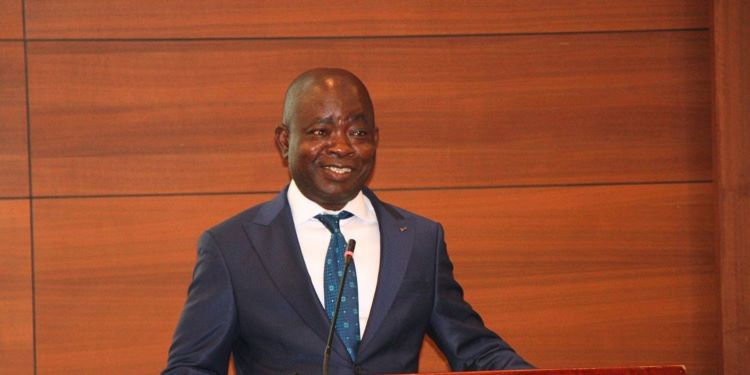
“Addressing the international delegation on behalf of President Mahama, the Deputy Minister for Trade, Agribusiness and Industry, Hon. Sampson Ahi, detailed the administration’s strategic intent to reshape Ghana’s market architecture.
“Opening the proceedings, the Deputy Minister framed the trade mission as a critical legislative and administrative milestone, configuring a long-standing political alliance into an operational asset capable of accelerating national GDP growth, expanding industrial output, and generating structural employment opportunities”
Ministry of Trade, Agribusiness and Industry
The framework of this trade mission focused on specific capital deployment across ten distinct economic verticals, as Ghana has prioritized agriculture, agribusiness processing lines, heavy and light manufacturing, cross-border logistics, financial technology, tourism infrastructure, renewable energy systems, physical infrastructure development, mining extraction, and digital innovation ecosystems.
Rather than pursuing speculative portfolio investments, MoTAI leveraged the country’s institutional stability to attract fixed asset investments capable of establishing long-term manufacturing operations.
“This Trade Mission is the living expression of a commitment made at the highest levels of leadership.It is a belief that together, we can build enterprises, expand markets, create jobs and produce shared prosperity”
Hon. Sampson Ahi, Deputy Minister for Trade, Agribusiness and Industry

To insulate external capital from systemic shocks, the Ministry’s investment thesis relied heavily on the country’s established governance profile, as presentation logs emphasized that Ghana remains a highly competitive investment destination within the sub-region due to its “unbroken democratic stability, a transparently structured, investor-friendly regulatory environment, and an independent legal framework” engineered to protect private enterprise.
Anchoring the trade mission within these pre-existing legal protections, de-risked market entry for mid-tier and institutional American corporate treasuries looking to establish permanent footprints on the continent. A central pillar of Ghana’s economic pitch to the American delegation was the formal introduction of the 24-Hour Economy Programme as an operational multiplier.
Meant to alter industrial capacity utilization, the policy encourages multi-shift corporate operations to optimize existing capital assets, maximize manufacturing lines, and absorb underutilized labor pools.
For foreign manufacturing and logistics firms evaluating entry into Accra, this structural initiative provides a state-backed framework to accelerate production cycles and clear administrative bottlenecks that traditionally limit industrial efficiency within regional trade hubs.
Furthermore, MoTAI positioned the domestic market not merely as a localized consumption base, but as the geographic pivot for continental trade distribution, highlighting that by hosting the permanent Secretariat of the African Continental Free Trade Area (AfCFTA), Ghana offers incoming American enterprises direct, preferential tariff access to a single continental market encompassing more than 1.4 billion people.
This integration radically alters the scaling dynamics for external capital, turning localized production facilities inside the country into duty-free export platforms optimized for pan-African distribution. “A U.S. business that invests in Ghana is not investing in Ghana alone; it is investing in Africa,” Hon. Ahi stated.
Commitments and Institutional Alignment
This push for economic transformation was reinforced by a clear commitment to diplomatic philosophy.
Speaking at the summit, Ghana’s Ambassador and Special Envoy to the United States, Ambassador Victor Emmanuel Smith, delivered a precise critique of past engagement models, urging both state and private actors to move completely past legacy political dialogues.
The Ambassador emphasized that the contemporary alliance must be validated by the creation of strategic business partnerships that yield highly measurable, microeconomic returns. The focus must be on building strategic businesses that “create employment opportunities and empower young people to participate meaningfully in national development,” Ambassador Smith noted.
The focus was specifically targeted at securing joint-venture structures capable of absorbing skilled technical labor within high-growth fields like fintech, digital innovation, and precision manufacturing, to directly translate external capital injections into the preservation of local wealth and the systematic expansion of domestic industrial capacity.
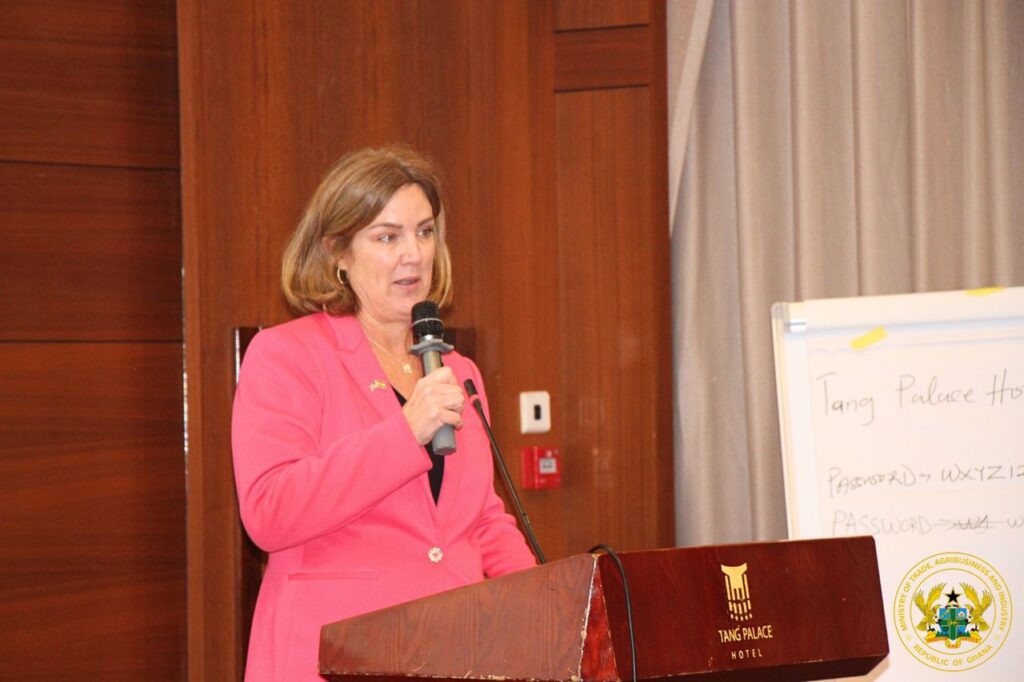
Responding to the state’s economic briefing, the leader of the United States delegation, Karen Fegely, confirmed the American commitment to transforming historical ties into sustainable commercial outcomes, noting that the current trade mission serves as a functional B2B and B2G platform, allowing corporate decision-makers to audit local conditions, form equity partnerships, and formalize long-term joint ventures.
Fegely expressed high confidence that the scheduled sessions would lead to immediate corporate asset allocation, providing reciprocal economic growth for both American enterprises and Ghanaian production networks.
“The trade mission provides an important platform for businesses from both countries to establish partnerships, explore investment opportunities and strengthen commercial relations,” Ms. Fegely noted, reiterating the commitment of the American delegation to building sustainable business relationships that capitalize on the strong historical ties between Ghana and the United States.
The scale of the summit was underscored by the broad coalition of institutional and private sector bodies managing the match-making pipelines. The mission featured active, direct representation from the U.S.–Ghana Chamber of Commerce, the World Trade Centre, the U.S. Commercial Service, and the Commerce Department of Philadelphia on the American side.
These entities are matched on the ground by key domestic private-sector associations, including the Ghana National Chamber of Commerce and Industry (GNCCI), the Federation of Associations of Ghanaian Exporters (FAGE), and the Association of Ghana Industries (AGI).
To ensure the summit moves entirely past abstract diplomatic rhetoric, the Ministry of Trade, Agribusiness and Industry established a strict evaluation framework to track the progress of the mission. The Deputy Minister explicitly warned against treating the event as a symbolic exercise, declaring that the absolute success of the bilateral engagement will be measured exclusively by tangible, auditable outcomes.

Ghana’s performance metrics are tied directly to hard deliverables: verified investment commitments, legally binding export agreements, fully structured corporate joint ventures, formalized technology transfer partnerships, and signed Memoranda of Understanding (MoUs) ready for immediate execution in the current fiscal year.
READ ALSO: Majority Chief Whip: President Ready To Sign Bill