The recovery of Afghanistan’s labour market has been accompanied by a deepening exclusion of women from economic activity, with female participation facing mounting restrictions under Taliban rule, according to a new assessment by the International Labour Organization (ILO).
The most recent ILO brief presents a very uneven picture of Afghanistan’s employment situation, demonstrating that while the country’s total employment has grown significantly since 2022, the recovery has been centred nearly entirely among men.
It is anticipated that overall employment increased by 14% from its low in 2022 to about 8.5 million workers in 2026. The employment-to-population ratio is currently projected to be 32.5% because the growth has not kept up with Afghanistan’s expanding population.
Despite the apparent rise in employment, that number is still more than four percentage points below the 2020 objective, highlighting the labour market’s ongoing weakness.
The growing gap between men and women, however, is the most notable aspect of the most recent data.
Female employment has drastically decreased, whereas male employment is predicted to be about 22% higher in 2026 than it was in 2020. The percentage of women working plummeted precipitously in 2022 to less than one-third of its 2020 level after a slight decline in 2021. Since then, there has only been a slight rebound.
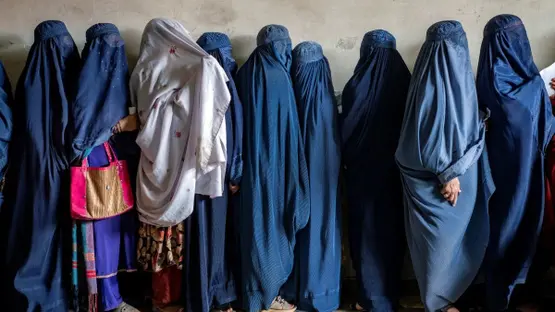
Afghanistan is among the nations with the lowest rates of women’s participation in economic activity worldwide, according to the most recent ILO modelled estimates, which peg female labour force participation at just 5.1%.
The ILO estimates that Afghanistan has the second-lowest female labour force participation rate globally.
The figures provide a stark indication of how the country’s economic structure has changed since the Taliban takeover in August 2021. While the labour market has gradually regained some of the jobs lost during the period of severe economic disruption, women have largely been left outside that recovery.
Tite Habiyakare, Senior Coordinator and Head of the ILO Office for Afghanistan, “Afghanistan cannot build a resilient labour market while such a large share of its population remains excluded from economic activity.”
“Expanding women’s access to productive employment, while creating opportunities for returnees, young people and other vulnerable workers, is essential for strengthening livelihoods and supporting more inclusive economic development.”
Tite Habiyakare
The ILO’s evaluation coincides with the fact that Afghanistan is under more strain due to the widespread repatriation of its residents from bordering nations.
Thousands of Afghans returning from Iran and Pakistan are moving into areas where there are already few job options and where people are dealing with underemployment and poverty. As a result, there is more competition for jobs, income, and livelihood prospects due to the inflow of returnees.
Finding long-term work will be one of the most pressing issues for many returnees after they arrive. The communities that receive them are already struggling with a lack of economic opportunities, mounting demand on essential services, and precarious household incomes.
The ILO cautioned that in the absence of fruitful reintegration possibilities, returnees would experience increased economic instability and put more strain on regional labour markets.
Afghan workers face additional risks as a result of the current Middle East crisis, including increased energy costs and wider inflationary pressures.
Over 70% of Afghan workers are involved in jobs that are deemed to expose them to these influences at least moderately. Therefore, a large portion of the workforce may be impacted by rising costs, especially households who already have tight budgets.
ILO Demands Jobs-Centred Recovery Amid Growing Economic Strain
In light of this, the ILO is advising decision-makers and development partners to prioritise productive employment in Afghanistan’s economic response.
According to the organization, more assistance is required for the growth of the private sector, labour-intensive industries, and micro, small, and medium-sized businesses, which continue to be significant sources of employment and revenue for Afghan households.
In addition to boosting companies that confront challenging operational conditions, such actions could assist offer more chances for workers to enter the employment market.
The ILO is also advocating for measures that will facilitate the successful reintegration of Afghans who have returned from Iran and Pakistan. The organization contends that focused job and livelihood programs could assist returnees in regaining their economic independence rather than letting a huge number of people enter already crowded labour markets without assistance.
The challenge is particularly significant for young people, who face the prospect of entering adulthood in an economy where employment opportunities remain limited and where skills do not always translate into secure livelihoods.
The ILO is therefore calling for expanded access to productive employment opportunities across all segments of the population, including vulnerable workers who face structural barriers to entering the labour market.
Moreover, ILO argues that expanding women’s access to productive employment is essential to building a more resilient and inclusive economy.
The organisation has also called for stronger protection for vulnerable households as rising living costs put additional pressure on incomes. Inflation and higher energy costs can have particularly severe consequences for low-income families, whose budgets are already dominated by essential goods and services.
READ ALSO: Ablakwa Secures Visa Waiver, Doubled Scholarships, and Defence Ratification in Russia