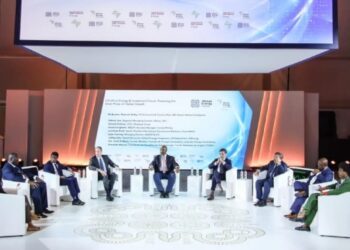
Bright Simons, a renowned policy analyst and Vice President of IMANI Africa, has called for an urgent re-examination of the widely circulated statistical narrative asserting that Africa holds 30 percent of the world’s mineral reserves.
Delivering an address in Kigali under the auspices of the Africa School of Governance, the public policy advocate targeted what he characterized as a “crooked” and “fiendish” metric that distorts the actual economic realities of the continent.
He emphasized that dismantlement of this persistent claim is essential to establishing a grounded paradigm for resource governance and economic development across African nations.
“Many of the investors that sell Africa use natural resources to get attention. African leaders find that it is a quick way to say that ‘we matter’. Activists need it as a premise for bigger arguments about how everyone is sucking Africa dry.”
Bright Simons, a renowned policy analyst and Vice President of IMANI Africa,

The policy analyst noted that the 30 percent global mineral share figure remains exceptionally resilient because diverse political and economic actors find convenience in preserving it.
Foreign investors frequently utilize the natural resource narrative as marketing leverage to secure capital and draw global attention to emerging markets across the continent.
Simultaneously, African political leaders leverage the figure as an expedited effort to assert geopolitical relevance on the international stage, while civil society activists utilize the data point as a foundational premise to argue that external powers are systematically depleting the continent’s wealth.
The Mirage Of Statistical Abundance
Simons argued that maintaining unverified wealth metrics creates a counterproductive narrative cycle that ultimately undermines domestic policy formulation.
Detractors of the continent frequently weaponize the same dataset to construct reductionist arguments regarding regional governance standards and economic management. By framing Africa as the world’s richest continent in subsoil resources yet paradoxically home to severe poverty, critics reinforce tropes of systemic inefficiency and economic mismanagement.

The persistent repetition of unrefined resource claims obscures crucial economic variables required for actual industrial extraction, such as proven reserve valuations, extraction costs, and processing infrastructure.
Bright Simons pointed out that treating broad geological potential as realized wealth distracts policymakers from the essential work of capital formation and local value addition. Consequently, reliance on inflated metrics leaves governments vulnerable to poor concession negotiations and unrealistic fiscal projections.
Dismantling The Resource Curse Narrative
The policy analyst further highlighted that the “richest continent yet poorest people” paradox serves no constructive purpose in sovereign policy planning.
Rather than serving as an asset for diplomatic bargaining, reliance on flawed statistical foundations provides a convenient shield for both external exploitation and domestic policy failures.
By framing economic potential around static mineral percentages, African nations risk overestimating their leverage in global commodity supply chains.

Bright Simons maintained that establishing accurate, data-driven assessments of actual extractable assets must replace emotional and promotional rhetoric.
Grounding extractive sector governance in empirical precision enables governments to formulate realistic industrial strategies, secure fair fiscal regimes, and foster transparent accountability structures. Moving past misleading metrics, he argued, is a necessary prerequisite for building sustainable economic systems across the extractive landscape.
Strategic Imperatives For Extractive Governance
To break free from the narrative trap of overstated resource dominance, African governments must prioritize rigorous geological mapping and transparent reserve reporting.
Relying on vague international estimates hinders effective sovereign planning and leads to misallocated investments in non-viable mining corridors.
Establishing independent, nationally controlled geological surveys will provide the precise data required to negotiate equitable contracts with foreign multinational entities.
Ultimately, economic transformation in Africa’s mining sector hinges on shifting focus from raw underground deposits to domestic processing capabilities and value-chain integration.
Unlocking real extractive value requires strong institutional frameworks, infrastructure development, and fiscal discipline rather than passive reliance on geological endowments.
As policy experts push to retire flawed statistical benchmarks, African states must anchor their economic strategies in technical accuracy, institutional efficiency, and industrial execution.
READ ALSO: MMFL to Blend Music, Culture and Digital Finance to Push ‘Do More with MoMo’ Agenda