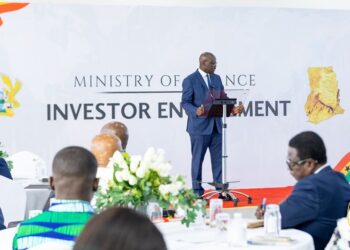
President John Dramani Mahama has inaugurated Ghana’s five-member Independent Fiscal Council, turning a fiscal reform that existed largely on paper into an operational institution charged with independently assessing government policy, compliance with fiscal rules, and the sustainability of the public finances. The Council, established under the Public Financial Management (Amendment) Act, 2025, begins work at a sensitive point in Ghana’s recovery, when lower inflation and stronger growth coexist with renewed questions about domestic borrowing and the durability of fiscal consolidation.
Its arrival matters because Ghana’s fiscal framework now rests on two hard numerical anchors. Government is required to maintain an annual primary surplus of at least 1.5 percent of GDP on a commitment basis and to reduce the public debt-to-GDP ratio to 45 percent or lower by 2034. These rules are intended to prevent a return to arrears, excessive deficits, and debt dynamics that helped push the country into restructuring.
The challenge is that rules acquire economic value only when they are monitored credibly and breaches carry consequences. Ghana’s recent rise in domestic borrowing has renewed debate about fiscal space, refinancing exposure and the future cost of financing government. The Fiscal Council therefore enters when independent scrutiny can help distinguish genuine fiscal improvement from temporary gains created by favourable growth, delayed spending, or short-term financing conditions.
Fiscal Rules Now Have an Independent Referee
The Council is not a second Ministry of Finance and it does not possess a veto over the budget. Its influence will come from independent assessment, public reporting and the reputational cost government may face when fiscal decisions depart from the rules without convincing justification.
That distinction is important. Fiscal policy remains the responsibility of elected government, but independent surveillance can reduce the information gap between the executive, Parliament, investors and citizens. When forecasts, borrowing plans or expenditure assumptions are challenged by a statutory body with access to relevant public information, optimistic budgeting becomes harder to sustain without explanation.
The law also requires the Council to publish a first-half assessment of compliance with the fiscal responsibility rules no later than September each year, and an annual assessment no later than April. That obligation places an early test on how quickly the newly inaugurated body can move from ceremony to substantive analysis.
Debt Anchor Faces a More Demanding Test
The 45 percent debt anchor will be watched particularly closely. Ghana’s total public debt stood at about GH¢719.5 billion, or 45.0 percent of GDP, in June 2026, while domestic debt had risen by roughly GH¢57.3 billion from end-2025 to GH¢391.1 billion.
A debt ratio around the statutory anchor does not by itself imply renewed distress. Government also reported a 0.9 percent primary surplus on a commitment basis by end-June, against the 1.5 percent full-year target. Neither figure alone settles compliance: the annual rule must be judged over the full year, while debt sustainability also depends on growth, borrowing costs and maturity.
The Council’s credibility will therefore depend on whether it looks beyond a single headline ratio. Debt maturity, interest costs, contingent liabilities, arrears and the quality of projects financed through borrowing all shape sustainability.

Fiscal Discipline Must Protect Productive Spending
Independent fiscal oversight should also guard against mechanical compliance. A government can improve a deficit by controlling waste and interest costs, but it can also achieve a better headline balance by delaying capital expenditure important for roads, energy, water or other productivity-enhancing infrastructure.
That is why Ghana’s current budget reforms increasingly emphasise commitment controls rather than targets alone. The stronger standard is not merely whether the primary surplus reaches 1.5 percent, but whether that adjustment is achieved without rebuilding arrears, hiding obligations outside the budget or weakening productive investment needed for long-run growth.
A credible Fiscal Council should therefore assess the quality as well as the quantity of adjustment. That would make fiscal rules more compatible with development rather than turning them into an accounting exercise detached from economic outcomes.
Credibility Will Be Earned Through Independence
For households and firms, the Fiscal Council may appear distant from everyday economic life, but fiscal credibility affects borrowing costs, taxes, inflation risks and the resources available for public services. Persistent fiscal slippages can eventually raise sovereign risk, absorb domestic savings and increase pressure on monetary policy.
The Council cannot guarantee lower interest rates or stronger growth. Its contribution is more indirect: credible independent scrutiny can improve expectations, expose policy inconsistencies early and make corrective action more likely before fiscal problems become crises.
President Mahama has pledged to respect the Council’s independence. The stronger test will come when its assessments are uncomfortable for government. If the body can publish evidence-based evaluations without political interference, Ghana will have added an important institutional safeguard to its post-restructuring framework. If it becomes ceremonial, the numerical rules may remain impressive on paper while fiscal risks rebuild underneath them.
READ ALSO: Harvard-Trained Dr Aziz-Bamba Heads Ghana’s Value for Money Office