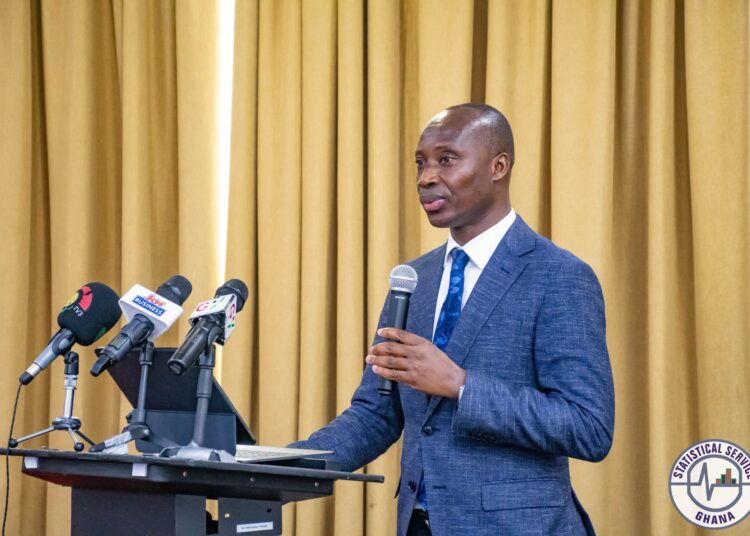
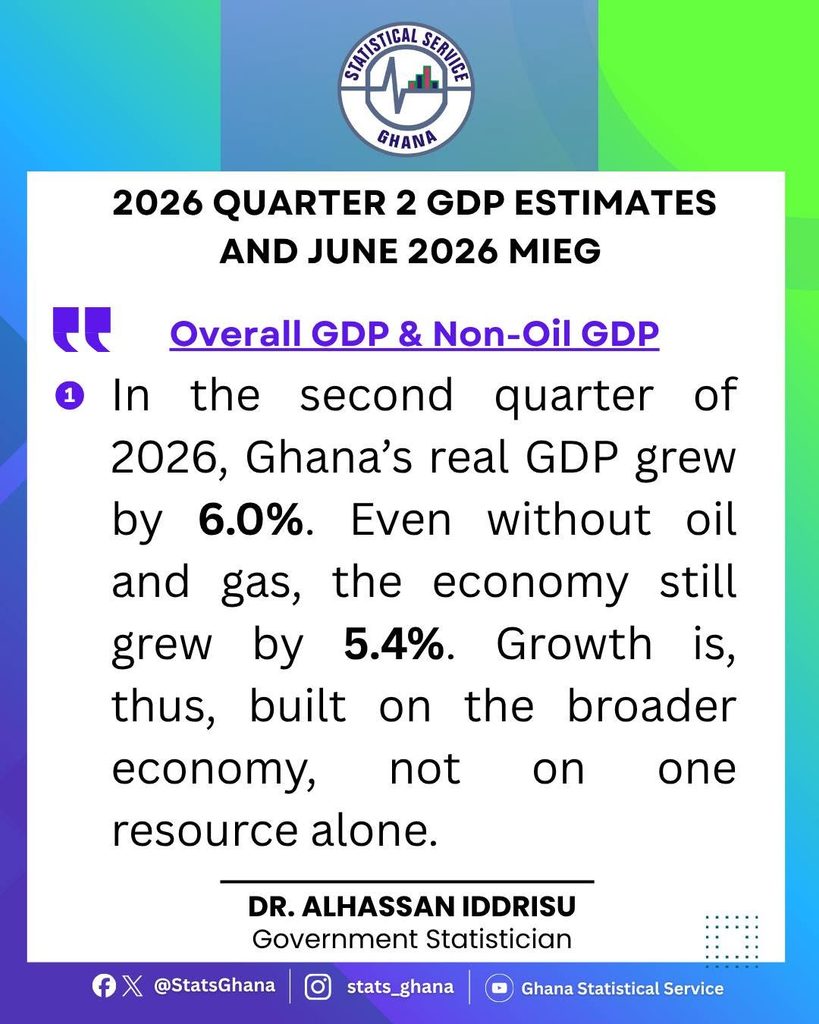
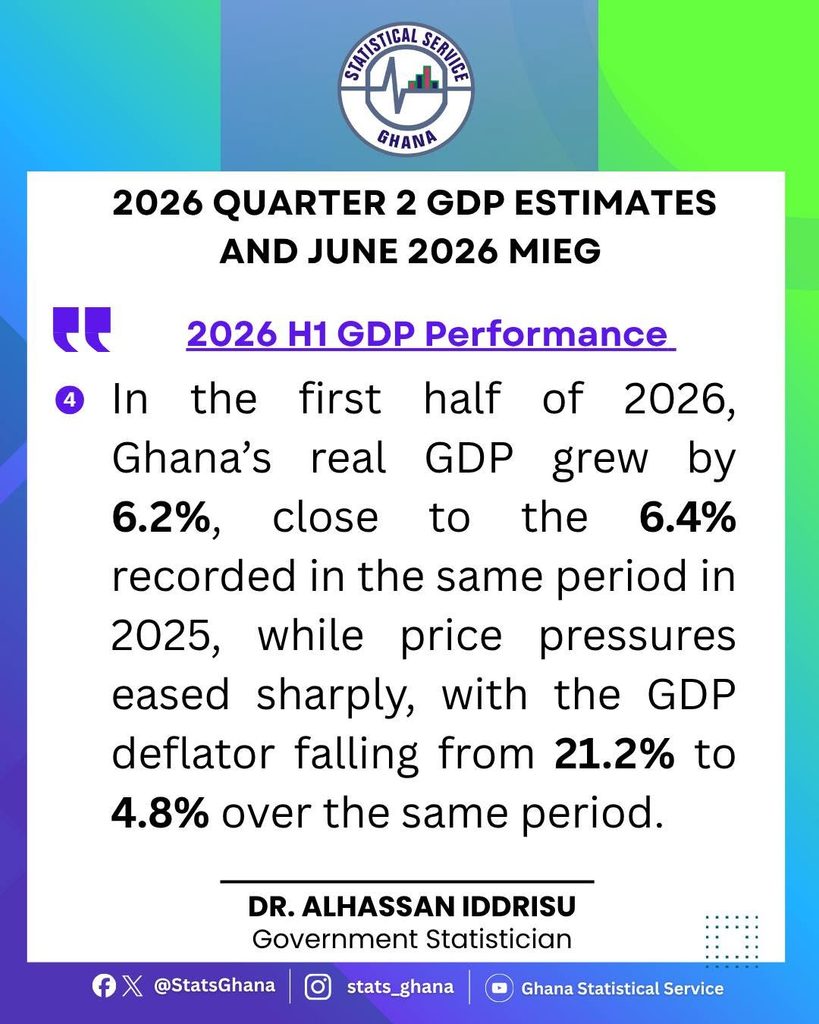
Ghana’s economy expanded by 6.0 percent year on year in the second quarter of 2026, extending the strong momentum recorded at the start of the year. The latest Ghana Statistical Service release puts real GDP growth at 6.2 percent for the first half of 2026, close to the 6.4 percent recorded over the same period in 2025, while non-oil GDP grew by 5.4 percent in the second quarter.
The composition of that expansion is the bigger economic story. Information and communication technology grew by 30.9 percent and accounted for 41.5 percent of total real GDP growth in the quarter. Government Statistician Dr Alhassan Iddrisu summarised the scale of the contribution: “Information and Communication Technology alone delivered 4 in every GHS10 of that growth.” The result puts Ghana’s digital economy at the centre of the latest growth cycle.
Price conditions also improved sharply. The GDP deflator, which measures price changes across domestically produced goods and services, fell to 5.5 percent in the second quarter from 18.6 percent a year earlier. For the first half, the deflator dropped from 21.2 percent to 4.8 percent. Unlike consumer inflation, the deflator covers the economy’s output more broadly, but the direction still points to growth occurring alongside substantially calmer price pressures.
ICT Drives a Services-Led Expansion
Services grew by 8.0 percent in the second quarter and contributed 57.6 percent of overall growth, while accounting for 45.9 percent of GDP. ICT was the standout activity, but transport and other market services also supported the sector. Dr Iddrisu said the digital performance was not a temporary spike, noting that the sector has maintained double-digit quarterly growth for three years.
The macroeconomic implication goes beyond telecommunications. Connectivity, digital payments, cloud services and technology-enabled business processes increasingly raise efficiency across retail, finance, logistics and public services. That makes digital infrastructure a form of productive capital, particularly if its rapid expansion lowers business costs and allows firms outside the technology sector to produce more efficiently.
That concentration also raises a resilience question. When one sub-sector supplies such a large share of quarterly growth, the headline rate becomes more sensitive to any slowdown in that activity. Ghana therefore needs the current digital surge to diffuse into other sectors through cheaper connectivity, better logistics, data-driven production and stronger links between technology firms and traditional businesses. The more broadly those productivity gains spread, the more durable and employment-rich the expansion becomes across the economy.
Headline Growth Still Masks Uneven Momentum
The 6.0 percent headline nevertheless conceals important differences. First-half non-oil growth slowed to 5.9 percent from 8.2 percent a year earlier. Industry expanded by 4.3 percent as oil and gas rebounded, while agriculture grew by 3.9 percent. Fishing contracted by 24.7 percent, showing that the benefits of the expansion are far from uniform across sectors and communities.
That concentration matters for jobs and household welfare. High growth in ICT and extractive activity can lift national output quickly, but broad-based gains require stronger performance in manufacturing, agriculture, construction and labour-intensive services. As Vaultz News has argued in its coverage of Ghana’s New Economy programme, the quality of the next investment cycle will depend on whether capital raises productivity, employment and export capacity rather than simply increasing spending.
Investment Surge Brings an Import Test
The expenditure accounts add another important dimension. Domestic demand increased by 11.2 percent and gross capital formation jumped by 53.0 percent. Exports grew by 14.2 percent, but imports expanded by 29.9 percent, a much faster pace.
A surge in investment can strengthen future productive capacity when it reflects machinery, infrastructure and business expansion. But the accompanying import acceleration creates a policy test. If domestic production does not deepen alongside investment, more demand can leak abroad and weaken the external balance. The risk deserves attention even as falling import prices have recently strengthened Ghana’s inflation buffer. The composition of imports will therefore matter as much as their headline growth rate.
June Data Point to Continued Momentum
The June Monthly Indicator of Economic Growth suggests that activity remained firm at the end of the quarter. The MIEG index reached 116.7 and expanded by 6.5 percent year on year, its strongest monthly growth reading so far in the current release, with services growing by 10.8 percent.
For policymakers, the combination of strong real growth and easing economy-wide price pressures is favourable, but the next test is breadth. Dr Iddrisu put the challenge succinctly: “Growth remains strong, but it is concentrated in a handful of sectors.” Sustaining the momentum will require the expansion to generate more jobs, wider income gains and stronger domestic supply capacity.
Ghana therefore enters the second half of 2026 with solid momentum, but not without structural questions. The digital economy is doing unusually heavy lifting, investment is accelerating and price pressures have eased. The stronger outcome will be achieved if those gains spread into productive sectors that employ more people and if the investment surge reduces, rather than deepens, the economy’s dependence on imports.
READ ALSO: Gov’t Positions Economic Zones as Drivers of Jobs and Exports