Ghana’s gas story is entering a new phase, and the latest development is taking place far from the power plants and industrial facilities that will ultimately depend on it.
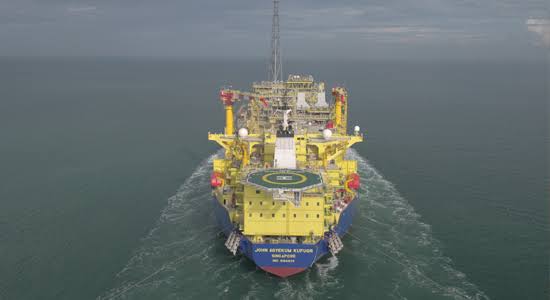
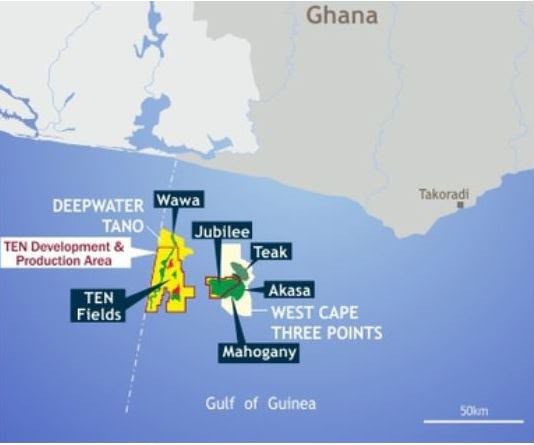
Offshore, aboard the FPSO John Agyekum Kufuor, an expansion of gas-processing capability is set to deepen the role of the Offshore Cape Three Points (OCTP) project in Ghana’s domestic energy system, while simultaneously extending the commercial life of one of the country’s most important offshore production assets.
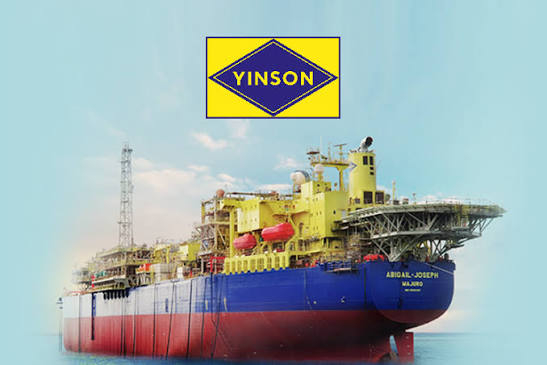
Yinson Production, which owns and operates the FPSO under its contract with Eni Ghana, has secured a contract amendment linked to the vessel’s gas-capacity upgrade.
The arrangement is valued at about US$810 million, with approximately US$600 million attributable to Yinson Production, while the FPSO’s lease has been extended by four years to 2036.
On the surface, the development looks like another offshore contract award.
Its deeper significance for Ghana is elsewhere.
It potentially gives the country more room to expand domestic gas supply at a time when reliable gas has become increasingly important to electricity generation, industrial activity and the broader effort to reduce exposure to imported fuels.
The FPSO Upgrade Changes The Equation
The John Agyekum Kufuor is not a new asset in Ghana’s petroleum story.
The FPSO has been operating on the OCTP project since 2017, with Yinson listing its existing gas-export capacity at 210 million standard cubic feet per day and oil production capacity at 58,000 barrels per day.
What is changing is the extent to which the infrastructure can be used to support Ghana’s gas requirements.
The development follows an earlier expansion of the OCTP gas-processing system. In July 2025, Eni Ghana and its partners, Vitol Upstream Ghana and GNPC, completed an upgrade that increased non-associated gas-processing capacity from 246 MMscfd to 270 MMscfd. Eni said OCTP was already supplying around 70% of Ghana’s domestic gas, predominantly for electricity generation.
The next phase is therefore not simply about squeezing more output from an existing field.
It is about building additional capacity around an asset that has already become strategically important to Ghana’s energy system.
GNPC said in May that the planned OCTP Non-Associated Gas Upgrade Project could eventually increase gas production to as much as 350 MMscfd by 2028, subject to approvals and implementation timelines. The plan includes development of the Gye Nyame field, a booster compressor and additional gas infrastructure on the FPSO.
That creates a second story beneath the headline contract.
Ghana is effectively trying to extract greater energy value from infrastructure it already has rather than treating every increase in domestic supply as a requirement for an entirely new production system.
Gas Is Becoming More Than A Petroleum Commodity
The importance of this investment becomes clearer when Ghana’s electricity system is considered.
Gas is not merely another commodity produced offshore and sold into the domestic market. It is an input into the country’s power system.
OCTP’s significance has consequently extended beyond oil production. Its gas output has helped reduce the need for more expensive and less efficient alternatives in electricity generation, while providing a domestic source of fuel for thermal power plants. Eni has previously described the project as contributing to Ghana’s energy security and reducing reliance on oil-fired generation.
That makes every additional unit of reliable domestic gas potentially valuable beyond the upstream sector.
More gas can mean greater flexibility for thermal generators. Greater gas availability can support electricity reliability. And greater domestic supply can reduce the amount of foreign exchange required to source alternative fuels.
The relationship is straightforward: offshore infrastructure can ultimately affect the cost and reliability of electricity onshore.
GNPC has itself placed gas at the centre of its energy strategy.
At a September technical consultative workshop, the Corporation said gas revenue reached US$952.38 million in 2025, representing 65.6% of its standalone revenue. It also reported that its three producing fields were exporting more than 409 MMscf of gas per day as of September 21.
For a country trying to expand industrial production while managing the cost of electricity, those volumes are not insignificant.
The Real Test Is Whether Supply Becomes Security
Yet the offshore upgrade also exposes a more complicated question.
Can Ghana turn additional gas-processing capacity into durable energy security?
The answer depends on more than what happens aboard the FPSO.
Gas must move through the entire value chain: production, processing, transportation, aggregation, payment and utilisation.
A production increase that cannot be transported efficiently, contracted on commercially sustainable terms or paid for by offtakers does not automatically translate into a stronger energy system.
GNPC’s own assessment is revealing. The Corporation has argued that Ghana’s gas value chain must function as an integrated ecosystem because weakness in one segment can undermine the financial and operational stability of the entire system.
That is why the OCTP expansion matters beyond its headline capacity.
It creates additional supply, but Ghana still has to ensure that infrastructure and commercial arrangements downstream can absorb it.
Investment Is Following The Infrastructure
There is also an important signal in Yinson’s decision to extend the FPSO lease to 2036.
The company is not merely installing additional equipment and walking away. The longer contract period links the investment in the vessel to a longer period of offshore operations.
For Ghana, that matters because offshore infrastructure is expensive and highly specialised. Investors are more likely to commit significant capital where there is sufficient visibility over the period in which the asset can generate returns.
The US$810 million contract amendment therefore represents more than expenditure on equipment.
It demonstrates that existing Ghanaian offshore infrastructure can continue attracting substantial investment when there is a credible production and gas-development case.
That is particularly relevant as Ghana attempts to reverse concerns about declining upstream production and attract capital into mature as well as prospective assets.
The country’s recent upstream developments suggest that the investment conversation is broadening.
In September, Eni Ghana and Vitol signed memoranda of understanding with the Government of Ghana covering two offshore blocks in the Tano Basin, GH WB 3 and GH WB 8. The blocks cover approximately 2,100 square kilometres and are being pursued under an infrastructure-led exploration strategy.
The message is increasingly clear: Ghana’s existing infrastructure is becoming an asset not only for current production, but also for unlocking nearby resources.
The Bigger Prize Is Domestic Value
For Ghana, however, the most important question is not how much the FPSO contract is worth to Yinson.
It is how much additional economic value Ghana can retain from the infrastructure.
The country has spent years trying to move beyond a petroleum model dominated by crude exports towards one in which oil and gas support electricity, industry and domestic value creation.
Gas is particularly suited to that ambition because its value extends into sectors far beyond the offshore platform.
It can support power generation. It can provide fuel for industry. It can reduce the need for imported alternatives. And where supply is reliable and competitively priced, it can improve the economics of domestic production.
This is why the OCTP upgrade should be viewed as part of Ghana’s wider energy-security architecture rather than simply an offshore engineering project.
There is also a local-content dimension.
Yinson’s own sustainability reporting shows that 92.3% of purchase orders associated with the John Agyekum Kufuor were issued to local suppliers in the latest reporting period disclosed for the asset.
That provides another avenue through which offshore investment can translate into domestic economic participation.
Ghana’s Gas Future Is Being Built Offshore
The irony is that Ghana’s energy transition debate is often dominated by discussions about renewables, electric mobility and reducing dependence on fossil fuels.
Those issues remain important.
But Ghana’s immediate energy reality still requires dependable thermal power, and dependable thermal power requires dependable fuel.
That makes natural gas a bridge between Ghana’s present energy system and its longer-term transition.
The challenge is ensuring that the bridge does not become a permanent dependence.
The latest OCTP investment offers Ghana an opportunity to use domestic gas strategically: to stabilise electricity supply, support industry, reduce imported-fuel exposure and create time and financial space for renewable-energy development.
The offshore expansion therefore carries a significance that extends well beyond the vessel itself.
It is a reminder that in Ghana’s energy sector, the next major development does not always have to begin with a new discovery.
Sometimes, the bigger opportunity lies in making existing infrastructure work harder, last longer and deliver more value to the economy.
For Ghana, the real measure of the OCTP upgrade will ultimately be whether additional gas moves beyond the FPSO and into the economy, powering plants, supporting industries, reducing import dependence and strengthening the country’s ability to control its own energy future.
READ ALSO: Government Releases GH¢106 million In Allowances to Assembly Members For 2026