European Union leaders have welcomed the election victory of Serbia’s student-led Student List, which is poised to end Aleksandar Vučić’s 12-year grip on power and potentially reset relations between Belgrade and Brussels.
Vučić conceded defeat on Sunday, acknowledging that the opposition movement was expected to secure a majority in the country’s 250-member parliament.
Speaking after the vote, he said that a sample of results indicated that the Student List would win between 135 and 140 seats, compared with 105 for his electoral list.

According to the Republic Election Commission (RIK), the Student List secured 52.54 per cent of the vote, based on results processed from 8,077 of 8,392 polling stations. The United Serbia list, led by Vučić’s Serbian Progressive Party, received 39.29 per cent.
Voter turnout reached 68.78 per cent, the highest level in more than 30 years, according to RIK data.
Although the final election results have yet to be announced, the figures indicate that the Student List could form a government without the need for coalition negotiations.
European Council President António Costa and European Commission President Ursula von der Leyen welcomed the election outcome. “We stand ready to support reforms on the rule of law, media freedom, the fight against corruption and strong democratic institutions, and to work together to advance Serbia’s future in the European Union,” the two leaders said in a joint statement.

European Commissioner for Enlargement Marta Kos also welcomed the result, describing the election as an opportunity for Serbia to begin a new political chapter.
“After nearly two years of protests for democracy, the rule of law, and the fight against corruption, Serbians turned out in historic numbers. A new chapter can begin for Serbia. The door to the EU is open, and we are ready to move forward together.”
Marta Kos
Tonino Picula, the European Parliament’s rapporteur for Serbia, similarly called for reforms and stronger institutions. “Now is the time for the rule of law, reforms, and institutions that serve all citizens,” Picula wrote on social media, adding, “That should be the path toward the EU.”
The statements reflect Brussels’ hopes that the change in Belgrade could create opportunities to advance reforms and strengthen Serbia’s alignment with European democratic standards.
The Student List’s victory follows nearly two years of youth-led protests triggered by the 2024 collapse of a railway station canopy in Novi Sad, which killed 16 people.
The demonstrations initially demanded accountability for the tragedy but subsequently developed into a broader political movement challenging alleged corruption and the capture of democratic institutions.
In its electoral programme presented in September, the Student List identified the fight against corruption and organised crime as key priorities. The movement also pledged to improve living standards, increase employment opportunities, strengthen education, protect media freedom and safeguard the independence of Serbia’s institutions.
Its electoral success marks a significant development for a movement that emerged from public protests and transformed demands for accountability into a nationwide political campaign.
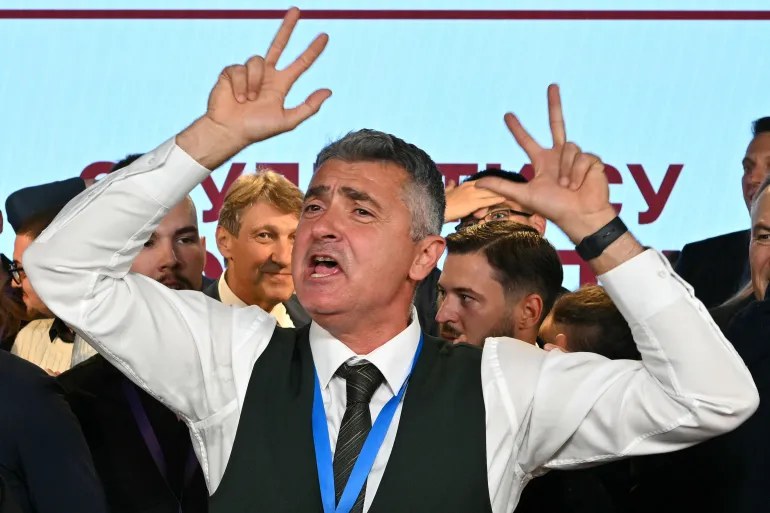
The high voter turnout further emphasized the scale of public participation in the election, with the Student List securing a parliamentary majority according to the results announced so far.
Serbia’s EU Accession Bid Faces Significant Obstacles
Despite the optimism surrounding the election, Serbia’s path towards EU membership remains uncertain.
The country, regarded as the largest and most influential in the region, has maintained a complicated relationship with the bloc, with its accession process facing significant obstacles following Russia’s full-scale invasion of Ukraine.
Belgrade has continued to maintain friendly relations with Moscow, while its failure to align with EU sanctions against Russia has contributed to tensions with member states.
In July, the European Commission attempted to open a new accession cluster, but eight EU member states blocked the move, citing concerns over Serbia’s rule of law record and its position on sanctions against Russia.
Relations were further strained by the funeral of convicted war criminal Ratko Mladić, which was attended by senior Serbian officials and held with military honours.
The Student List’s victory has raised expectations that Serbia could pursue a different approach to democratic governance and relations with Brussels. However, whether the new political leadership will deliver the reforms required to revive accession negotiations remains unclear.
Government Formation Expected After Final Results
The formation of Serbia’s next government will depend on the announcement of the final election results and the subsequent convening of parliament.
The new National Assembly must be established within 30 days of the final results being announced. A government must then be formed within 90 days after that.
The Student List’s projected parliamentary majority could simplify the process by eliminating the need for lengthy coalition negotiations. Nevertheless, the immediate priority will be the formal completion of the electoral process and the establishment of the new legislature.
For the European Union, the election presents a potential opportunity to strengthen ties with Serbia and revive its stalled membership ambitions. Whether that opportunity translates into concrete progress will depend on the new government’s commitment to the rule of law, anti-corruption measures, media freedom and institutional independence.
READ ALSO: Sánchez Rules Out Moroccan Role In Ceuta Migrant Surge