Ghana’s Minister for Foreign Affairs, Hon.Samuel Okudzeto Ablakwa, has categorically denied reports suggesting that the United States government plans to deport Kilmar Abrego Garcia, a non-West African national, to Ghana.
The North Tongu Member of Parliament described the reports as false and misleading, emphasizing that Ghana has not agreed to receive any deportees who are not of West African origin.
In a firm statement issued in response to recent media publications circulating in the United States, Hon. Ablakwa made clear that Ghana has “not accepted Abrego Garcia, and he cannot be deported to Ghana.”
The Minister stressed that this position had been directly and unambiguously conveyed to U.S. authorities through official diplomatic channels.
Hon. Ablakwa explained that although Ghana has, in limited instances, accepted a small number of West African deportees under specific humanitarian considerations, such cooperation does not extend to individuals from outside the West African subregion.
“In my interactions with U.S. officials, I made clear that our understanding to accept a limited number of non-criminal West Africans, purely on the grounds of African solidarity and humanitarian principles, would not be expanded”.
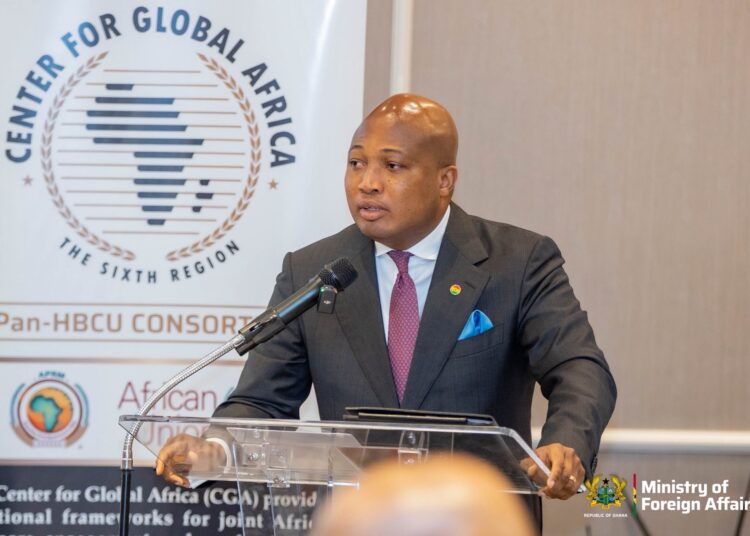
Ghana’s Minister for Foreign Affairs, Hon.Samuel Okudzeto Ablakwa

The Foreign Minister’s clarification comes in the wake of a developing story reported by ABC News in the United States, which claimed that the U.S. Department of Homeland Security (DHS) was planning to deport Abrego Garcia to Ghana.
The report, filed by journalist Laura Romero, cited a notice purportedly sent from the DHS to Garcia’s attorneys indicating that arrangements were being made for his removal to Ghana.
Garcia, whose nationality has been identified as Central American, is currently at the center of a legal battle over his deportation status in the U.S., with his case scheduled for a hearing on Friday.
Ghana’s Bold Objection
Hon. Ablakwa’s statement decisively refutes the narrative that Ghana has agreed to accept Garcia or any other deportee from outside the Economic Community of West African States (ECOWAS) region.
“Ghana strongly objects to these misleading media reports,” he said, underscoring that the country’s immigration and diplomatic policies are guided by established international norms and regional frameworks.

He stressed that Ghana’s immigration cooperation with the United States has always been transparent, lawful, and based on clearly defined parameters rooted in regional solidarity rather than arbitrary decisions.
The Foreign Minister emphasized that Ghana’s sovereignty and national identity must be respected in all international engagements. Hon. Ablakwa also warned against the spread of unverified reports that could harm Ghana’s international reputation or strain its bilateral relations.
He reiterated that his ministry maintains open and constructive communication with the United States government and that no such arrangement to accept Abrego Garcia or any non-West African national exists or has ever been discussed.
The case of Kilmar Abrego Garcia has drawn international attention due to the unusual claim by the DHS that Ghana had been designated as the receiving country for his deportation.
Garcia’s attorney, Simon Sandoval-Moshenberg, has reportedly challenged the move in court, arguing that deporting his client to Ghana, a country with which he has no ties, would be unlawful and contrary to international standards.
Ghana’s clear and prompt response underscores the government’s insistence on maintaining strict control over its immigration and foreign relations policies. The statement also reflects Ghana’s broader commitment to regional cooperation within ECOWAS while guarding against external pressures that could compromise its sovereignty.
Under President John Dramani Mahama’s administration, Ghana’s foreign policy has increasingly emphasized assertive diplomacy grounded in respect for national interests and adherence to international law.

Hon. Ablakwa’s handling of the current issue is consistent with that posture, seeking both to protect Ghana’s image and to clarify the boundaries of its cooperation with external partners.
The Minister’s firm rejection of the deportation claim also signals Ghana’s unwillingness to serve as a repository for deportees from outside its recognized regional sphere.
This stance sends a strong message that African nations, while open to humanitarian collaboration, will not tolerate being used as arbitrary destinations for deportations that have no legal or cultural basis.
READ ALSO: Energy Minister Meets Tanker Drivers, Pledges Petroleum Reforms