
The resumption of crude oil refining at the Tema Oil Refinery (TOR) has reignited debate about its potential impact on Ghana’s fuel market, with policy analysts cautioning that the benefits will depend largely on how sustainably the facility operates.
Kodzo Yaotse, Policy Lead for Petroleum and Energy at the African Centre for Economic Policy (ACEP), says the refinery’s influence on fuel price stability will not be automatic, but rather determined by operational reliability and strategic choices around crude sourcing.
“To the extent it will be able to influence the market in terms of price stability will largely depend on one, its reliability, that is, it able to refine the product and supply the market over a longer term.”
Kodzo Yaotse, Policy Lead for Petroleum and Energy at ACEP
According to ACEP, Ghana’s fuel market has historically been exposed to volatility due to heavy reliance on imported refined petroleum products.
TOR’s restart, after years of inactivity, offers an opportunity to reduce that exposure, but only if the refinery can operate without frequent breakdowns or prolonged shutdowns.
Yaotse explained that sustained operations are essential for TOR to regain credibility among market players. He noted that sporadic production would do little to influence pricing dynamics, especially in a deregulated downstream market where Oil Marketing Companies (OMCs) respond quickly to supply uncertainties. In that context, reliability becomes the foundation for any meaningful price stabilisation effect.
Crude Sourcing Versus Tolling Model

Beyond reliability, the ACEP policy lead pointed to TOR’s operating model as another decisive factor.
“If it is going to buy its own crude, refine it, and then pump into the market, then we can be sure there will be some impact on reliability and price stability at the pump.”
Kodzo Yaotse, Policy Lead for Petroleum and Energy at ACEP
Under such a model, TOR would have greater control over supply volumes and timing, allowing it to respond more effectively to domestic market needs.
Conversely, if TOR operates largely as a tolling refinery, its influence on pump prices may be more limited. In that scenario, third-party crude owners would determine how much refined product enters the local market, potentially prioritising exports or private distribution channels over broad domestic supply.
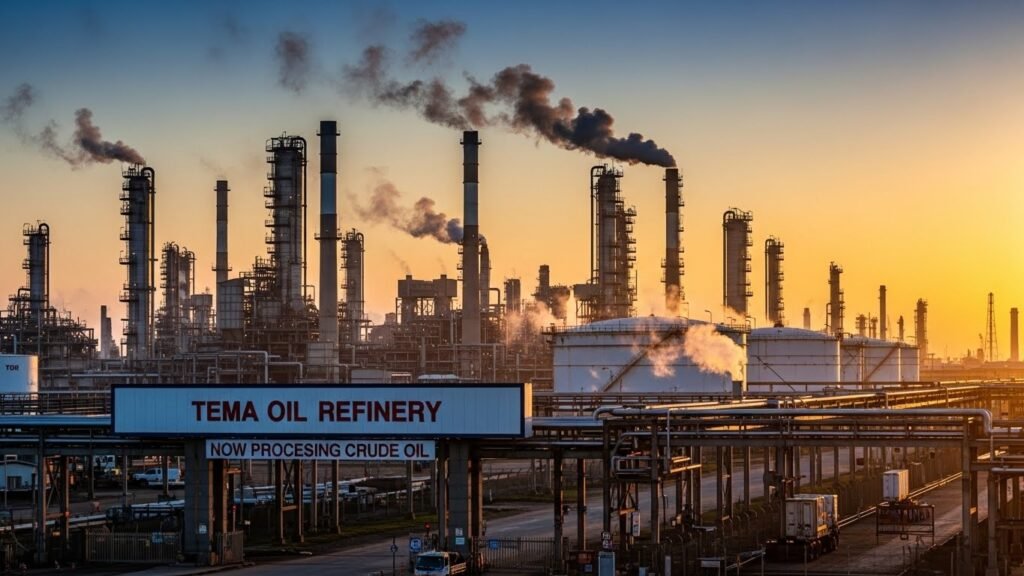
TOR’s restart follows extensive Turnaround Maintenance (TAM) works on its Crude Distillation Unit (CDU), carried out between August and October 2025.
The maintenance exercise marked the first major overhaul of the facility in years and was aimed at restoring operational integrity and safety.
Following the completion of the works, the National Petroleum Authority (NPA) conducted comprehensive inspections and confirmed that the refinery met all mandatory safety and operational standards.
The regulator subsequently granted clearance for TOR to resume refining activities, paving the way for the phased restart currently underway.
Implications for Fuel Prices

Analysts say higher and more stable domestic refining capacity could help cushion Ghana against international supply shocks and reduce costs associated with importing refined products.
However, Yaotse cautioned that capacity alone is not enough. Without consistent crude supply arrangements and sound commercial management, the refinery may struggle to operate at levels that meaningfully influence national fuel prices.
He added that TOR’s pricing impact would also depend on how its products are priced relative to imports. In a deregulated market, locally refined products must remain competitive to displace imports and influence pump prices.
While the refinery’s return has been widely welcomed as a boost to energy security, ACEP’s comments suggest that expectations should be managed carefully.
The restart, Yaotse implied, is a necessary but not sufficient condition for price stability. Long-term planning, financial sustainability and clear policy direction will be required to ensure TOR delivers lasting benefits to consumers.
As Ghana looks to strengthen its downstream petroleum sector, the coming months will be critical in determining whether TOR can move beyond symbolic revival to become a reliable anchor for fuel supply and price stability.
READ ALSO: DGPP’s Impact on BOG’s Financial Sheet, IMF’s Focus – Financial Analyst