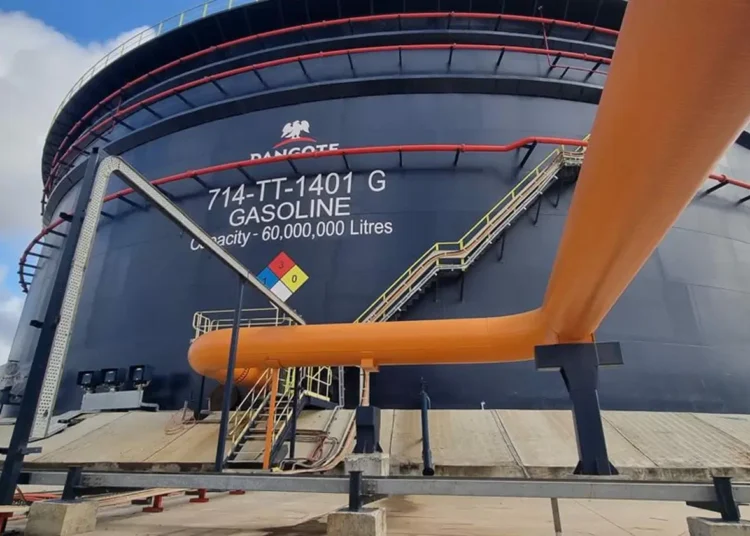
The Dangote Petroleum Refinery & Petrochemicals has announced plans to supply more than 65 million litres of Premium Motor Spirit (PMS) daily to the Nigerian market, a move expected to meet and exceed domestic demand while enabling exports of surplus volumes.
The development marks a significant turning point in Nigeria’s downstream petroleum sector, as the country transitions from decades of heavy reliance on imported refined products to a new era of fuel self-sufficiency.
President of the Dangote Group, Aliko Dangote, disclosed the details in Lagos, confirming that a structured offtake agreement has been finalised with selected marketers to guarantee nationwide distribution and eliminate supply instability.
“We have agreed an offtake framework to supply over 65 million litres daily for the domestic market.
“Any surplus, estimated at between 15 and 20 million litres, will be exported.”
Aliko Dangote, President of the Dangote Group
Ending Decades of Import Dependence

Nigeria’s average daily petrol consumption is estimated at between 50 and 60 million litres. With projected output exceeding this threshold, the refinery’s operations represent what industry observers describe as a decisive break from recurring fuel shortages and import dependency.
For years, Africa’s largest crude oil producer relied on importing refined petroleum products due to insufficient domestic refining capacity. This arrangement exposed the economy to foreign exchange volatility, global supply chain disruptions and periodic scarcity.
The refinery’s ability to refine volumes beyond local demand signals a structural reform in the country’s fuel supply chain. By refining crude oil domestically and distributing finished products nationwide, Nigeria stands to reduce its exposure to external shocks.
Analysts believe the economic implications of the refinery’s output could be far-reaching. With local refining now exceeding national petrol demand, Nigeria is expected to conserve billions of dollars annually in foreign exchange previously spent on fuel imports.
Reduced import bills could ease pressure on the naira, strengthen external reserves and improve trade balance stability. Lower exposure to global shipping costs and foreign currency fluctuations may also contribute to more predictable pricing dynamics in the domestic market.
The refinery’s export of surplus volumes, estimated at between 15 and 20 million litres daily could further enhance foreign exchange inflows while positioning Nigeria as a net exporter of refined products within the region.
A Transformative National Asset

The Group Chief Executive Officer of NNPC Limited, Engr. Bayo Bashir Ojulari, recently described the refinery as a transformative national asset capable of redefining Nigeria’s energy security framework.
During a visit to the facility, Ojulari commended its operational performance and technological sophistication, noting that it reflects Nigeria’s capacity to overcome long-standing industrial limitations.
He described the refinery as a source of national pride and a demonstration of how best-in-class global technology can accelerate industrial growth.
“This plant was designed for 650,000 barrels per day. None of us thought it would even touch 550,000. What we saw live today was 661,000. These are live parameters, not reports or photographs.”
Engr. Bashir Bayo Ojulari, Group Chief Executive Officer of NNPC Limited
The performance figures suggest the refinery is operating above its original nameplate expectations, reinforcing confidence in its capacity to sustain high output levels.
Central to the refinery’s strategy is the offtake framework concluded with selected marketers. According to Dangote, the arrangement ensures organised nationwide distribution and eliminates the supply instability that has historically plagued the sector.
Implications for Energy Security

The refinery’s ramped-up output represents a broader shift in Nigeria’s energy security architecture. Domestic refining capacity not only reduces import reliance but also enhances strategic autonomy in managing fuel supply.
For a country that has frequently grappled with queues at filling stations and subsidy-related fiscal burdens, the development signals a potential reset.
The facility’s capacity of 650,000 barrels per day places it among the largest single-train refineries globally, underscoring its scale and significance within the African energy landscape.
As operations stabilise and distribution systems mature, the Dangote Refinery petrol supply initiative is expected to reshape Nigeria’s downstream petroleum dynamics, supporting economic resilience and industrial expansion.
With surplus volumes poised for export and domestic demand fully covered, the refinery stands at the centre of what many view as a historic transformation of Nigeria’s fuel supply system, one that could redefine the country’s role in regional energy markets for years to come.