The landscape of Ghana-U.S. trade has entered a high-stakes transition period as the Ministry of Trade, Agribusiness and Industry (MoTAI) formally engaged the United States Embassy on the future of the African Growth and Opportunity Act (AGOA).
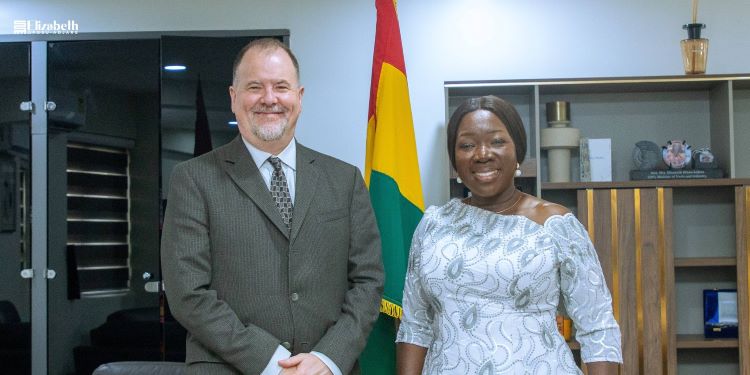
The Minister for Trade, Agribusiness and Industry, Hon. Elizabeth Ofosu-Adjare, hosted the U.S. Chargé d’Affaires, Rolf Olson, for a dialogue that went beyond mere diplomacy, touching on the mechanics of a “15-month strategic window,” and a looming shift toward reciprocal trade.
According to MoTAI, as the current global trade climate pivots toward more transactional bilateralism, Ghana is working to lock in its gains in the garment and textile sectors while preparing for a future where duty-free access to American markets may require opening its own doors wider to U.S. goods.
“While the recent renewal of AGOA has been widely reported as a one-year patch, Rolf Olson clarified during the discussions that the extension effectively grants Ghana a 15-month operational window, running retroactively from October 1, 2025, through December 31, 2026.
“This timeframe provides Ghanaian exporters with a clear, albeit narrow, horizon to maximize their volumes before the next major legislative hurdle in Washington”
MoTAI

However, the “free pass,” era of AGOA is evolving. Mr. Olson signaled that the current U.S. administration is increasingly prioritizing market access for American companies, suggesting that future trade frameworks will move away from the traditional non-reciprocal model.
Textile and Garment Engine
For Hon. Elizabeth Ofosu-Adjare, the stakes of these negotiations are measured in human livelihoods.
During the discussions, she underscored the transformative role the garment sector plays in Ghana’s industrial enclaves, noting that a single factory in this sector can provide employment for up to 5,000 workers, with a particular focus on inclusive employment for women and young mothers.
The Trade Minister warned that any sudden shifts in tariff policy could derail the progress made in decentralizing industry outside of Accra. For Ghana, AGOA is not just a trade policy; it is a social stability tool that curbs irregular migration by creating high-volume, local employment.
MoTAI noted that the dialogue was not without its points of friction. The U.S. delegation raised specific concerns regarding business dispute resolution and outstanding payments owed to American entities.
“Mr. Olson raised concerns about outstanding payments owed to some U.S. entities, explaining that unresolved arrears to American companies attract attention in Washington and could affect perceptions of the investment climate”
MoTAI

Hon. Ofosu-Adjare responded with transparency, acknowledging that while some financial obligations were inherited, the government is committed to a rigorous verification process to honor legitimate debts and maintain Ghana’s reputation as a stable, rule-based democracy.
U.S. EXIM Financing
Another significant commercial breakthrough of the meeting was the announcement that the U.S. Export-Import (EXIM) Bank has reinstated its short-term private sector financing facilities for Ghana.
This move is a direct nod to Ghana’s recent macroeconomic stabilization and progress in debt restructuring. The reopening of these facilities is expected to act as a catalyst for Ghanaian private sector expansion, allowing local firms to purchase U.S. goods and services for critical infrastructure projects with more “patient” financing terms.
As the meeting concluded, it became evident that the next 15 months will be a period of intense preparation.
The Office of the United States Trade Representative (USTR) is expected to initiate formal dialogues on what a “reciprocal trade arrangement,” will look like in practice. For Ghana, the challenge will be to maintain the duty-free protections that have built its textile industry while navigating the demands for lower tariffs on American agricultural inputs like wheat and corn.

The engagement reaffirms that while the “strategic window” is open, the terms of the Ghana-U.S. partnership are shifting toward a more balanced, albeit complex, commercial reality.
READ ALSO: First Atlantic Bank Hits GH¢393.8m Profit