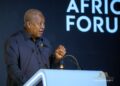
Minister for Energy and Green Transition, Hon. John Jinapor, announced a dramatic turnaround in Ghana’s power and petroleum landscapes, declaring that targeted financial reforms and deliberate policy implementations have firmly restored global investor confidence and revitalized the domestic energy landscape.
Speaking at the prestigious Ghana-UK Investment Summit 2026, the sector minister revealed that the West African nation has successfully navigated out of its recent systemic economic vulnerabilities, establishing an operational baseline characterized by heightened regulatory predictability and infrastructure reliability.
By positioning the administration’s baseline strategy as an active economic recovery lever, the minister outlined how strategic state interventions are converting latent hydrocarbon and renewable potentials into tangible commercial operations, effectively positioning the country to mitigate historical macroeconomic shocks.
This strategic policy recalibration marks a clear transition from emergency mitigation to long-term asset optimization, reinforcing the nation’s capacity to host capital-intensive global enterprise ventures.
“Ghana’s energy sector is now experiencing renewed growth and stability. We have secured over US$3.5 billion in upstream oil and gas investment commitments, resumed major drilling activities, and expect crude oil production to increase for the first time in almost six years.”
Minister for Energy and Green Transition, Hon. John Jinapor
The minister underscored how the strategic execution of the state’s economic recovery strategy dismantled complex regulatory bottlenecks that previously stalled capital inflow across the institutional value chain.

When the current administration assumed operational control in early 2025, the country was heavily burdened by a restrictive electrical power deficit, a multi-year contraction in upstream oil production, and a corresponding decline in international investor sentiment.
To reverse this structural decline, the government deployed aggressive policy tools designed to stabilize state-utility balances, guarantee off-taker financial commitments, and de-risk exploratory capital investments.
These deliberate institutional adjustments have successfully altered the sector’s operational outlook, triggered an influx of industrial commitments while ensured that household and commercial consumers across the sub-region are insulated from the systemic supply interruptions that defined previous fiscal cycles.
Restored Investor Confidence and Upstream Hydrocarbon Revitalization
According to regulatory disclosures provided during the summit, the legal enforcement of the revised National Energy Policy has injected immense commercial predictability into the country’s offshore exploration basins.
International oil companies, responding directly to these streamlined regulatory architectures, have formally pledged massive capital outlays to expand field infrastructure and accelerate production schedules.

This multi-billion-dollar financial influx has catalyzed immediate engineering activities, with major exploration entities moving heavy offshore assets back into deepwater concessions to execute critical development wells.
By restoring deep-water exploratory drilling campaigns, the state is effectively neutralizing the natural depletion curves of existing fields, transforming Ghana’s hydrocarbon trajectory from contraction back into expansion.
This imminent production spike is mathematically modeled to expand foreign exchange reserves, strengthen the local currency, and provide downstream thermal plants with a reliable, locally sourced supply of natural gas.
Structural Transformation and the Green Transition Framework
The Energy Transition Framework has established a strict dual-track development mechanism, optimized existing fossil assets while simultaneously deployed utility-scale decarbonization technologies across the country.
Government technocrats are actively routing a portion of these incoming upstream revenues to finance grid-scale photovoltaic arrays, run-of-river hydroelectric stations, and wind-energy infrastructure.

Furthermore, the state is systematically advancing its civil nuclear power program, recognizing that baseline atomic energy is essential to supporting heavy industrialization without compromising international emissions targets.
This diversified approach guarantees that as the domestic grid scales up to support commercial manufacturing centers, its carbon intensity decreases linearly.
By embedding strict green targets directly into the national architecture, the country is mitigating the risk of future carbon border taxes and aligning its electrical grid with the ESG mandates required by modern global financiers.
Industrial Expansion and Regional Power Hub Integration
A comprehensive macroeconomic analysis indicates that a stabilized power grid acts as a foundational relief mechanism, driving down the high operational expenditures that historically plagued domestic factories and mining companies.

By eliminating reliance on expensive, privately owned diesel generators, manufacturing entities can accurately project processing costs, lower their overall consumer pricing structures, and dramatically increase production output.
This enhanced operational efficiency is accelerating the government’s comprehensive industrial transformation goals, turning raw mineral processing and automotive assembly lines into commercially viable operations.
Ultimately, this structural stability underpins the vision to transform the republic into the primary supplier of cheap, reliable electrical energy for the West African Power Pool, creating a lucrative, cross-border commercial export market that yields long-term economic prosperity.