
Industrial consumers warn higher electricity bills could undermine manufacturing growth, despite government’s broader efforts to lower energy costs through renewable energy and industrial reforms.
The Association of Ghana Industries (AGI) has warned that a recent 48% increase in electricity costs for bulk industrial consumers could weaken the competitiveness of Ghanaian manufacturers, raise production costs and ultimately feed into higher consumer prices.
The development comes at a time when government is pursuing reforms aimed at making electricity more affordable for industry under its 24-Hour Economy agenda, highlighting the persistent challenge of balancing utility cost recovery with industrial growth.
Electricity costs remain industry’s biggest concern
Speaking during Channel One TV’s Quarterly Economic Review on Ghana’s mid-year economic performance, AGI Chief Executive Officer, Seth Twum-Akwaboah, said electricity continues to rank as the single biggest challenge confronting businesses, according to the Association’s Business Barometer Report over the past two quarters.
He explained that while businesses can improve operational efficiency in some areas, utility tariffs remain costs over which manufacturers have little control, making any significant increase particularly difficult to absorb.
Cost of utility is very key. And if you look at the AGI Business Barometer Report, for the past two quarters, cost of electricity has come up as the number one challenge facing the businesses.
Seth Twum-Akwaboah, Chief Executive Officer, Association of Ghana Industries (AGI)
According to Mr Twum-Akwaboah, the latest increase followed a change by the Electricity Company of Ghana (ECG) in the billing arrangement for bulk electricity consumers.
He said these companies, typically large manufacturers and industrial operators with high electricity demand, previously benefited from a pricing arrangement that reflected the economic principle of lower unit costs for higher-volume consumers.
Now suddenly, ECG changed the status. And within one month, the electricity tariffs went up by 48% for those who are bulk customers.
Seth Twum-Akwaboah, Chief Executive Officer, Association of Ghana Industries (AGI)
The AGI said industry has been engaging stakeholders on the issue since the beginning of the year, arguing that such sharp increases undermine business planning and investment confidence.
Energy costs threaten industrial competitiveness
For Ghana’s manufacturing sector, electricity is more than just another operating expense. It is a critical input for industries ranging from food processing and cement production to steel manufacturing, pharmaceuticals and textiles.
Higher electricity tariffs can increase production costs, reduce profit margins and make locally manufactured products less competitive against imported alternatives. Businesses may also delay expansion plans or reduce investment if operating costs become unpredictable.
Mr Twum-Akwaboah cautioned that sustained increases in production costs could eventually be passed on to consumers through higher prices.

When your pricing level is increasing, it means inflation is going up. And when local production costs go up, what it means is that we are becoming less competitive in the market.
Seth Twum-Akwaboah, Chief Executive Officer, Association of Ghana Industries (AGI)
The warning comes as Ghana continues efforts to position manufacturing as a key driver of economic transformation under the government’s industrialisation agenda.
Manufacturing also plays an important role in job creation and value addition, making energy affordability a recurring policy concern.
A contrast with government’s long-term energy strategy
The concerns raised by AGI also underscore the gap between current industrial electricity costs and government’s longer-term ambition to provide cheaper power for productive sectors.
As previously reported, government recently announced plans to develop 1.5 gigawatts of integrated solar and hydropower generation capacity with battery energy storage systems at Buipe to support industries operating under the proposed 24-Hour Economy programme.
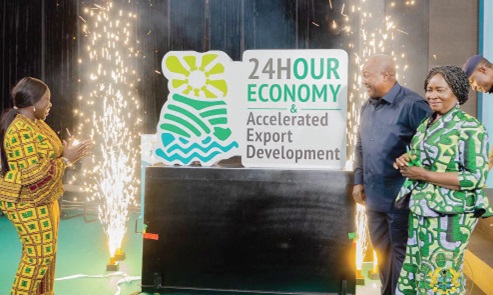
At the launch of the initiative, Presidential Advisor on the 24-Hour Economy, Augustus Goosie Tanoh, said the renewable energy programme aims to reduce industrial electricity costs significantly over time by supplying cheaper power to manufacturing, agro-processing and logistics facilities.
The objective is to lower electricity tariffs sufficiently to improve industrial competitiveness and encourage new investment.
However, the AGI’s latest concerns illustrate that while those projects may offer long-term relief, industries continue to grapple with immediate cost pressures under the existing tariff regime.
This reinforces a broader challenge within Ghana’s energy sector: ensuring utilities remain financially sustainable while maintaining electricity prices that support economic growth.
Balancing utility sustainability and economic growth
The debate also reflects wider issues within Ghana’s electricity sector.
Utilities such as ECG continue to face financial pressures linked to revenue collection, power purchase obligations and operational costs. At the same time, industries argue that high electricity prices reduce productivity, discourage investment and slow economic expansion.

Finding the right balance remains one of the country’s most significant energy policy challenges.
Reliable and affordable electricity has consistently been identified as a prerequisite for increasing local manufacturing, expanding exports and attracting foreign direct investment.
For businesses, stable energy pricing is equally important. Manufacturers typically make investment decisions over several years, and sudden increases in utility costs can affect production planning, financing and employment decisions.
Energy policy beyond generation
The AGI’s concerns also highlight that Ghana’s energy transition is not solely about increasing generation capacity or introducing more renewable energy.
Equally important is ensuring that electricity produced reaches consumers at prices that encourage productive economic activity.
As government advances major renewable energy projects and seeks to transform Ghana into a regional manufacturing hub, electricity affordability is likely to remain central to discussions on industrial policy, energy sector reform and economic competitiveness.
The latest concerns from industry therefore serve as a reminder that the success of Ghana’s broader energy agenda will ultimately be measured not only by additional megawatts installed, but also by whether businesses can access reliable electricity at prices that allow them to compete, expand and create jobs.
READ ALSO: Local Content To Drive New Digital Broadcasting Vision — Communications Minister