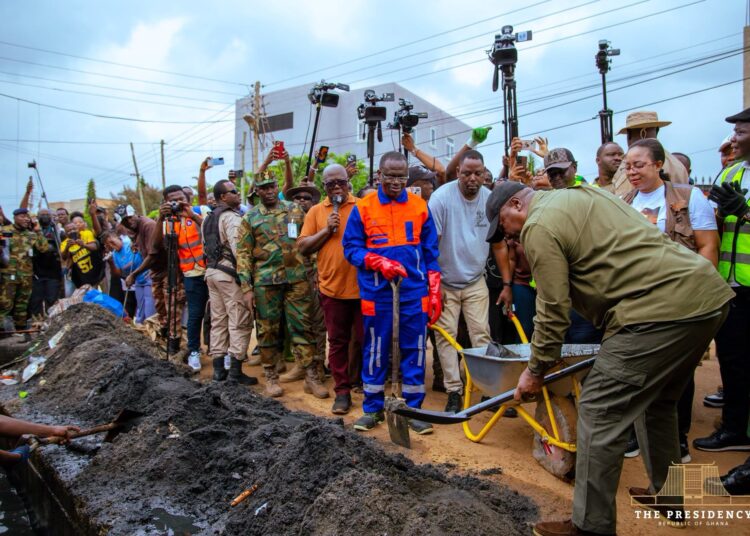
Ghana has watched this scene before. Rain falls hard for a single day, Accra drowns, families lose everything, and the nation mourns before moving on until the next downpour repeats the cycle.
This year, 140 millimetres of rainfall in twenty four hours submerged entire neighbourhoods, killed at least thirteen people including a four year old girl, and displaced roughly 8,000 residents out of 38,000 affected.
President John Dramani Mahama has pledged that Accra will bounce back stronger, and his administration has moved with unusual speed to back that promise with money and manpower. The real question is whether this moment finally breaks the pattern, or simply becomes another chapter in a story Ghanaians have grown tired of telling.
A Response Bigger Than Words
To his credit, President Mahama has not treated this disaster as a public relations problem to manage with sympathy alone. The Ministry of Finance released 350 million dollars from the national contingency fund for emergency relief.
A Flood Mitigation Task Force led by Brigadier General Forster Okae Yeboah has begun inspecting water retention ponds and encroached waterways across the capital, working alongside NADMO, the Ghana Armed Forces, the Fire Service and the Police Service. The National Security Council convened an emergency session to treat the flooding as a matter of national security rather than routine misfortune.

These are not small gestures. Technical Advisor at the Ministry of Finance, Federick Amissah, revealed that the current administration has channelled 13.52 million dollars into flood mitigation work within two years, a figure that already exceeds the 11.4 million dollars spent over the previous five to six years combined.
Government has also compressed the spending timeline for the Greater Accra Resilient and Integrated Development Project, approving 76 million dollars to be spent within two years instead of the three originally requested, a decision that reflects genuine urgency ahead of the next rainy season.
Why a Two-Day Clean-Up Cannot Fix a Structural Problem
Yet urgency in spending means little if the underlying machinery of waste management remains broken. Development analyst Alfred Appiah has put the criticism plainly. Cities far larger than Accra do not run national clean-up exercises to manage solid waste, he argues, because a two-day cleaning exercise does nothing about waste generation and collection.
His question cuts to the heart of the matter. Who dumps trash in drains when they know it will be collected every week or every other week. Appiah is not proposing anything untested. He is pointing back to an appraisal document already sitting on a government desk, the GARID project’s own allocation of 42.2 million dollars for transfer stations, capping old dumpsites, and extending disposal capacity.
The funding and the blueprint already exist. What has been missing is the discipline to execute them consistently, long after the flood waters recede and public attention drifts elsewhere.
The numbers explain why symbolic clean-ups will never be enough. Parliament’s Committee on Sanitation found that Accra generates about 4,000 tonnes of waste daily, while existing facilities in the Accra Metropolitan Assembly can process only 2,000 tonnes.

That leaves 2,000 tonnes unaccounted for every single day, a gap that ends up choking drains, overflowing landfills, and threatening public health long before the next storm arrives. The Kpone landfill, nearly full since 2019, could shut down within six months. When the capital cannot manage the waste it produces on an ordinary day, the outcome on an extraordinary one becomes predictable.
The Case for Tough, Unpopular Decisions
Government has already taken one difficult step by ordering the demolition of buildings and informal structures obstructing major drainage channels and natural waterways. Metropolitan, Municipal and District Assemblies have been directed to map out and eliminate illegal blocks alongside the Ministry of Water Resources, Works and Housing. These decisions will provoke resistance from property owners and communities who built on land they should never have occupied.
But half measures created this crisis, and half measures will not end it. A government serious about protecting lives must be prepared to enforce demolitions consistently, resist political pressure to spare well connected offenders, and complete the stalled Odaw River dredging that currently sits at just over forty percent after the original contractor’s delays forced a cancellation.
The proposed new city spanning Greater Accra, Eastern and Volta regions offers a long-term release valve for a capital whose drainage infrastructure was never built for its current population. That vision deserves support, but it cannot substitute for fixing what already exists.
Ghanaians do not need another grand announcement five years from now. They need functioning transfer stations, expanded landfill capacity, and drains that stay clear between rainy seasons.

Citizens Cannot Stand Outside This Fight
Government bears the larger share of responsibility, but citizens are not innocent bystanders in this story. Every sachet dropped in a gutter, every structure built on a waterway, every resident who waits for a state-organised clean-up rather than reporting illegal dumping in their own neighbourhood contributes to the crisis government now scrambles to contain. Accra’s floods are not purely a failure of governance.
They reflect a broader culture of neglect that treats public drains and waterways as someone else’s problem. Breaking Ghana’s annual cycle of flood and lamentation will require both government and citizens to change how they behave, not just for two days, but every day.
President Mahama’s pledge that Accra will bounce back stronger carries weight only if it survives the months after the headlines fade. Ghanaians have heard promises before. What they now need is proof that this time, the follow-through will match the urgency of the moment.
READ ALSO: The Strait of Hormuz Closure Permanently Reprices Oil Risk