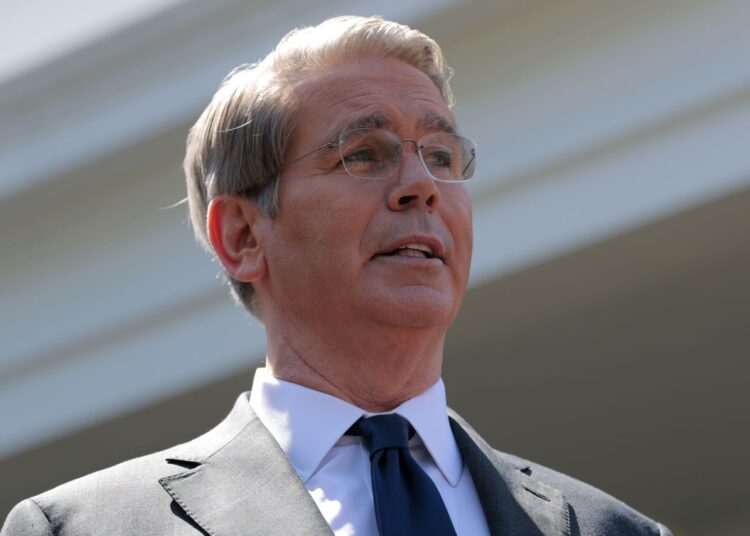
U.S. Treasury Secretary Scott Bessent has said a deal to reopen the Strait of Hormuz could be reached “today or tomorrow,” expressing optimism that ongoing discussions with Iran may soon restore the free movement of commercial shipping through one of the world’s most strategically important waterways.
Speaking to a news agency, Bessent pointed to negotiations between Washington and Tehran, saying that they were making progress and could lead to an agreement aimed at reopening the narrow shipping lane after days of heightened tensions that disrupted global trade and energy markets.
“We are in talks with the Iranians, and I think there is a chance we may have a deal today or tomorrow to open the strait and move towards a more normalised position in this conflict.”
Scott Bessent
His remarks come amid international efforts to ease tensions in the Gulf after recent hostilities disrupted maritime traffic through the Strait of Hormuz, a vital passage connecting the Persian Gulf with the Gulf of Oman and the Arabian Sea.

The waterway is widely regarded as one of the world’s most important energy chokepoints, with a significant share of globally traded crude oil and liquefied natural gas passing through it each day.
In addition to crude oil and petroleum products, the route is used to transport chemicals, industrial gases, fertilisers and a wide range of manufactured goods destined for markets across Europe, Asia and North America.
Concerns over shipping safety in the strait have unsettled energy markets in recent days, prompting higher freight costs and raising fears of supply disruptions. Several vessels have delayed transit or remained anchored while governments and shipping companies monitored the security situation.
When asked whether Iran would be allowed to charge a toll for passage via the strait of Hormuz, Bessent said that the arrangement being discussed would guarantee unrestricted navigation rather than impose new costs on commercial operators. “It would be freedom of movement,” he stated.
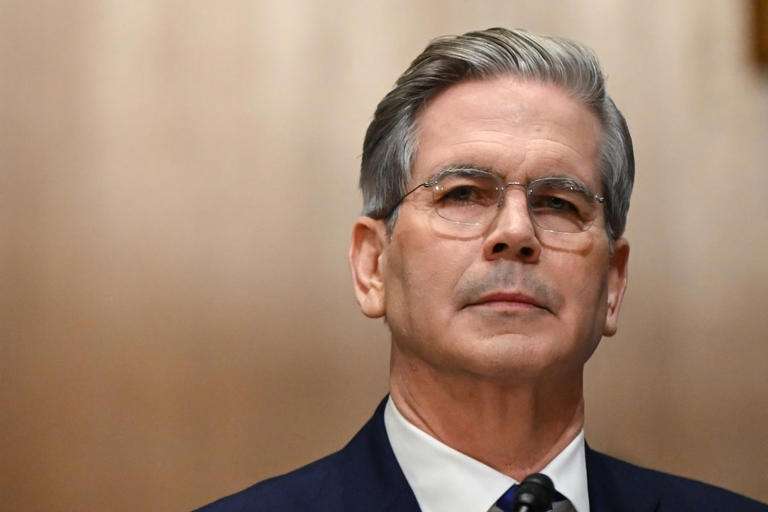
Although acknowledging that security concerns remain, Bessent suggested commercial activity had already begun to recover. Even though things are still a little dicey there over the past few days, we saw quite a few ships coming out even now.
He added that he expects oil prices to fall further when the strait of Hormuz opens. The U.S Treasury Secretary also predicted that reopening the waterway would ease pressure on global commodity markets, particularly energy prices, by allowing ships that have been delayed to resume their voyages.
He added that the impact would extend beyond oil exports, noting that numerous other goods transported through the Strait of Hormuz have also been affected by the disruption.
“There are hundreds if not thousands of ships sitting in there and waiting to go out.…It’s not just energy. It’s fertiliser, it’s refined products, it is the various industrial gases. We could see a big relief trade as those prices go down.”
Scott Bessent
Although Bessent expressed confidence that an agreement could be reached quickly, neither U.S. nor Iranian officials have announced that a final deal has been concluded. The specific terms of any agreement also remain unclear, including the mechanisms that would guarantee the safe passage of commercial vessels.
Whether that optimism results in a formal agreement is expected to become clearer as talks continue
Qatar Calls For Return To Normalcy in Hormuz Strait Amid Ongoing Diplomatic Efforts

Prior to Bessent’s comments, Qatar’s Foreign Ministry Spokesperson Majed al-Ansari said that the state of Qatar has “a clear position” and that is “to go back to the normal situation in the Strait of Hormuz.”
In a news conference, al-Ansari said that there is currently no clear timeline for when an agreement could be reached but the Foreign Ministry hopes to reach an agreement “as soon as possible.”
He also commended Pakistan’s and Oman’s mediation efforts and said that Oman has “been taking a very important and significant role in the past couple of weeks.”
Al-Ansari asserted that mediators’ “focus right now is on avoiding escalation, reopening the strait and reopening the door for diplomacy between the parties. What we do not want to see right now is a major escalation in our region.”
He told reporters during the news conference, “We are working very closely with our partners in the region and with the parties of the conflict to reach a diplomatic resolution.”
READ ALSO: Big Push Agenda Must Benefit Every Sector of Economy – Hon Iddrisu