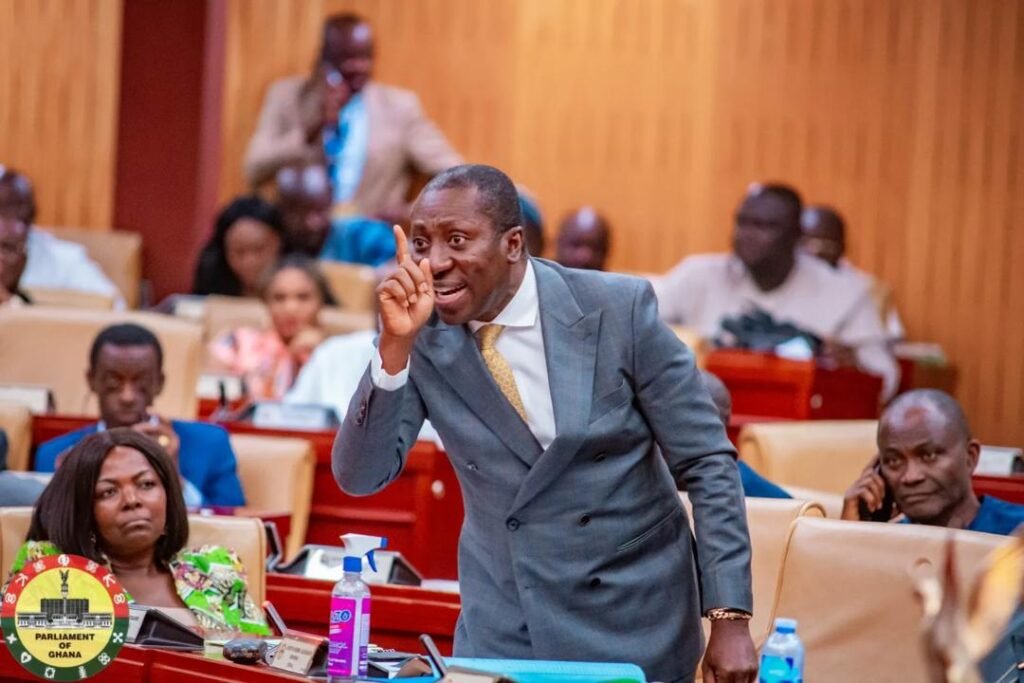
Sammy Gyamfi, Chief Executive Officer of the Ghana Gold Board (GoldBod), has strongly refuted claims made by Minority Leader Afenyo Markin regarding alleged financial losses incurred by the state institution.
Dismissing the Minority Leader’s assertion as a “blatant lie,” Gyamfi clarified that the narrative being pushed by the political opposition is entirely untrue and detached from the official records.
“The blatant lie being persistently peddled by Afenyo Markin that the GoldBod has made losses, is only a figment of his hallucinatory imagination. What a joke of a Minority Leader he is. For the avoidance of doubt, this audit report was prepared and published by the Auditor-General of the Republic of Ghana.”
Sammy Gyamfi,
Providing further evidence to counter the political rhetoric, the GoldBod head pointed directly to page 16 of the institution’s audited Annual Report and Financial Statements for the year ended 31st December, 2025.
The official financial disclosure clearly highlights an operational surplus/profit of GHS907 million alongside a massive overall surplus/profit of GHS5.4 billion.
Mr. Gyamfi underscored that this comprehensive audit report was independently prepared and officially published by the Auditor-General of the Republic of Ghana, stressing that “facts are sacrosanct.”
Audited Financial Truths vs Political Rhetoric
The public dispute underscores the ongoing tension between government sector leadership and opposition oversight in Ghana’s extractive sector management.
By bringing the Auditor-General’s published figures to the forefront, the GoldBod leadership aims to firmly neutralize claims of fiscal mismanagement.
Mr. Gyamfi’s detailed refutation serves to reassure institutional stakeholders, investors, and the general public that the organization maintains a robust profit margin while fulfilling its statutory mandate.
Furthermore, the publication of a GHS907 million operational profit illustrates that GoldBod’s core day-to-day trading activities remain highly lucrative.
The additional overall surplus of GHS5.4 billion demonstrates effective balance sheet management and sound financial governance throughout the 2025 fiscal year. Rather than operating at a deficit, the state-backed body has demonstrated strong performance, effectively positioning itself as a key revenue driver for the national treasury.
Macroeconomic Impact of GoldBod Operations
Beyond internal balance sheets, GoldBod’s strategic operations have generated profound economic benefits across Ghana’s domestic economy.
By formalizing artisanal and small-scale gold mining (ASM) supply chains, the board has successfully channelled billions of dollars into the formal banking system.
This structured purchasing and export mechanism has significantly bolstered foreign exchange reserves, helping to stabilize the Ghanaian Cedi and curb domestic inflation.

Additionally, the central purchasing system managed by GoldBod has curbed gold smuggling across national borders, ensuring that mineral royalty payments and corporate taxes are retained within the domestic economy.
The steady inflow of foreign currency generated through official gold sales has enriched national reserves, allowing the central bank to maintain greater monetary stability.
Through direct purchasing initiatives, local artisanal miners receive fair, market-aligned pricing, which directly boosts rural incomes and stimulates secondary commercial activity in mining communities.
Structural Reforms and Extractive Industry Stability
The financial performance disclosed in the 2025 audited statement reflects broader structural reforms executed within Ghana’s extractive sector governance.
Prior to these interventions, informal gold trading led to significant revenue leakages and unregulated environmental damage.

By establishing a central, highly transparent trading standard, GoldBod has built international investor confidence while maximizing state revenue generation.
Looking forward, the institution’s substantial surplus of GHS5.4 billion provides a critical fiscal cushion for ongoing infrastructure development and sustainable mining initiatives across the country.
As the debate surrounding sector regulation continues, the verified financial figures published by the Auditor-General establish a strong benchmark for public accountability, confirming that the state’s gold management strategy is yielding tangible economic dividends.